
Turning Tweets into Traffic Intelligence: An Ontology-Based Approach to Thai Road Reports
Road Traffic Question Answering System Using Ontology
The paper presents an ontology-based Question Answering (QA) system for road traffic information in Thailand, utilizing real-time Twitter data. It leverages a domain-specific ontology to transform unstructured tweets into structured knowledge, enabling semantic inference of affected Points of Interest (POIs) and natural language interaction via Thai.
TL;DR
Researchers have developed a semantic Question Answering (QA) system that transforms chaotic Twitter feeds into a structured traffic knowledge base. By using a custom-built ontology, the system can understand Thai natural language queries and infer which specific buildings or junctions are affected by accidents and congestion, even if they weren't explicitly named in the tweet.
Problem & Motivation: Beyond the Retweet
For years, accounts like @traffy in Thailand have served as vital hubs for traffic updates. However, these systems were historically "passive"—they simply reposted what users said. If a user asked, "Is it congested near Siam Paragon?", the system couldn't "reason" that an accident reported "in front of Pathumwan Junction" actually blocked the road to the mall.
The challenge is twofold:
- Linguistic Complexity: Thai language lacks word delimiters (spaces), making tokenization difficult.
- Spatial Reasoning: Traffic incidents have a "ripple effect." A blockage at one point affects a sequence of connected Points of Interest (POIs) along a road.
Methodology: The Power of Ontology
The heart of this system is its Ontology Design, which provides the brain for the spatial reasoning engine.
1. The Knowledge Schema
The ontology defines four primary classes: Road, POI, Region, and Incident. Unlike a simple database, this schema understands relationships. For instance, a "frontage road" is treated as distinct from a "main road" because traffic flow is independent—a crucial distinction for accurate reporting.
2. Semantic Inference Rules
The authors implemented several critical logic rules to expand the impact of a single tweet:
- TrafficNextTo: If an accident occurs between Point A and Point B, the system recursively identifies every POI in between as "affected."
- Opposite: Recognizes that an incident on one side of a major road may or may not affect the other side, depending on the road type.
 Figure 1: The system workflow, from Tweet Acquisition to Information Summarization.
3. The Processing Pipeline
The system uses Lexto for Thai tokenization and filters out noise. It then converts informal names (e.g., "Paragon") into official entities ("Siam Paragon Shopping Center") before mapping them to the ontology.
Experiments & Results: Real-World Performance
The system was evaluated using 300 real-world mentions of @traffy from February 2014.
- Question Detection: The system successfully identified user questions with an 85% accuracy.
- Summarization: When answering questions about current traffic, the system achieved 76.92% accuracy.
- Knowledge Density: At the time of evaluation, the system managed over 11,174 records, with nearly 80% of those being "implied" records—knowledge generated by the ontology's reasoning rather than stated directly in tweets.
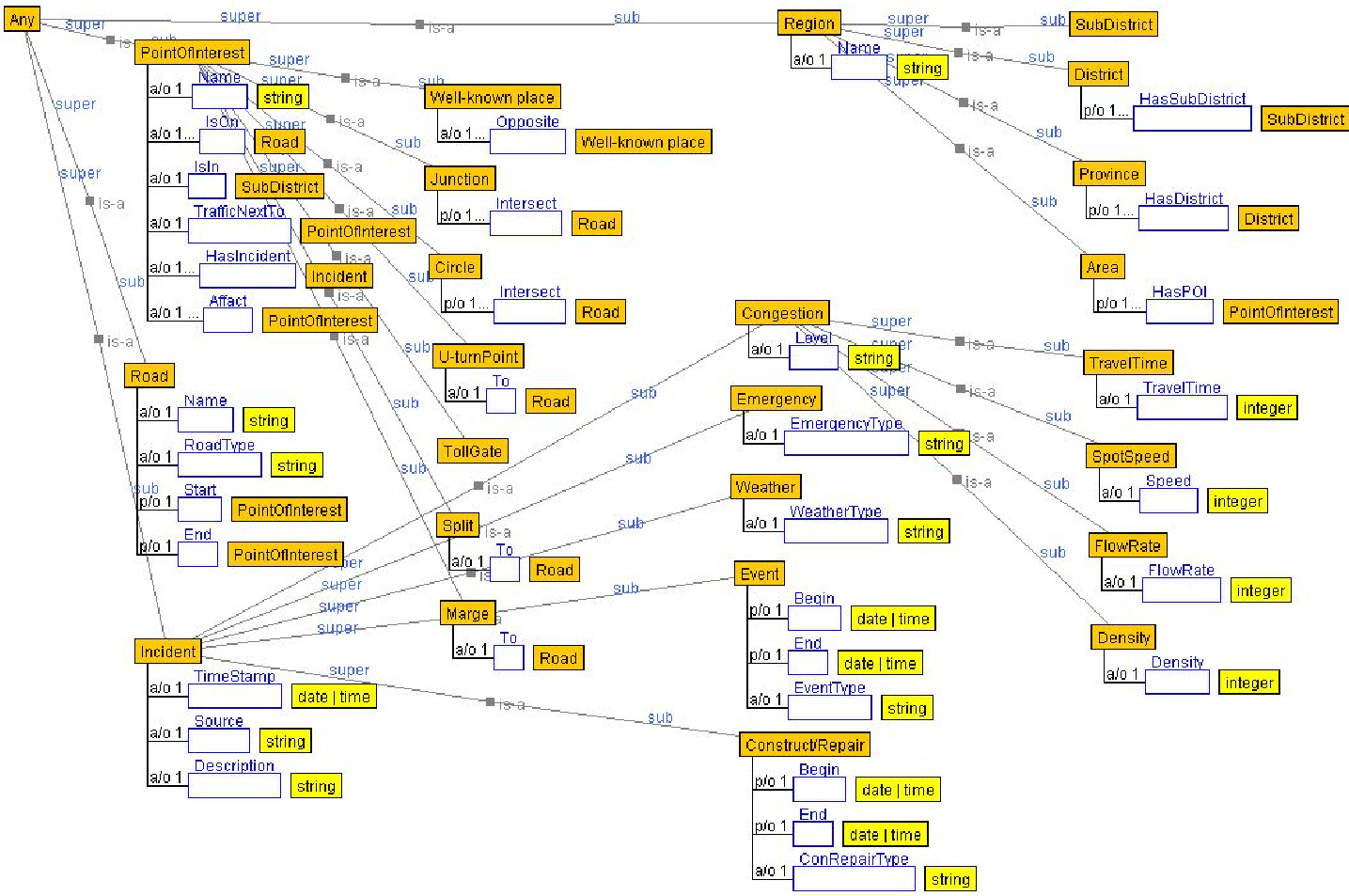 Figure 2: The Traffic Ontology structure showing the relationship between Roads, POIs, and Incidents.
Critical Analysis & Conclusion
Takeaway
The core contribution of this work is the shift from Keyword Search to Semantic Understanding. By defining the physical layout of the city within an ontology, the system can answer "Why" and "Where" with much higher precision than a standard text-search engine.
Limitations & Future Work
The system's current bottleneck is its reliance on a manually curated ontology of roads and POIs. As cities grow, keeping this knowledge base updated is a massive task. The authors suggest that future iterations could:
- Integrate diverse data sources like Facebook.
- Improve temporal reasoning (detecting future events like planned roadworks vs. past accidents).
- Handle cross-road incident analysis for highly complex intersections.
In the era of modern AI, this work serves as a foundational reminder that structured domain knowledge (Ontology) is just as important as raw data (Tweets) when building reliable, safety-critical Intelligent Transport Systems.