
Learning from the Crowd: How Human Experience Bridges the Gap in Robot Collaboration
Learning from Human Collaborative Experience: Robot Learning via Crowdsourcing of Human-Robot Interaction
The paper introduces a robot learning framework for human-robot collaboration (HRC) using a data-driven crowdsourcing approach. By collecting interaction data from human-human collaboration in a simulated environment, the authors build a case-based planning library that allows robots to infer appropriate collaborative actions based on specific state features.
TL;DR
Building robots that can assist in daily tasks is difficult because human behavior is unpredictable. This paper presents a framework that uses crowdsourcing to collect human-human collaboration data, which is then transformed into a Case-Based Planning library. By defining a "minimum information" set including partner actions and work conditions, the robot learns to mimic collaborative logic without manual hard-coding.
The Scalability Wall in Human-Robot Interaction
In the world of robotics, "unstructured environments" (like a messy kitchen or a busy living room) are the ultimate frontier. The core issue isn't just the physical complexity, but the behavioral diversity of humans. If you ask ten people to help you set a table, you will get ten different sequences of actions.
Prior works attempted to solve this with large-scale data collection (e.g., The Restaurant Game), but often lacked a formal explanation of what exactly the robot needs to observe to be a good partner. This paper tackles the "Why" and "How" of information selection in HRC.
Methodology: The Logic of Collaboration
The authors argue that a robot’s intelligence in a collaborative task can be boiled down to a specific state-mapping function. They define the learning policy through a Minimum Information principle:
- Self_Action (i-1): What did I just do?
- Partner_Action (i): What is my partner doing right now?
- Work_Condition (i): Where are all the objects (plates, forks, etc.) currently located?
By capturing these three elements, the robot can search its "Experience Library" for the most similar past scenario and execute the corresponding "Self_Action (i)".
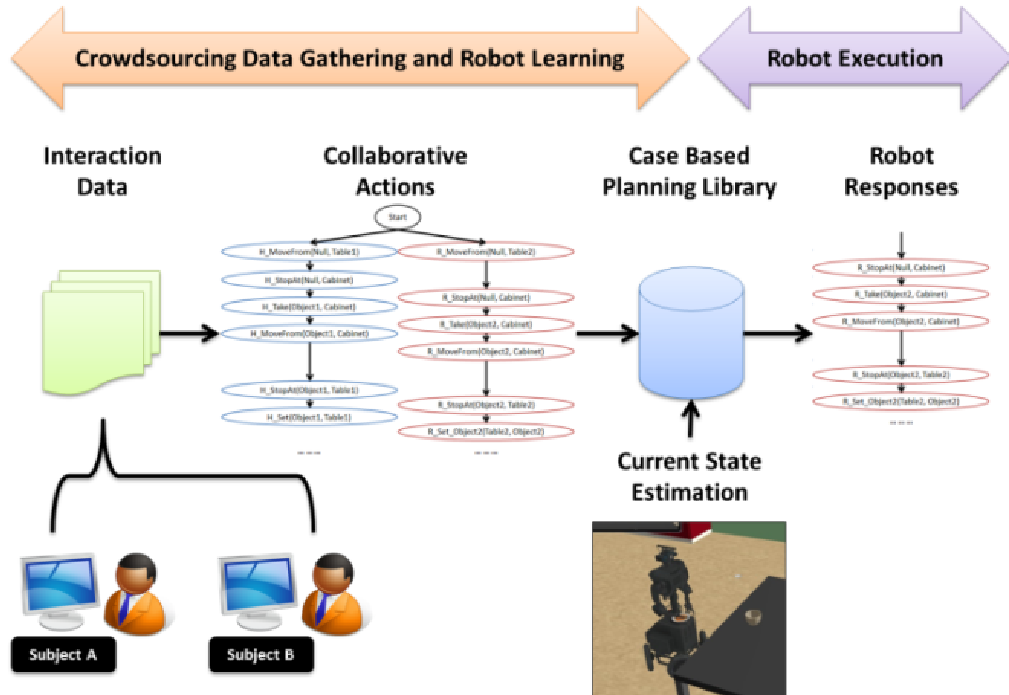 Figure 1: The framework starts with human-human data collection, processes it into a case library, and ends with autonomous execution.
Experiments: From Data to Decision
The researchers used a table-setting scenario to test their theory. First, they let humans play both roles (Human and Robot) in a simulation to gather "gold standard" collaborative data.
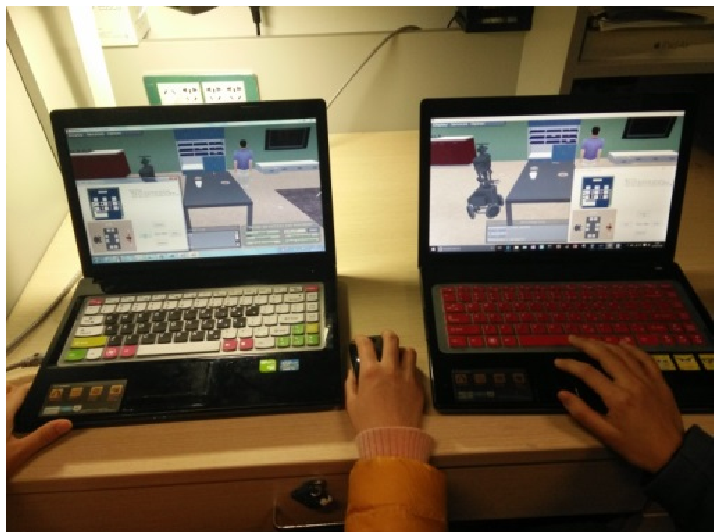 Figure 2: Human subjects collaborating in the virtual environment to generate training data.
The results were clear: the more "experience" the robot had, the smarter it became.
- With 64 data points: The robot often stood still, unable to find a matching case ("No Action").
- With 256 data points: The robot became significantly more responsive, matching its actions to the human partner’s needs more accurately.
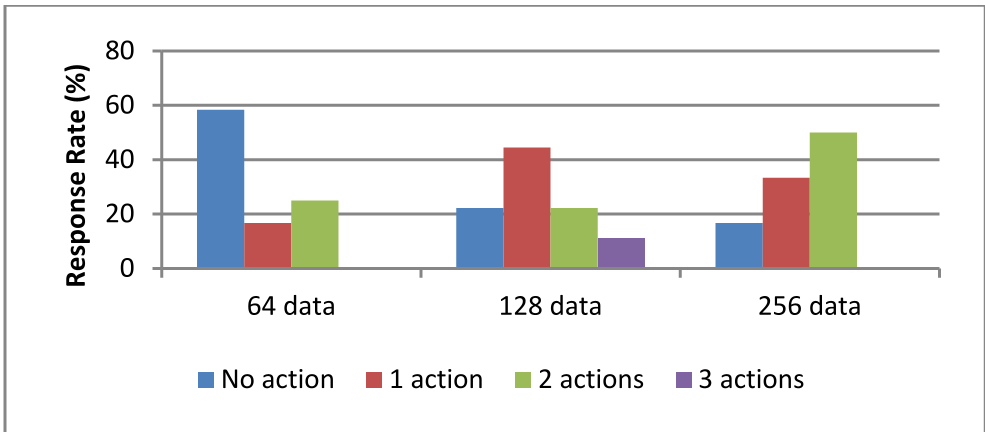 Figure 3: As library size increases, the robot's "No Action" rate drops, and successful collaborative responses rise.
Critical Insight & Conclusion
This work highlights that data-driven crowdsourcing is a viable path for social robotics. However, it also reveals a bottleneck: case-based planning relies heavily on exact or near-exact matches.
Takeaway: While the formal definition of "work conditions" and "partner actions" provides a great roadmap for what a robot should sense, future iterations would benefit from probabilistic models or Neural Networks that can generalize between similar cases, rather than just searching a library. Nonetheless, this paper provides a robust foundation for building "socially aware" robots that learn by watching us work together.