
Robotic Neck Brace: Advancing Head-Neck Rehabilitation with Force-Field Training
Using a Robotic Neck Brace for Movement Training of the Head–Neck
This paper introduces the second generation of a portable robotic neck brace designed for head-neck movement training using a 3-RRS parallel mechanism. It implements an "assist-as-needed" force controller that provides restorative moments to help users follow specific trajectories, achieving a significant reduction in movement coupling errors during lateral bending tasks.
TL;DR
Researchers at Columbia University’s ROAR Laboratory have developed a second-generation portable robotic neck brace that moves beyond simple stabilization. By employing an "assist-as-needed" force controller, the device helps users—specifically those with neurological disorders like ALS—relearn complex head movements. A pilot study proves it can significantly reduce "unnatural" movement errors through an active haptic force field.
Problem: The Limits of Static Orthotics
For individuals suffering from Amyotrophic Lateral Sclerosis (ALS) or Cerebral Palsy (CP), the simple act of holding the head upright or turning to look at an object is a monumental challenge. Current clinical solutions, such as the "Miami J" brace, are static: they lock the neck in a neutral position. While this prevents "dropped head syndrome," it effectively "freezes" the patient's remaining mobility, leading to muscle atrophy and a diminished quality of life.
The technical challenge lies in the complexity of the neck: it isn't just a simple hinge. Natural movement involves coupled rotations across multiple planes. Previous robotic attempts were either too heavy, non-portable, or lacked the "intelligence" to provide subtle force feedback instead of rigid position control.
Methodology: The Software-Defined Force Field
The core innovation of this new brace is its transition from rigid assistance to probabilistic motor learning.
1. Hardware Refinement
The brace utilizes a 3-RRS (Revolute-Revolute-Spherical) parallel architecture. Unlike the first generation, which required swapping modules for different tasks, this version uses Dynamixel XM430 servomotors. These motors are back-drivable and feature high-frequency current sensing, allowing the brace to act simultaneously as a precision measurement tool and a haptic actuator.
2. The "Assist-as-Needed" Controller
Instead of forcing the head along a path (which can cause user resistance and discomfort), the team implemented a virtual spring-damper system.
- If the user follows the desired trajectory accurately, the brace remains "transparent" (zero torque).
- If the user deviates (e.g., their head tilts or rotates unintentionally), the motors generate a restorative torque proportional to the error.
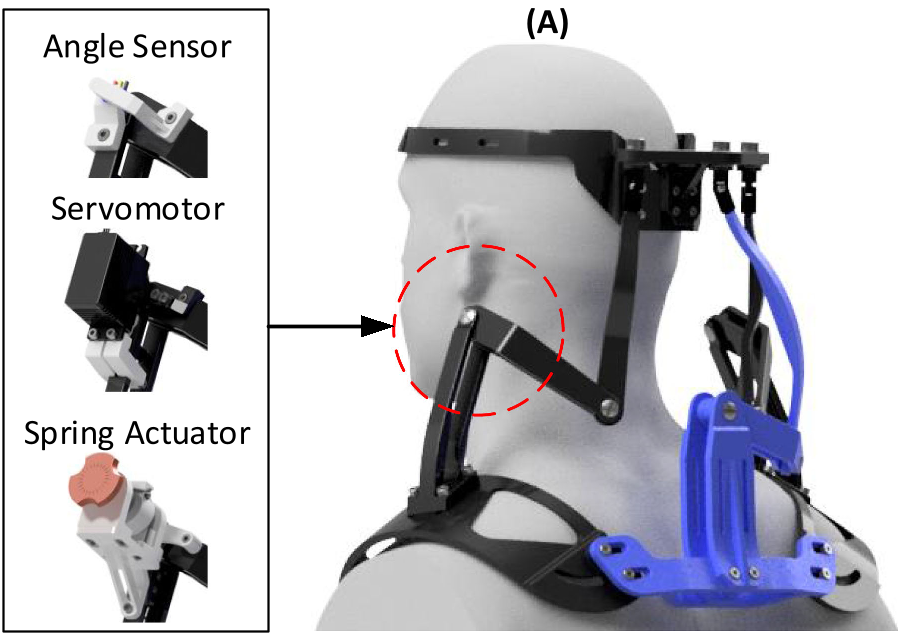 Fig 1: The evolution of the neck brace from previous iterations to the current portable, force-controlled version.
Experimental Validation
To test the system, the researchers chose lateral bending—a task surprisingly difficult for humans to perform without accidental axial rotation.
Kinematic Accuracy
First, they validated that the brace doesn't interfere with natural movement. In "Transparent Mode," the brace's sensors matched gold-standard Vicon motion capture systems with less than 2% RMS error, while applying negligible resistive forces (<2 N).
Human Training Results
In a study of 10 healthy adults, the subjects were asked to follow a moving avatar on a screen.
- Visual Feedback Only: Subjects struggled to keep their head from rotating while bending.
- Visual + Force Feedback: The brace's restorative moments significantly suppressed these unwanted rotations.
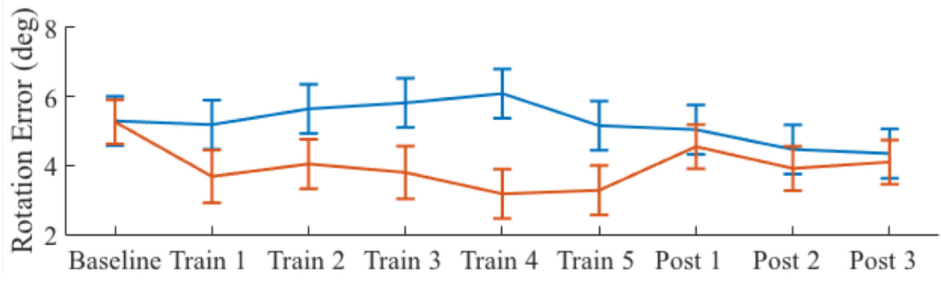 Fig 2: Comparison of error rates. The green bars highlight the significant reduction in rotational error when the force field was active.
One interesting finding was a temporal trade-off: while the force field improved spatial accuracy, it slightly increased time delay (latency in following the target). This suggests that users were "negotiating" with the robot's force field, increasing their cognitive load to ensure precision.
Critical Insight & Future Outlook
While the study demonstrated immediate performance gains during training, these gains were not "retained" once the brace was removed (no short-term motor learning washout effect).
Takeaway for the Field: This suggests that while the robotic brace is an excellent assistive tool to prevent pathological movements in real-time, long-term rehabilitative training may require more intensive protocols or "fading" force schedules where the robot's help is gradually withdrawn to force the brain to adapt.
The portability (1.7kg) and the use of soft head-attachments represent a massive leap toward a device that patients could actually wear during daily activities, transforming a "static collar" into a "smart co-pilot" for the head and neck.
Limitations
- Retention: The lack of post-training retention suggests the 5-minute training window was too short for permanent neural adaptation.
- EMG Variability: Muscle activation patterns (via sEMG) showed high individual variance, making it hard to draw universal conclusions about muscular efficiency gains at this stage.