
Robots in Need: Leveraging Emotion to Survive the Human World
Robots in Need: Acquiring Assistance with Emotion
This paper investigates "Robots in Need," a research framework exploring how emotional expressions (sadness and happiness) can motivate humans to provide assistance to robots. By leveraging psychological theories of empathy and prosocial behavior, the study identifies that emotional cues can accelerate human response times and foster a "helper's high" feedback loop.
TL;DR
Why did hitchBOT end up destroyed in a Philadelphia park while other robots thrive? The answer may lie in affective prosociality. This research explores how robots can use simulated emotions—sadness to signal distress and happiness to signal gratitude—to motivate humans to help them. While emotionally expressive robots get help faster, they also face tougher ethical scrutiny from the humans they interact with.
Background: The Vulnerability of the Machine
We often envision robots as autonomous powerhouses, but the reality is that the world is too complex for perfect autonomy. Whether it's a collision in a hallway or a complex social barrier, robots will inevitably require human intervention. This paper positions the robot not as a servant, but as a social actor that must master the art of "asking" through emotional signaling to survive and integrate into society.
Problem & Motivation: The Empathy Gap
Prior HRI (Human-Robot Interaction) research has focused heavily on task efficiency. However, the author argues that true altruism—behavior intended to benefit others without immediate reward—is driven by empathy.
- The Problem: Neutral robots are often ignored because they fail to activate the "perception-action model" of empathy in humans.
- The Insight: If a robot can mirror human-like distress, it can induce a congruent emotional state in the observer, prompting them to alleviate the "shared" distress by helping.
Methodology: Sadness, Happiness, and Ethics
The research moves through two distinct phases:
1. The Behavioral Experiment
Participants interacted with a tele-operated robot under three conditions:
- Negative: The robot shows sadness when it needs help.
- Positive: The robot shows happiness after receiving help.
- Neutral: A control group with no emotional output.
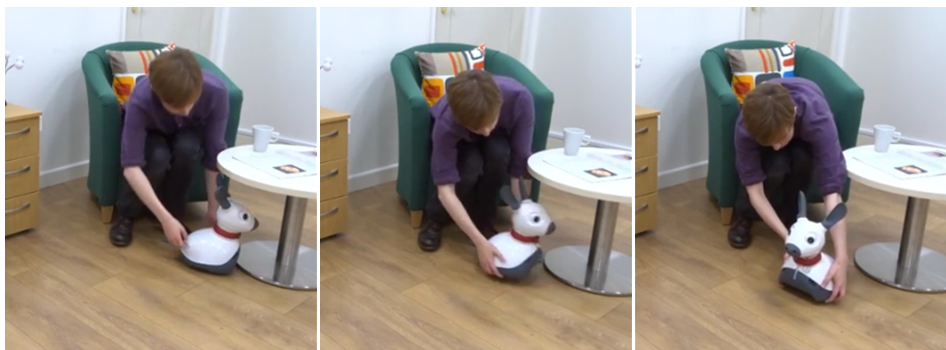 Fig 1. A robot receiving human assistance to recover from a collision, used to test emotional response triggers.
2. The Ethical Assessment
An online study involving 201 participants examined whether using "fake" emotions to manipulate human behavior is acceptable. This is a critical pivot from "Can we do it?" to "Should we do it?"
Key Results: The Speed of Sadness
- The "Empathy Trigger": Emotional behavior subtly increased the speed of human response. Specifically, individuals with a high baseline for empathy responded significantly faster when the robot displayed sadness.
- The Ethical Trade-off: Interestingly, while emotional robots were more effective at getting help, they were rated as less ethical than neutral ones. People perceive the use of emotion as a form of "deceptive facade," particularly in assistive roles.
Critical Insight: Toward a "Helper's High"
The most profound takeaway from this research is the concept of the Positive Feedback Loop. In human psychology, the "Helper's High" (an increase in positive mood after helping) reinforces prosocial behavior. The author suggests that if a robot's "happiness" can trigger this high in a human, the robot becomes more than a tool—it becomes a source of emotional well-being for the user.
Conclusion & Future Outlook
This work challenges the "Stoic Robot" paradigm. To truly coexist with us, robots must be vulnerable. However, the path forward requires a delicate balance:
- Authenticity: How do we design emotional cues that don't feel like "manipulation"?
- Intensity: Does a "louder" emotional display lead to faster help, or does it trigger antipathy?
- Anthropomorphism: Does the robot need a face to be felt?
Ultimately, the goal is a symbiotic future where humans help robots overcome physical limitations, so that robots can fulfill their primary function: helping us.
Takeaway for the Industry: For developers of delivery or companion robots, adding a layer of affective signaling isn't just "flavor"—it's a critical safety and recovery feature.