
Deciphering Social Influence: Robust Information Fusion via Percolation Theory
Robust Information Fusion on Social Networks
This paper introduces a general framework for statistical information fusion on social networks, specifically targeting scenarios where agents’ decisions are influenced by prior actions of others. The authors propose a minimax robust decision scheme utilizing Percolation Theory to mitigate the lack of complete network topology information, achieving stable performance across various random and small-world network structures.
Executive Summary
TL;DR: This paper tackles the challenge of making accurate decisions (Information Fusion) in social networks where people's choices are influenced by others. By using Percolation Theory, the authors develop a Minimax Robust Decision Rule that works even when the exact structure of the social network is unknown, effectively outperforming classical methods in highly correlated environments.
Context: Situated at the intersection of Statistical Signal Processing and Social Network Analysis, this work shifts from the "independence assumption" of classical detection to a "topological correlation" model, providing a bridge between graph theory and robust statistics.
1. The Conflict: Correlation vs. Independence
In classical information fusion, we assume agents act as independent sensors. But in the real world—think Amazon reviews or Twitter trends—your decision is often a "reaction" to someone else's earlier decision. This is Social Networking Correlation.
The Pain Point: If a fusion center ignores these correlations, it over-counts dependent information, leading to massive errors (the "Echo Chamber" effect). However, knowing the exact connection of every user on a platform is a computational and privacy nightmare.
2. The Insight: Percolation as a Tool for Uncertainty
The authors' core breakthrough is realizing that we don't need to know who follows whom exactly. We only need to know the statistical probability of information spreading through the network.
Methodology Brief:
They use Percolation Theory to identify the "Giant Component" ()—the fraction of the network where information can flow freely.
- If the probability of a link being active () exceeds a threshold (), a large cluster forms.
- By looking at the network through this statistical lens, the authors can treat social influence as an -contamination of the original data.
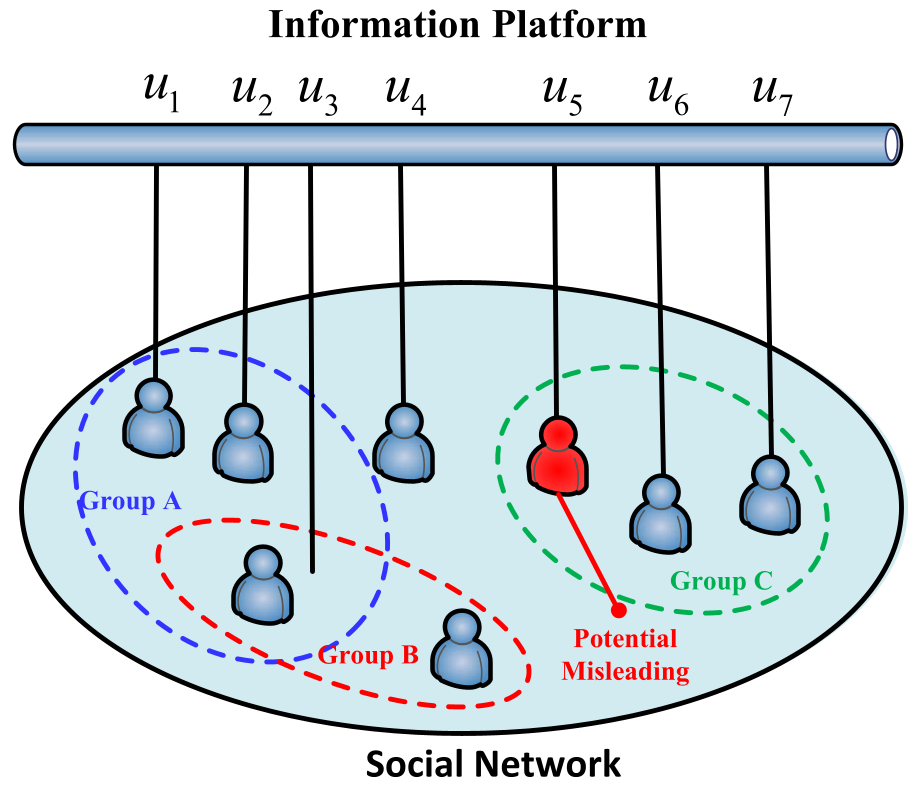 Fig 1: The model of agents interacting via an information platform, showing the dynamic flow of decisions.
3. The Robust Rule: The Minimax Strategy
The problem is formulated as an optimization task: minimize the worst-case error probability.
Given that the network structure is incomplete, the authors derive a Least-Favorable Density (LFD). The resulting robust fusion rule is essentially a modified likelihood ratio test:
Where represents the probability distributions "contaminated" by social correlation. Interestingly, this complex math simplifies into a practical k-out-of-N decision rule, where the fusion center decides based on whether the number of positive local decisions exceeds a robustly calculated threshold.
4. Experimental Evidence
The simulations compare the Minimax Robust Rule against a Classical Rule (which assumes independence).
- In Low-Correlation Scenarios: Both perform similarly.
- In High-Correlation Scenarios (Social Herding): The classical rule's performance collapses as the correlation grows. The robust rule, however, remains resilient.
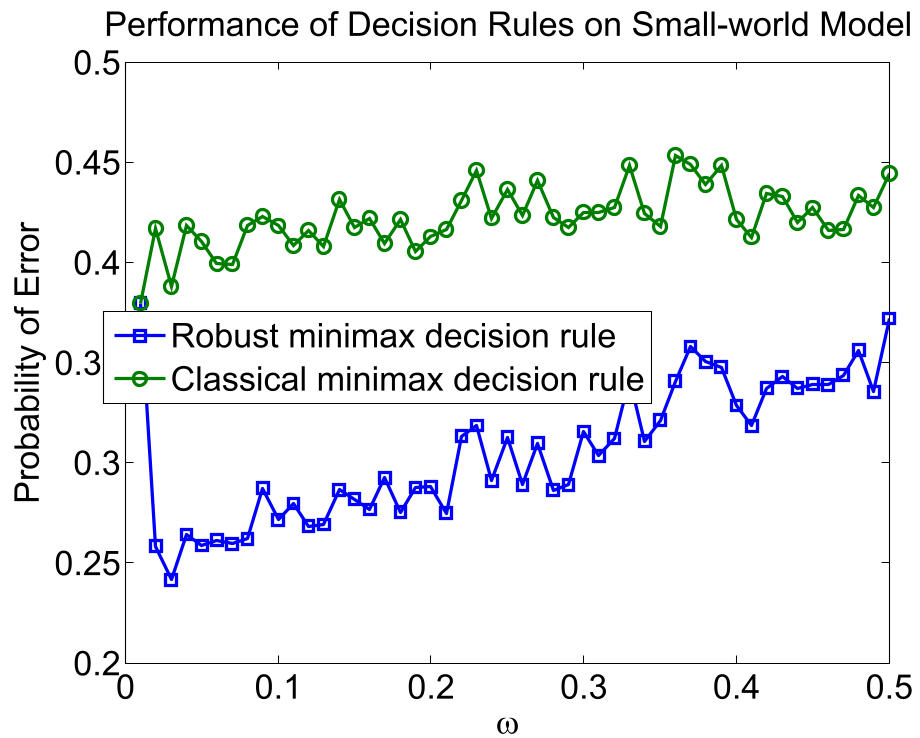 Fig 2: Performance comparison on Small-World networks. Note how the robust rule (lower curve) maintains lower error rates as social influence () increases.
5. Critical Analysis & Future Outlook
Takeaway
The value of this research lies in its robustness. It acknowledges that social networks are messy and unpredictable. By using the "statistical mechanics" of percolation, it provides a safety net for automated decision systems in e-commerce and social monitoring.
Limitations
- Binary Assumption: The current model assumes simple 0/1 decisions. Real-world social influence is often multi-valued or continuous.
- Stationarity: The model assumes the network structure and correlation parameters are static during the fusion process.
Future Work
Integrating this robust framework with Deep Learning could lead to "Correlation-Aware" neural networks that don't overfit to trending (but potentially biased) social data.