
A Robust Joint Face Model: Why Two Halves are Better Than a Whole in Emotion Recognition
A robust joint face model for human emotion recognition
This paper introduces a robust joint face model for human emotion recognition using 3D motion capture data from the IEMOCAP dataset. By combining statistical shape models of the full face with partitioned models of the upper and lower face halves, the approach achieves superior classification accuracy compared to holistic models.
TL;DR
Recognizing human emotion via computer vision is notoriously difficult because facial movements are often "polluted" by actions like talking or voluntary masking. This paper proposes a Joint Face Model that splits the face into upper and lower regions, using PCA-based statistical shape models and Mahalanobis distance to achieve up to 89% accuracy, outperforming human observers and standard holistic SVM classifiers in many scenarios.
Context & Motivation
In the quest for natural Human-Computer Interaction (HCI), understanding a user's emotional state—Happy, Sad, Angry, etc.—is a holy grail. However, humans are experts at "masking" emotions. Research suggests that while the lower face (mouth, chin) is easily controlled voluntarily, the upper face (eyebrows, forehead) is much harder to manipulate, making it a more "honest" signal of true emotion.
The authors identified that existing holistic models (treating the face as one unit) suffer from high confusion rates, particularly because mouth movements during speech are often mistaken for emotional expressions.
Methodology: The Power of Partitioning
The core innovation lies in the Joint Face Model. Instead of relying on a single 84D vector representing the entire face, the system breaks the problem down:
- Data Preprocessing: Using the IEMOCAP dataset, the authors utilized 3D motion capture markers. They filtered out markers that didn't move (nose) and combined those that moved in sync.
- PCA and Noise Reduction: By applying Principal Component Analysis, they discovered that the 1st Principal Component (PC1) was almost entirely correlated with talking. By simply discarding PC1, they effectively "muted" the noise of speech.
- Model Triangulation: The researchers built three separate models:
- Full Face Model: Holistic overview.
- Upper Face Model: Focuses on the "honest" signals of the forehead and eyes.
- Lower Face Model: Focuses on the highly expressive mouth and cheeks.
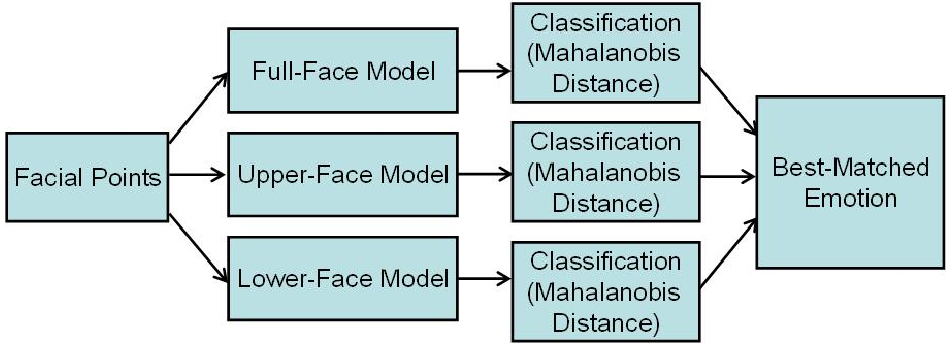
The classification is determined by the Mahalanobis Distance, which accounts for the variance and spread of emotional clusters in the 4D principal component space.
Dissecting the Principal Components
The authors provide a fascinating look at what these mathematical components actually represent physically:
- PC2: Outward vs. inward movement of lips (Smile vs. Frown).
- PC3: Upward/Downward movement of eyebrows.
- PC4: Inward/Outward movement of forehead markers.
- PC5: A "circular" lip motion associated specifically with laughing.
Experimental Results & Robustness
The Joint Model was compared against Support Vector Machines (SVM) and simple Rule-based PCA classifiers.
Key Findings:
- Accuracy: The Joint Model hit 88.5% on 4-class emotion tasks (Neutral, Angry/Frustrated, Happy/Excited, Sad).
- Stability: On the male dataset, while SVM performance fluctuated significantly, the Joint Face Model remained relatively consistent.
- Resilience to "Dirty" Data: A standout feature of this research was the robustness test. The authors intentionally mislabelled training data. The Joint Model maintained high accuracy until 25% of the data was corrupted, whereas the SVM showed unpredictable performance degradation.

Critical Analysis & Takeaways
The brilliance of this work is its anatomical intuition. By acknowledging that different parts of our face serve different communicative functions (and levels of honesty), the "Joint Model" mimics how a trained psychologist might observe a patient.
Limitations: The study relies on 3D motion capture markers, which are difficult to deploy in real-world scenarios compared to standard 2D RGB cameras. Further, the model struggles with the "Angry vs. Frustrated" distinction—a common overlap even for human observers.
Future Outlook: The authors suggest that their discarded "Talking PC" could be repurposed for Speaker Detection, effectively creating a multi-task system that knows who is talking and how they feel simultaneously. This partitioning logic is a precursor to modern "Modular AI" where specific sub-networks handle localized features to improve overall system robustness.
Conclusion
This paper serves as a reminder that "more data" isn't always the answer; sometimes, smarter data organization—like splitting a face into its functional halves—is the key to breaking through performance ceilings in Affective Computing.