
MSCD: Bridging Local Tracking and Global Detection for Robust Mobile Robotics
Robust Multiperson Detection and Tracking for Mobile Service and Social Robots
This paper presents a robust vision system for multi-person detection and tracking tailored for mobile service robots. The core method, Mean-Shift Combining Detections (MSCD), integrates multi-model detections and color-based appearance within a Maximum Likelihood (ML) framework, achieving real-time performance of approximately 10 FPS.
Executive Summary
TL;DR: The paper introduces Mean-Shift Combining Detections (MSCD), a real-time framework that fuses multi-modal human detections (Stereo + HOG) directly into an Expectations-Maximization (EM) mean-shift tracker. This approach allows mobile robots to maintain stable tracklets even during fast rotations and dense crowd interactions, achieving 92.4% coverage at 10 FPS.
Context: Within the taxonomy of computer vision, this work sits between "local inter-frame tracking" and "global tracking-by-detection," offering a computationally efficient middle ground specifically optimized for the constraints of mobile service robots.
The "Drift" Problem in Robot Vision
Mobile tracking is notoriously difficult. Unlike a fixed CCTV camera, a robot’s camera suffers from:
- Ego-motion: Fast rotations cause massive inter-frame pixel displacements.
- Unreliable Appearance: Color histograms (the staple of Mean-Shift) fail when the background has similar hues or lighting shifts.
- Complex Occlusions: In social settings, humans frequently walk behind each other, causing "ID bleeding" where a tracker jumps from a target to an occluding person.
The authors' insight? Don't just track, and don't just detect. By mathematically embedding detection results into the Mean-Shift iteration, the tracker is effectively "pulled" toward verified human candidates, preventing the common drift toward background clutter.
Methodology: The MSCD Framework
The core innovation is the reformulation of the tracking probability. Instead of relying solely on an appearance model , the authors define a joint likelihood:
Where represents the likelihood based on spatial detections. This is solved via an EM-like iteration:
- E-Step: Estimate the association weights () between current tracks and new detections (Stereo/HOG).
- M-Step: Update the target's position by finding the new Maximum Likelihood peak.
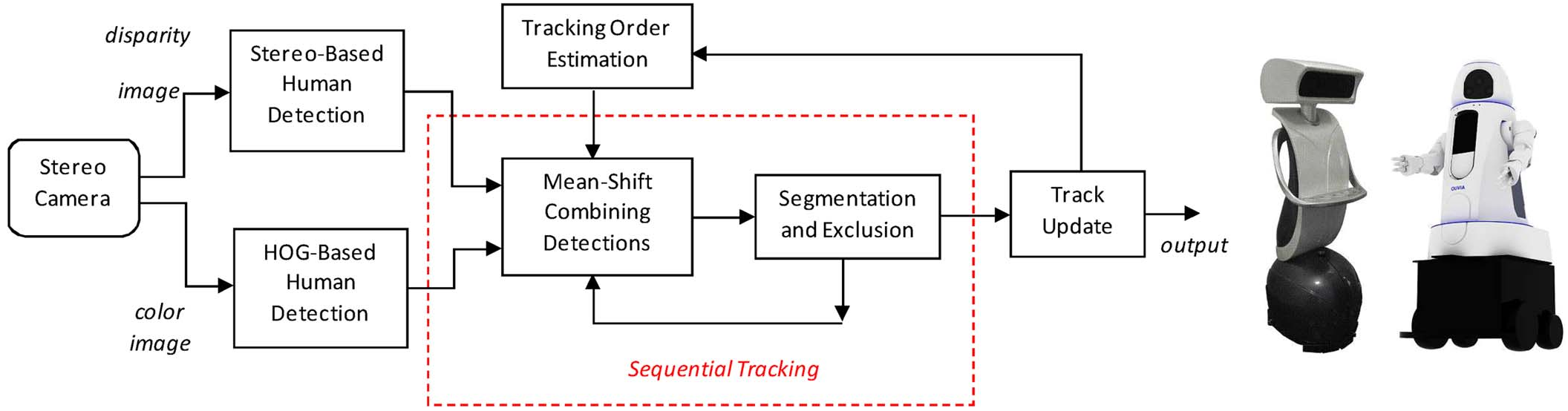 Figure 1: The vision system integrates disparity maps for distance-based filtering and HOG for shape-based verification.
The "New Sequential Strategy" (NSS)
Traditional sequential tracking processes targets one by one. If Target A is wrongly assigned to Target B's pixels, Target B is lost forever. The authors propose tracking the top two candidates simultaneously and selecting the one with the higher confidence score. This "look-ahead" mechanism significantly reduces ID switches in high-density crowds.
Experimental Validation
The system was tested on real-world "Robotic Butlers" and "Receptionists." A key highlight is the comparison against Conventional Mean-Shift (CMS) and Fusion of Detection and Tracking (FDT).
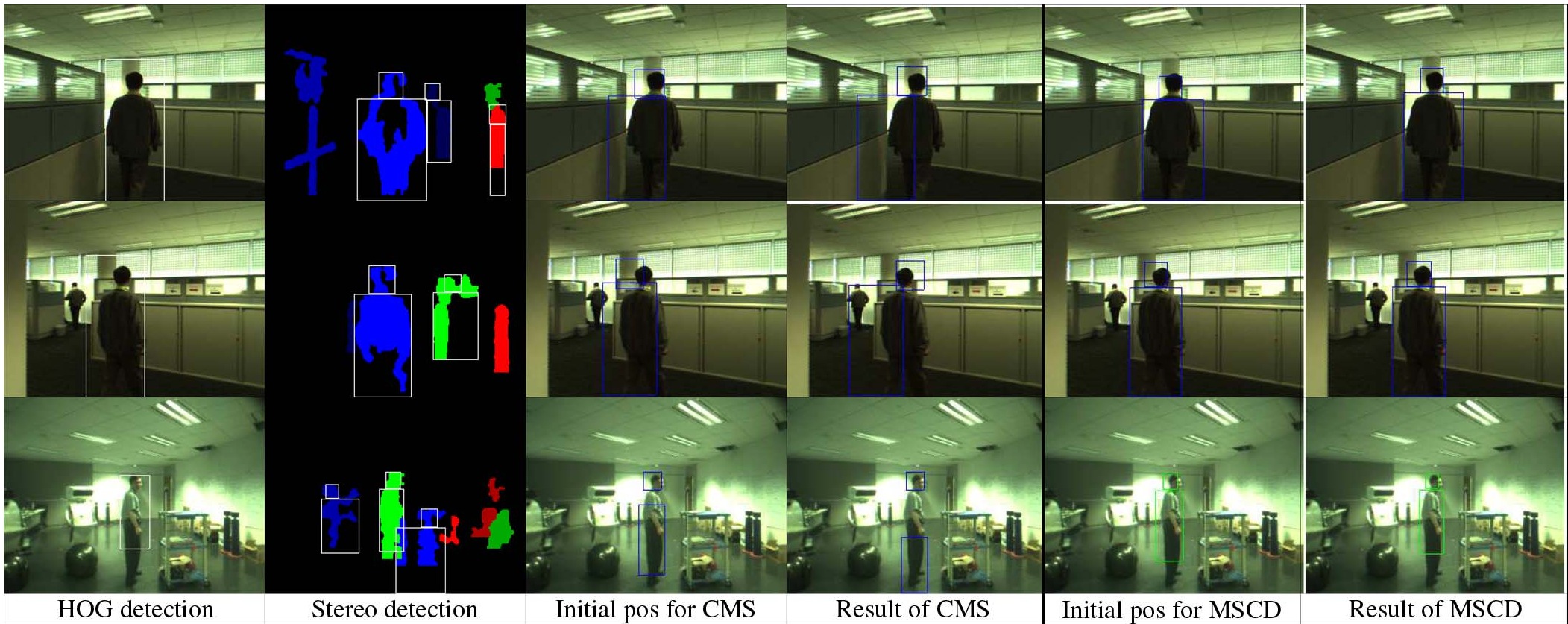 Figure 2: Performance comparison showing MSCD's ability to handle large inter-frame displacements where earlier methods failed.
Key Metrics:
- Speed: 10 FPS on a Core 2 Duo (impressive for the era).
- Accuracy: WAoC increased to 92.4% (compared to 84.8% for FDT).
- Occlusion Handling: Successful tracking through 85% of recorded occlusion events.
Critical Analysis & Conclusion
Takeaway
The MSCD approach provides a mathematically elegant way to prevent Mean-Shift from getting stuck in local minima. By using "detections as anchors," the system gains the robustness of a detector with the efficiency of a local tracker.
Limitations
- Heuristic Priority: The priority score relies on many hand-tuned parameters.
- Hardware Dependent: The reliance on stereo-depth (disparity) means the system's performance degrades significantly in low-texture environments where stereo matching fails.
Future Outlook
While this paper uses HOG and DCH, the underlying ML-fusion framework is perfectly applicable to modern Deep Learning. Replacing HOG with a lightweight CNN (like YOLO-tiny) and incorporating robot odometry would make this a formidable baseline for modern autonomous navigation tasks.