
Adaptive Hypervideo: Architecting Robust Tracking for Social Interaction
Robust tracking for interactive social video
The paper introduces an adaptive object tracking system designed for interactive "social video" (hypervideo) environments. By dynamically switching between SURF/KLT, MeanShift, and Template-based matching based on visual content, the system achieves robust tracking that is scalable and optimized for real-time web deployment.
TL;DR
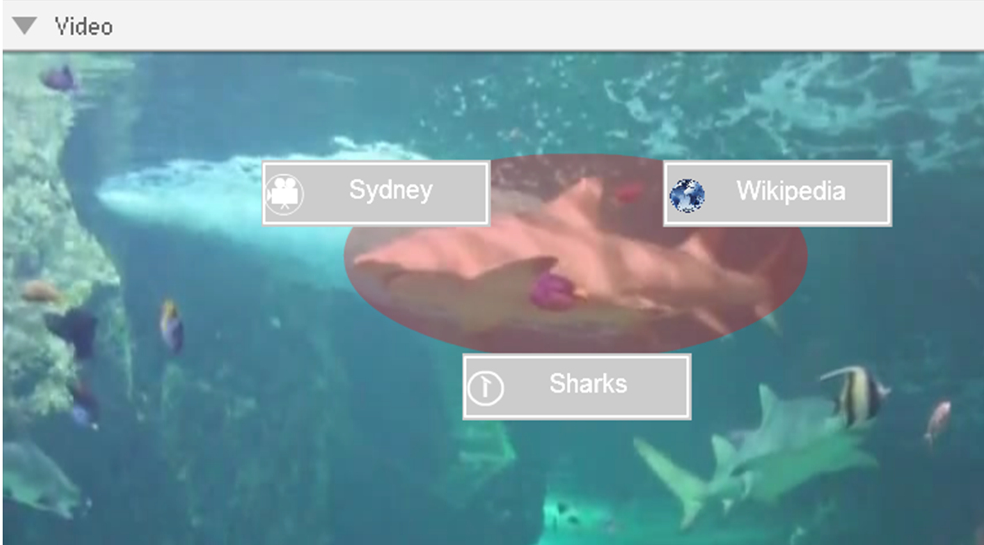
The paper presents a pragmatic, adaptive tracking framework for "Social Video"—an interactive medium where users can annotate and interact with video objects. By intelligently switching between SURF/KLT, MeanShift, and Template Matching, the system maintains high precision (88.2%) while remaining fast enough to support 12,000 users in a distributed web environment.
Problem & Motivation: The Chaos of User-Generated Content
While computer vision researchers often focus on specialized datasets, the authors tackle the "wild west" of social media. The challenges are three-fold:
- Imprecise Templates: Users rarely draw perfect bounding boxes.
- Object Volatility: Real-world videos feature rapid motion, scaling, rotations, and frequent occlusions.
- The Scalability Wall: Tracking must happen almost instantly on the server side to satisfy web users, often without the luxury of dedicated GPUs for every request.
The author's core insight is that no single algorithm is a silver bullet. SURF excels at texture but fails on smooth surfaces; MeanShift loves color but gets lost in similar backgrounds. A "meta-tracker" that understands these trade-offs is the key.
Methodology: The Logic of Selection
The system follows a hierarchical decision-making process based on the template's characteristics:
1. The Expert: SURF + KLT
If a template contains enough distinct keypoints (calculated via Speeded Up Robust Features), this method takes the lead. To handle the "user error" of drawing background pixels, the algorithm reduces the template size by 10% at the borders to focus on internal features. When features are temporarily lost (e.g., slight occlusion), the Kanade-Lucas-Tracker (KLT) steps in to estimate motion via optical flow.
2. The Colorist: MeanShift
If the template lacks features but has a unique color distribution (measured in HSV space relative to the frame), MeanShift is deployed. It iteratively shifts towards the mean of the data clusters. It is particularly effective for organic shapes like humans or animals.
3. The Fallback: Template Matching
When neither texture nor color is distinctive, the system reverts to brute-force template matching in a local neighborhood—sensitive to change, but a necessary safety net.
Real-Time Engineering: Beyond the Algorithm
To make this viable for 12,000 users, the authors implemented several "engineering hacks":
- PCA Compression: Reducing SURF descriptors from 64 to 20 elements.
- Frame Interpolation: Estimating the position for every frame but only calculating for every 6th frame, achieving a 3-4x speedup.
- Distributed Cloud: Scaling via Amazon EC2 Small instances to handle bursty traffic from social networks.
Experiments: Proving the Hybrid Advantage
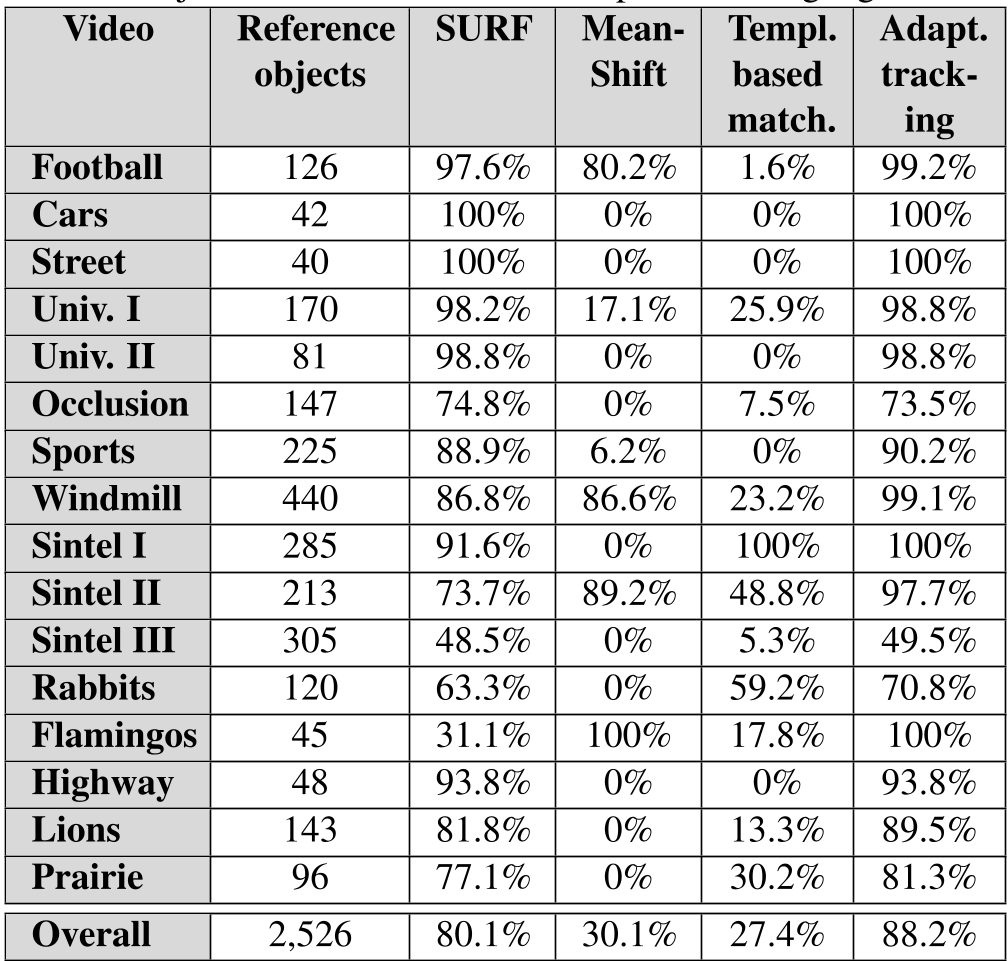
The evaluation used 16 complex sequences ranging from football matches to animations with occlusions and scene breaks.
Key Findings:
- Precision: The adaptive approach achieved 88.2% accuracy, significantly higher than MeanShift (30.1%) or Template Matching (27.4%) alone.
- Occlusion Handling: The system successfully managed 95.6% of partial occlusions and 56% of full occlusions by using linear interpolation of movement vectors.
- Social Validation: Integrating with Facebook provided a massive testbed, where users reported high satisfaction and negligible latency.

Critical Insight & Future Outlook
This work highlights a crucial lesson for AI engineers: Context is everything. By treating tracking as a resource-allocation problem (which algorithm fits the data?), the authors built a system more resilient than the sum of its parts.
Limitations: The system still struggles with "Semantic Occlusion"—where an object enters a new shot from a completely different angle (e.g., profile to front view), as the local features change entirely. Future Work: The authors suggest integrating Particle Filters for non-linear movement prediction and finally moving toward GPU-accelerated cloud nodes, which would allow for even more complex feature extraction in real-time.