
Simulating the Surgical Symphony: How Interruptions Shape Healthcare Trajectories
Design of a role-playing game to study the trajectories of health care workers in an operating room
The paper introduces a web-based role-playing game (RPG) designed to simulate the coordination of trajectories among health care workers in an operating room (OR). Developed from ethnographic research, its core contribution is an experimental framework to measure how active versus passive notification systems (interruptions) impact workflow coordination and individual performance.
TL;DR
Researchers have developed a web-based role-playing game to study how surgeons and nurses navigate the chaos of an operating room (OR). By simulating the conflict between shared scheduling goals and individual tasks, the study reveals how "active" vs. "passive" interruptions create different patterns of work—conceptualized as trajectories.
Background Positioning
In the world of Human-Computer Interaction (HCI) and Computer-Supported Cooperative Work (CSCW), this paper represents a bridge between deep ethnographic observation and controlled experimental design. It moves beyond just watching doctors work to creating a "living laboratory" where the impact of digital notification systems can be measured quantitatively through the lens of trajectory management.
The Problem: The High-Stakes Balancing Act
In an Operating Room, plans are essentially "living documents." An emergency or a broken piece of equipment can derail the schedule for the entire day. Health care workers must manage their own trajectories—their sequence of activities—while ensuring they intersect correctly with others (e.g., the anesthesiologist must be present exactly when the surgeon is ready).
The tension lies in interruptions. Currently, we don't fully understand if it's better to "push" information to workers (active) or let them "pull" it from a central dashboard (passive).
Methodology: The OR Role-Playing Game
The researchers built a web-based simulation where three players take on critical roles:
- Charge Nurse (CN)
- Anesthesiologist in Charge (AIC)
- Surgeon Coordinator (SC)
The Dual-Task Conflict
To mirror reality, players don't just sit and wait; they must complete a "background task" (reading medical cases and answering questions) while simultaneously monitoring and updating the Master Schedule.
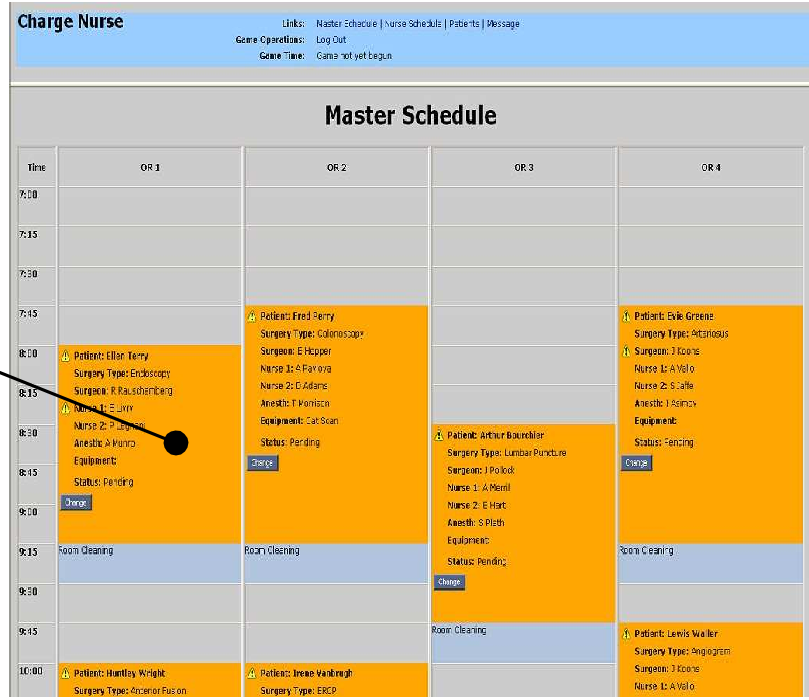 Figure 1: The Master Schedule interface where players coordinate surgeries.
Experimental Insight: "Jagged" vs. "Smooth" Trajectories
The core of the study revolves around how players move between their individual work and the shared schedule.
- Active Notifications: Like a pager or a direct call. These "interrupt" the flow, forcing a switch in activity.
- Passive Notifications: Like a whiteboard in a hallway. The player must choose to look at it.
The authors measure the "shape" of work over time. If a player switches tasks constantly, their trajectory is "jagged." If they focus on one thing for a long time, it is "smooth."
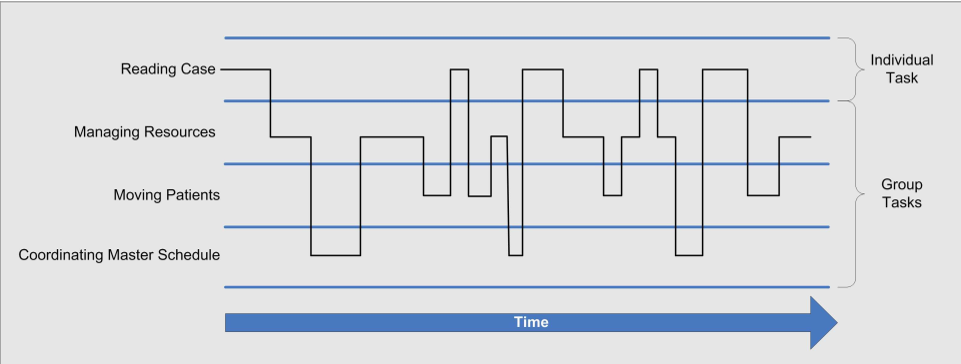 Figure 2: A reconstructed trajectory showing the temporal order and duration of player activities.
Hypotheses and Results
The paper posits a fundamental trade-off:
- Hypothesis 1 & 3: Active notifications ➔ Jagged Trajectories ➔ Better Group Performance (The schedule stays updated, but the individual is distracted).
- Hypothesis 2 & 4: Passive notifications ➔ Smooth Trajectories ➔ Better Individual Performance (The individual completes their cases, but the schedule may fall apart).
Critical Analysis & Conclusion
The brilliance of this work lies in its operationalization of "work flow" into "trajectories." It acknowledges that in a hospital, there is no "perfect" notification system—only a choice of which performance metric to prioritize.
Takeaways for the Future:
- Inductive Bias for Design: Designers of medical software should not aim to eliminate interruptions, but to balance their "intrusiveness" based on the criticality of the coordination required.
- Limitations: As an early simulation, the game may not capture the visceral stress of a real-life OR, and the background task (reading cases) might not perfectly replicate the physical demands of clinical work.
- Legacy: This work sets the stage for modern "Digital Twins" of hospital workflows, providing a framework to test AI-driven scheduling assistants before they ever reach a real ward.