
Scaling Truth: The Synergy of Crowds, Professionals, and AI in Sustainable Fact-checking
Examining the Roles of Automation, Crowds and Professionals Towards Sustainable Fact-checking
This paper explores "Sustainable Fact-checking" by analyzing the reddit/politicalfactchecking community, a model that integrates crowdsourcing with human moderation. It introduces a mixed-method approach to study how crowds find, verify, and argue about claims, while proposing a machine learning-based argument classification model to automate evidence filtering.
TL;DR
In an era of information overload, professional fact-checkers are overwhelmed. This study analyzes a unique Reddit community to prove that a hybrid model—combining the breadth of the crowd, the authority of professional moderators, and the speed of machine learning—creates a sustainable and scalable framework for combatting misinformation.
Background: The Crisis of Scale
The traditional model of fact-checking is under siege. With investigative journalism resources plummeting and rumors spreading at viral speeds, relying solely on professional units is no longer a viable defense. However, the alternative—purely crowdsourced verification—is often dismissed by experts as biased or unskilled.
This paper positions itself at the intersection of these two worlds, arguing for "Networked Journalism." By analyzing the r/politicalfactchecking subreddit, the authors demonstrate how a moderated crowd can actually maintain high standards of factual integrity.
The "Tripartite" Ecosystem
The researchers identify three distinct pillars that make the Reddit model work:
- The Crowd (The Engine): They act as the primary discovery mechanism, flagging "check-worthy" claims from alternative media and social platforms (like Imgur) that professional outlets might ignore.
- The Moderators (The Gatekeepers): They function as "seminar leaders," enforcing rules, filtering out "political bickering," and making final determinations based on the evidence pooled by the crowd.
- Automation (The Filter): Computational tools bridge the gap between crowd output and moderator capacity.
Methodology & Architecture
The study employed a mixed-method approach:
- Qualitative Analysis: Deep dive into moderator behavior and rule enforcement.
- Quantitative Coding: Categorizing 10,221 comments for argument type, source credibility, and action (e.g., seeking clarification vs. providing evidence).
- Machine Learning: Implementation of a Gradient Boosting classifier to automate the "boring stuff."
Computational Efficiency
The authors identified that a major bottleneck for moderators is sifting through "opinionated noise" to find "factual signals." They built a binary classifier to solve this.
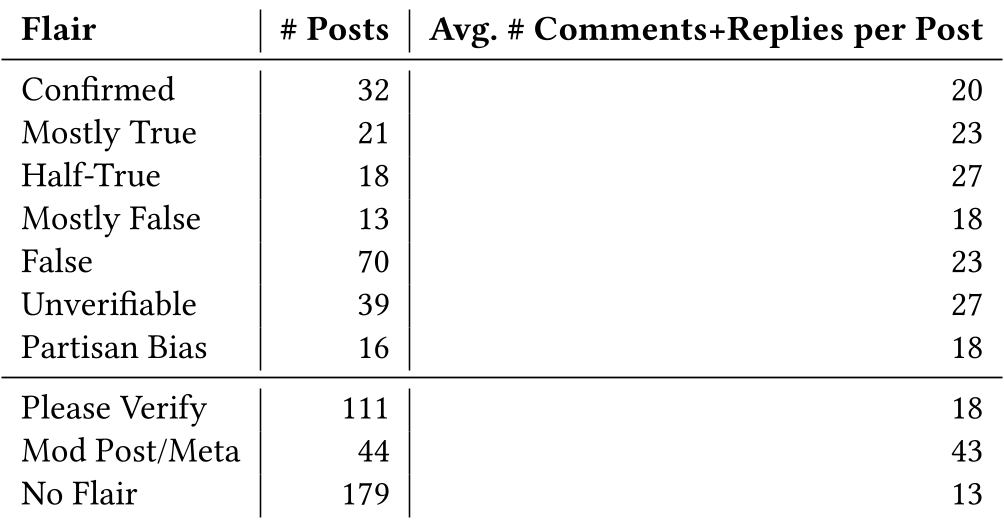 The table above shows that "False" claims draw significant engagement, but "Unverifiable" posts often lead to higher ratios of purely opinionated comments.
Key Insights: Does the Crowd Actually Fact-check?
The results were surprising. Contrary to the belief that internet users only offer opinions:
- 70% of comments were used to provide substantive arguments.
- 50%+ of arguments contained factual evidence.
- The crowd frequently cited high-quality sources like Wikipedia, the Washington Post, and even WhiteHouse.gov.
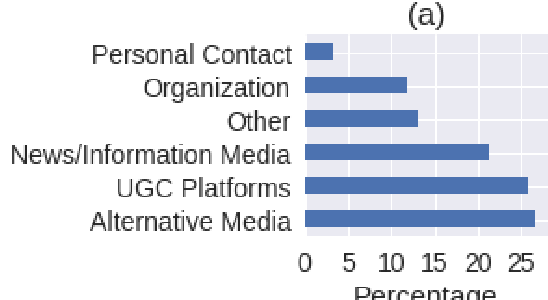 Analysis shows that the crowd is most interested in fact-checking "Persons" and "Policies," predominantly sourcing their claims from Alternative Media and Social Media (UGC).
The Role of Machine Learning
The authors demonstrated that even with a relatively small dataset, automation can achieve 85% precision in identifying comments that contain factual evidence. In a production environment, this allows moderators to ignore "noise" (off-topic bickering) and focus entirely on verifying the high-probability factual inputs provided by the crowd.
Critical Perspective: Is Reddit Enough?
While the paper proves the viability of the model, it also notes its limitations:
- Time Lag: The average time to fact-check a claim was 7 days—often too slow for a 24-hour news cycle.
- Contacting Sources: Unlike professional journalists, the crowd almost never contacts original sources for comment, relying strictly on existing web documentation.
Conclusion: A Blueprint for the Future
The takeaway for news organizations is clear: Don't fight the crowd; lead them. By adopting a "seminar leader" role supported by AI filters, professional organizations can dramatically scale their impact without a linear increase in costs. The future of fact-checking isn't just an algorithm or a journalist; it is a community managed by both.