
Beyond Balance Sheets: Diagnosing Corporate Distress via Rough Sets and Governance Variables
Using Rough Set Theory and Decision Trees to Diagnose Enterprise Distress – Consideration of Corporate Governance Variables
This study develops a hybrid enterprise distress diagnosis model by integrating Rough Set Theory (RST) and Decision Trees (DT) using data from TSEC/GTSM listed companies. The research demonstrates that combining traditional financial ratios with corporate governance variables, optimized through RST attribute reduction, significantly enhances prediction accuracy, with RST models achieving a superior average accuracy of 83.68%.
TL;DR
Financial distress is rarely a "purely financial" phenomenon. This paper identifies that while ratios like the Debt Ratio are vital, Corporate Governance variables—such as the shareholding ratios of major stakeholders—are critical leading indicators of crisis. By utilizing Rough Set Theory (RST) for feature selection and Decision Trees (DT) for classification, the authors achieved an 83.68% accuracy rate in predicting enterprise distress, significantly outperforming traditional ratio-only models.
The "Why": Why Financial Ratios Aren't Enough
Historically, enterprise distress models (like Altman's Z-score) focused on the symptoms—low liquidity, high debt, and poor profitability. However, the authors argue that the root cause often lies in the management structure. Lessons from the 1997 Asian Financial Crisis and scandals like Enron show that over-concentrated shareholding and lack of monitoring (agency problems) precede financial collapse. Traditional statistical methods like Logistic Regression often fail here because they struggle with non-linear, qualitative, and "fuzzy" behavioral data.
Methodology: The Power of Information Reduction
The study employs a two-stage hybrid approach:
- Attribute Reduction (RST): Instead of overwhelming the model with 28 variables, the authors use RST to find the "Reduct"—the minimal subset of variables that retains the same classification power.
- Classification (DT & RST): These reduced features are used to build models that generate human-readable rules.
Core Indicators Identified
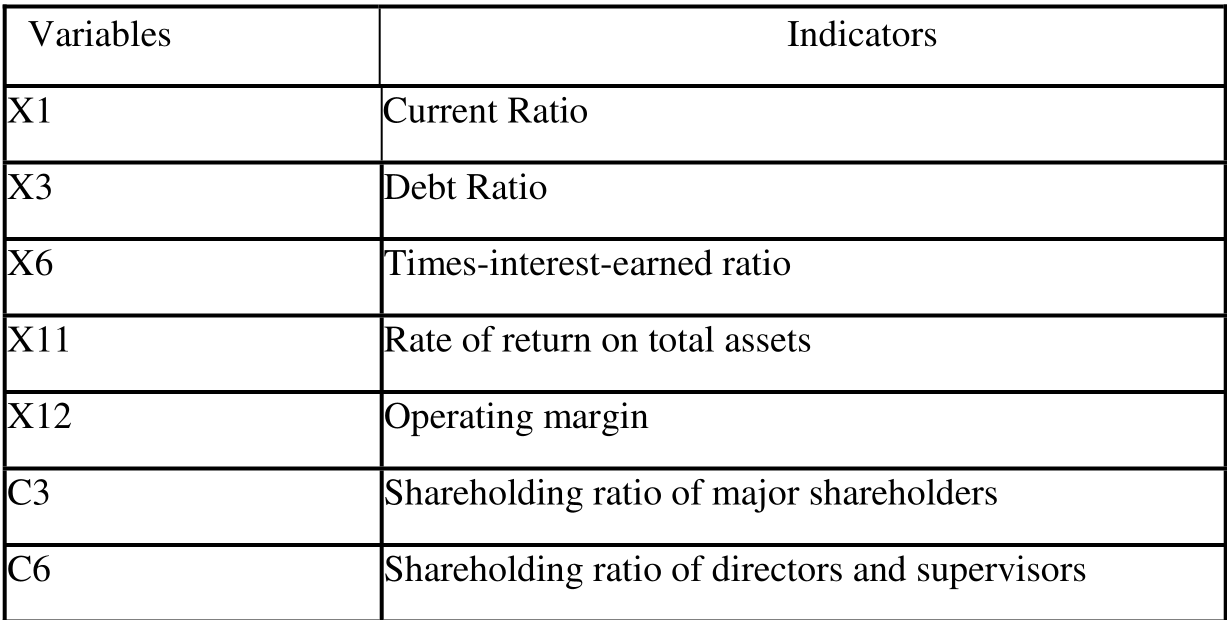
Through RST, 7 key variables emerged as the most critical "hidden" indicators of health:
- Financial: Current Ratio, Debt Ratio, Times-interest-earned, Rate of Return on Assets, Operating Margin.
- Governance: Shareholding ratio of major shareholders, Shareholding ratio of directors and supervisors.
Experiments & Results: Governance Makes the Difference
The researchers tested the models on TSEC/GTSM listed companies (2002–2007). The results were definitive:
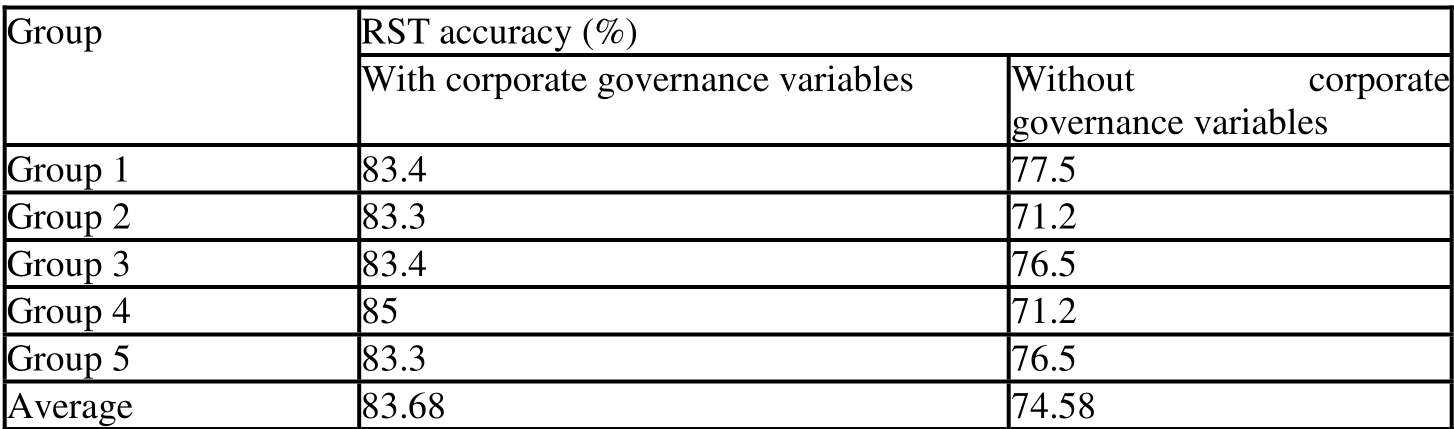
- RST Performance: Adding governance variables boosted accuracy by roughly 9.1% (from 74.58% to 83.68%).
- DT Performance: Adding governance variables improved accuracy by 6.2%.
- The Winner: The RST Model consistently outperformed the Decision Tree (DT), suggesting that RST’s ability to handle imprecise information is better suited for the volatility of financial markets.
Deep Insight: The Value of Interpretability
The true value of this work isn't just the higher accuracy; it's the interpretability. Unlike "black box" deep learning models, the RST-DT hybrid provides specific decision rules. For example, if a company's debt ratio is above a certain threshold AND the director shareholding ratio is declining, the model triggers a specific "Distress" rule.
Limitations & Outlook
While highly effective, the study focuses on the Taiwan market and data prior to 2008. Future research could explore:
- Global Generalization: Applying these governance-heavy models to Western markets or emerging digital economies (e.g., "Dot-coms").
- Real-time Dynamics: Incorporating High-Frequency data instead of annual reports to detect "Flash Distress."
Conclusion
This research proves that governance is not just a "soft" metric for CSR reports—it is a "hard" predictor of solvency. By leveraging Rough Set Theory, stakeholders can filter out the noise and focus on the structural integrity of the firms they invest in.