
RpR: Leveraging Social Graph Intuition for Trustworthy IoT Networks
RpR: A Trust Computation Model for Social Internet of Things
This paper introduces RpR, a robust Trust Computation Model for the Social Internet of Things (SIoT). It combines recommendations from "friendly" objects and reputations from third-party entities, utilizing an adapted, low-complexity PageRank-inspired numerical model to estimate trustworthiness in distributed environments.
TL;DR
As the Internet of Things evolves into the Social IoT (SIoT), the challenge shifts from simple connectivity to "who can I trust?" The RpR (Recommendations plus Reputations) model addresses this by treating objects like social actors. By adapting the PageRank algorithm to distinguish between direct friends and third-party interactions, and utilizing an "Inverse PageRank" to find trustworthy authorities, the model provides a scalable and resilient way to filter out malicious actors in decentralized networks.
Problem & Motivation: The Social Trust Gap
In a world where your car might talk to a parking meter or a rental broker, trust isn't just a security policy—it's a social necessity. Prior work in trust management was often designed for static networks or specific architectures (like WSN or MANET).
The authors identified two major gaps:
- Complexity & Scalability: Centralized systems (like eBay's rating) don't work in a distributed SIoT.
- Resilience: Most models are easily "gamed" by fake reviews or bot communities.
The core insight of this paper is that structural social intent matters. An object with many friends (outgoing links) is likely a more reliable recommender than an isolated one, but having too many incoming links doesn't automatically mean an object is "good" if those links come from dishonest actors.
Methodology: The Core Mechanism
The RpR model splits trust into two numerical domains:
1. The Recommendation Model (Direct Friends)
Inspired by Google's PageRank, the model assumes that a recommendation from a "friend" carries more weight. However, to solve the "fake reputation" problem, the authors use Inverse PageRank.
- The Intuition: Most "good" objects have a healthy balance of social interactions. By inverting the graph and looking at outgoing links, the model identifies "Trustworthy Roots."
- Biased Distribution: Instead of starting the algorithm with a uniform distribution, the initial trust scores are biased toward these identified "Trustworthy Roots."
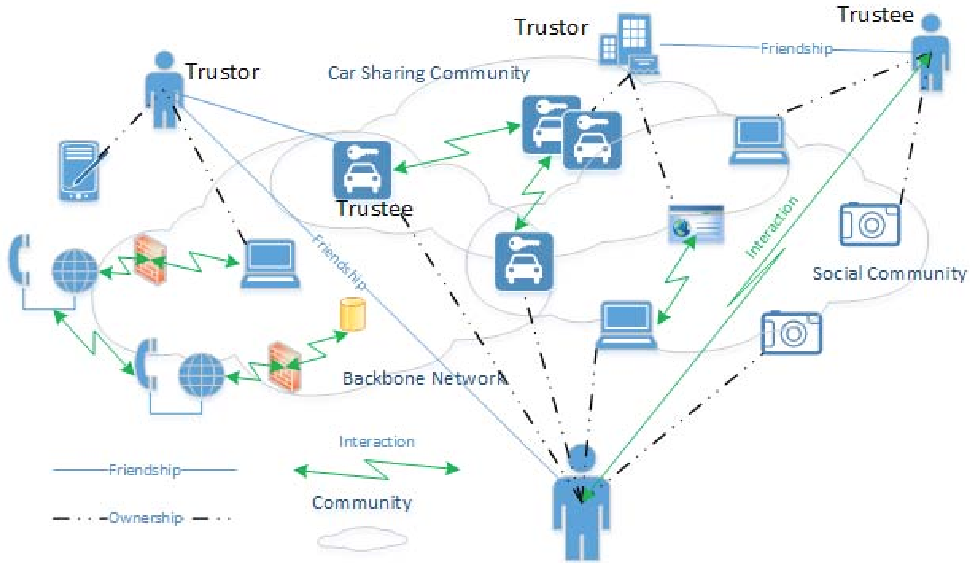
2. The Reputation Model (Third Parties)
Reputation is calculated for objects that aren't directly connected. Using the property of transition matrices, the model looks at up to 3 levels of depth (3-hop connections). Beyond three levels, the "social signal" becomes too noisy and the computational cost outweighs the benefit.
3. The Combined Algorithm (RpR)
The final score is a weighted sum: This formula ensures that direct, verified social knowledge () and broader community consensus () are balanced via decay factors.

Experiments & Results
The authors validated RpR by scaling simulations from 5 to 100 objects (noting it can handle tens of thousands due to its linear complexity relative to iterations).
- Convergence: The algorithm is remarkably efficient, reaching stable values in just 6 iterations.
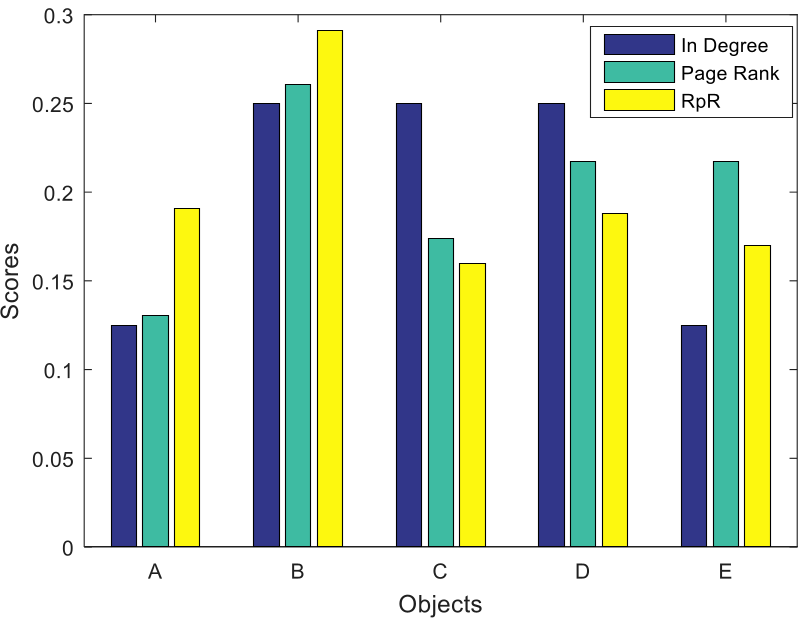
- Sensitivity: Compared to standard PageRank, RpR assigns lower scores to suspected dishonest nodes and higher scores to truly trustworthy ones, showing a steeper, more "sensitive" curve in adversarial scenarios.
- Stability: While standard PageRank performance degraded as the network grew, RpR's ability to detect the "Top 20%" of trustworthy nodes remained constant.
Critical Analysis & Conclusion
Takeaway
The RpR model proves that we can achieve high-fidelity trust scoring in a distributed SIoT without heavy cryptographic overhead. The use of Inverse PageRank to anchor the trust system in "Trustworthy Roots" is a clever way to handle the sybil-attack-like nature of fake reputations.
Limitations & Future Work
While RpR is excellent for objective metrics (Recommendations and Reputations), it currently ignores Knowledge—the subjective, experience-based component of trust. For instance, a device might be "reputable" but still fail a specific user's preference for latency or privacy. Integrating fuzzy logic or machine learning to quantify this subjective "Knowledge" remains the next frontier for this research.
Conclusion
RpR offers a mathematically sound, scalable framework for the next generation of social objects, moving us closer to a "Trusted Information Infrastructure" for the IoT ecosystem.