
Beyond "Friend-Only": Rethinking Social Privacy via Relationship Logic
Rule-Based Access Control for Social Networks
This paper presents a pioneering rule-based access control model specifically designed for Web-Based Social Networks (WBSNs). It introduces a decentralized framework named REL-X that utilizes Semantic Web technologies (OWL, N3) to regulate resource sharing based on the type, depth, and trust level of social relationships.
TL;DR
In the era of expanding Web-Based Social Networks (WBSNs), traditional "Private vs. Public" settings are no longer sufficient. This paper introduces a sophisticated Rule-Based Access Control model that leverages the Semantic Web. By analyzing relationship type, depth, and trust, it allows users to define granular policies (e.g., "only colleagues within two hops with 80% trust"). It shifts the security burden to the requester, who must present a logical "proof" to gain access.
Contextual Positioning
This work is one of the foundational entries into Semantic Access Control. At a time when FOAF (Friend of a Friend) was starting to standardize social data, the authors recognized that "availability" was outpacing "controllability." This paper acts as a bridge between traditional Access Control Lists (ACL) and modern Decentralized Identity (DID) architectures.
The Problem: The "Flat" Social Graph Malfunction
Traditional Social Network Management Systems (SNMS) treat all connections equally. The authors identify three critical missing dimensions:
- Relationship Type: A "friend" should not necessarily have the same access rights as a "work colleague."
- Transitive Depth: Access shouldn't just be limited to direct nodes; however, trust decays as the path gets longer (the "friend of a friend" problem).
- Trust Intensity: Not all friends are equal; some are more trustworthy than others.
Methodology: The Proof-Carrying Authorization
The authors propose a semi-decentralized architecture. Instead of a central server deciding who sees what, the Resource Owner sets the rules, and the Requester must prove they satisfy them.
1. The REL-X Vocabulary
Since RDF properties didn't natively support attributes like "trust level" or "depth," the authors designed REL-X, an OWL vocabulary that treats a relationship as a first-class object (a class instance) rather than just an edge.
2. Architecture: Centralized Certificates, Decentralized Enforcement
To prevent users from "lying" about their relationships, the system uses a Central Node (CN) to store signed certificates.
- Workflow: When User A (Requester) wants a file from User B (Owner), User B sends a set of N3 Logic rules. User A then fetches verified relationship certificates from the Central Node, runs a Cwm reasoner locally to generate a "Proof," and sends that proof back to User B.
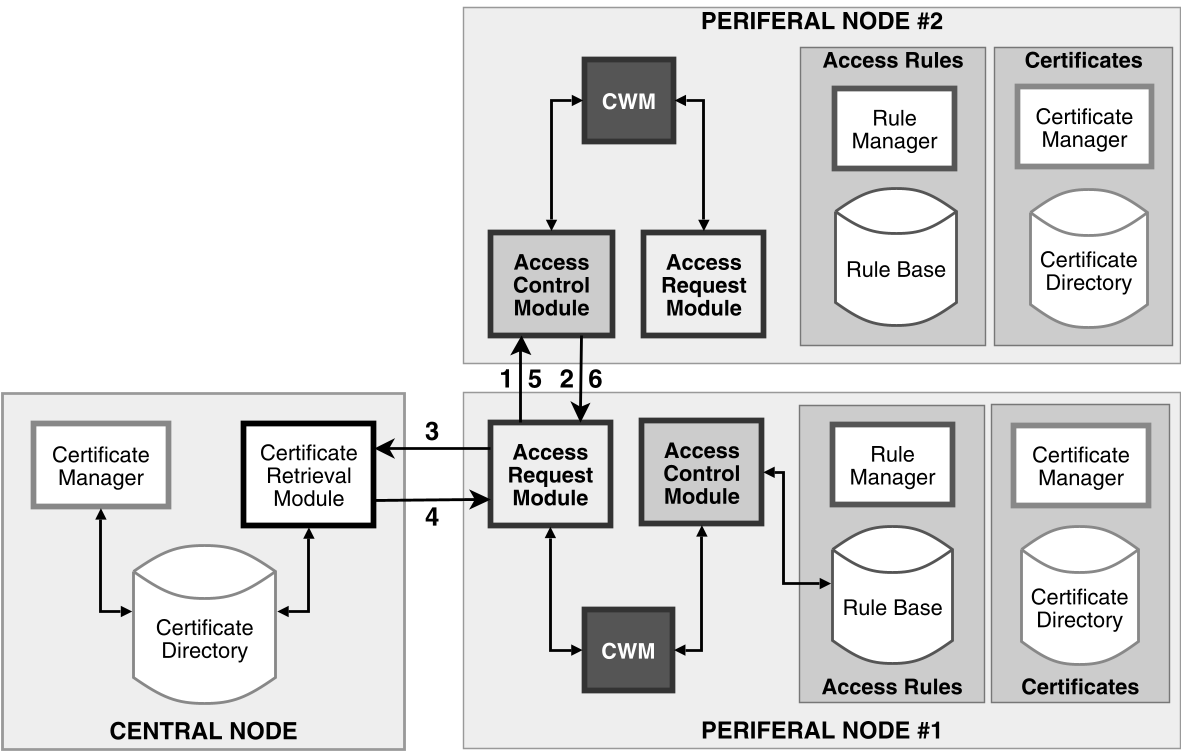 Figure 1: The interaction between Peripheral Nodes (Users) and the Central Node (Certificate Manager).
Logic in Action: A Running Example
Imagine Alice (Owner) has a file. Her rule might be:
- *Rule: (Context: friendOf, Depth: *, Trust: ) AND (Context: colleagueOf, Depth: 1, Trust: 0.5) This means the requester must be any-depth friend but a direct colleague with at least 50% trust.
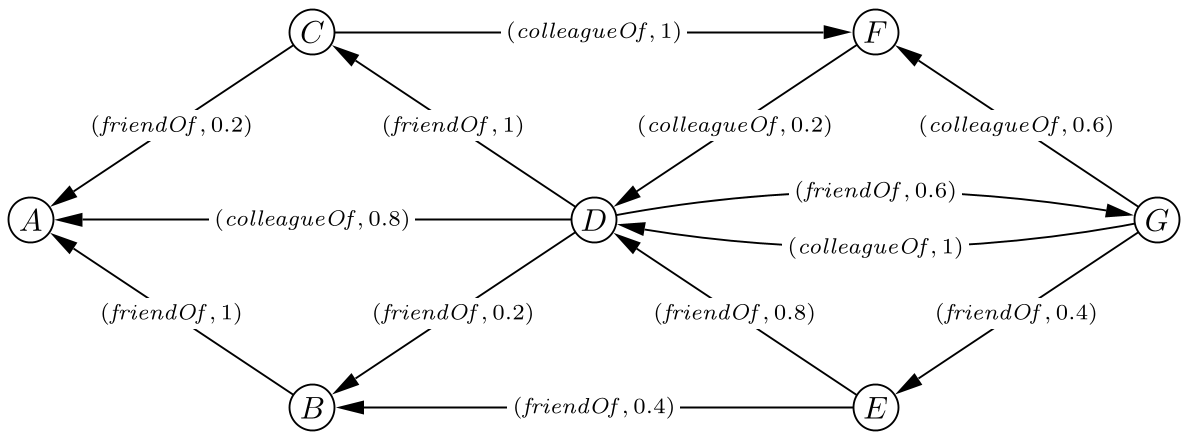 Figure 2: A sample social graph where David (D) must prove his multi-hop connection to Alice (A) via multiple paths (DBA, DCA).
The beauty of this system is that it can handle complex lattice logic. As shown in the David-Alice example in the paper, the system calculates trust levels across multiple paths (e.g., path DBA and DCA) to arrive at an aggregate trust score before the reasoner validates the claim.
Critical Insight & Conclusion
While the centralized "Central Node" for certificate storage acts as a minor point of centralization, it successfully preserves the privacy of the data itself, which remains on the owner's machine.
Takeaways for Modern AI/Web3:
- Inductive Bias: The model assumes trust is transitive but decaying—a principle now used in most graph-based recommenders.
- Zero-Knowledge Context: Modern versions of this would likely use Zero-Knowledge Proofs (ZKP) to prove the "relationship depth" without revealing the "intermediary friends."
Limitations: The reliance on a central node for trust calculation is a potential bottleneck, and the computational overhead of running an N3 reasoner on a client-side browser extension (as proposed in 2006) was ambitious for its time.
Future Outlook: Transitioning this to Topical Trust (e.g., "I trust Bob for movie advice but not for financial data") remains the next frontier in nuanced social access control.