
Beyond Binary Logic: A Hybrid Fuzzy Approach to Social Network Anomaly Detection
A Rule-based Hybrid Method for Anomaly Detection in Online-Social-Network Graphs
The paper introduces a rule-based hybrid method for anomaly detection in Online Social Networks (OSNs) using graph theory, Fuzzy C-Means (FCM) clustering, and a Fuzzy inference engine. By calculating "starness" and "cliqueness" scores (scScore) from user egonets, the model identifies outliers like near-cliques or near-stars that deviate from the standard "friend-of-friends" behavior.
TL;DR
Online Social Networks (OSNs) are breeding grounds for both community building and malicious activities. This paper presents a hybrid framework that blends Graph Theory, Fuzzy C-Means (FCM), and Fuzzy Rules to spot anomalies. By looking at "egonets" (a user and their immediate neighbors), the system identifies suspicious "Star" or "Clique" patterns with an F-score improvement of up to 20% over traditional SOTA methods like OddBall.
Background: The Social "Gray Area"
In a typical social network, "the friend of my friend is my friend." Most users follow this transitive pattern. However, anomalous actors—be they bots, intruders, or cyber-bullies—often exhibit extreme structural signatures:
- Stars: A central node connected to many disconnected satellites (typical of telemarketing or broadcast bots).
- Cliques: A group where everyone is connected to everyone else (potentially indicating artificial engagement rings or highly insulated malicious cells).
The problem? Detecting these isn't black and white. Human relationships are inherently "fuzzy," and traditional algorithms that force users into a single "Normal" or "Anomalous" bucket often fail to capture the nuanced transitions between behaviors.
Methodology: The Hybrid Engine
The researcher proposes a multi-stage pipeline to handle the uncertainty of social data:
1. Feature Engineering: The scScore
The core metric is the starness-cliqueness score (scScore). It measures how much a user's local neighborhood (egonet) resembles a perfect star or a perfect clique. This provides a quantitative basis for anomaly detection.
2. Clustering: GMM-EM and FCM
Instead of guessing how many types of users exist, the author uses Gaussian Mixture Models (GMM) with EM to find the "natural" number of clusters (determined to be 6 in this study). Then, Fuzzy C-Means (FCM) is applied. Unlike hard clustering, FCM gives each user a "membership degree" (e.g., a user might be 70% normal and 30% star-like), allowing for much smoother decision boundaries.
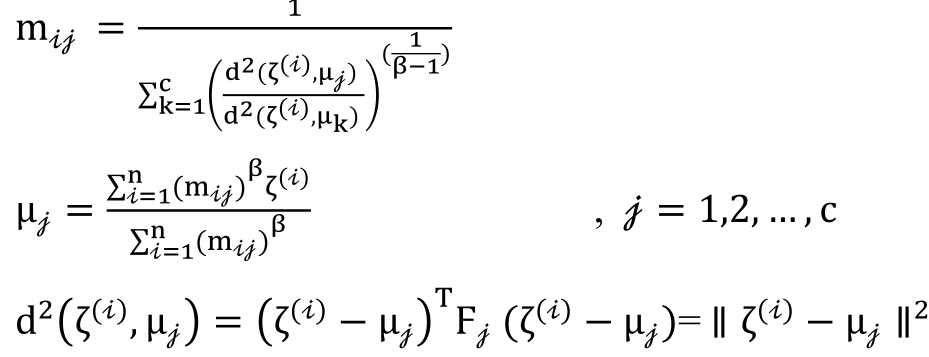 The math behind membership: Each point belongs to every cluster to a certain degree.
3. Logic: The Fuzzy Inference Engine
To turn clusters into actionable insights, a Fuzzy Inference Engine uses IF-THEN rules. For example:
- IF the starness score is LOW OR the cliqueness score is HIGH, THEN the node is anomalous.
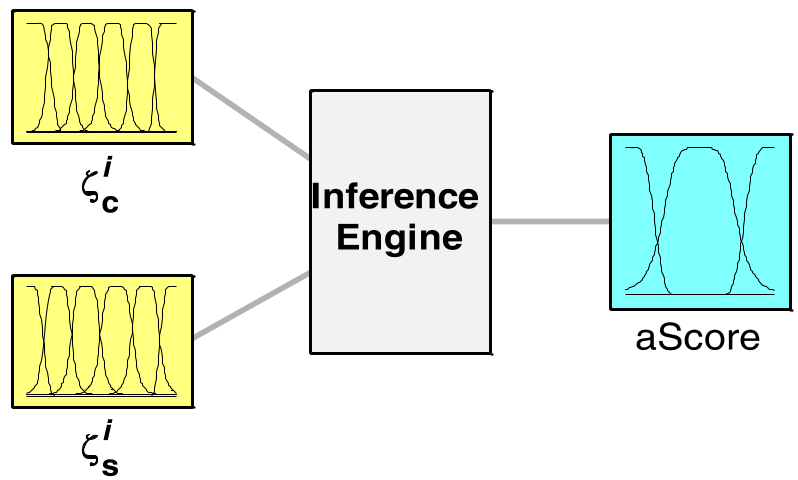 The logic bridge: Converting quantitative scScores into qualitative linguistic labels.
Experiments: Dominating the Baselines
The method was tested across three massive datasets: Facebook (64K nodes), Flickr (1.8M nodes), and Orkut (3M nodes).
The results were clear. By incorporating fuzzy logic, the model significantly reduced false positives and negatives.
- Facebook: Reached an F-score of 97.96%, compared to OddBall's 74.63%.
- Orkut: Maintained superior precision even in sparse, massive-scale environments.
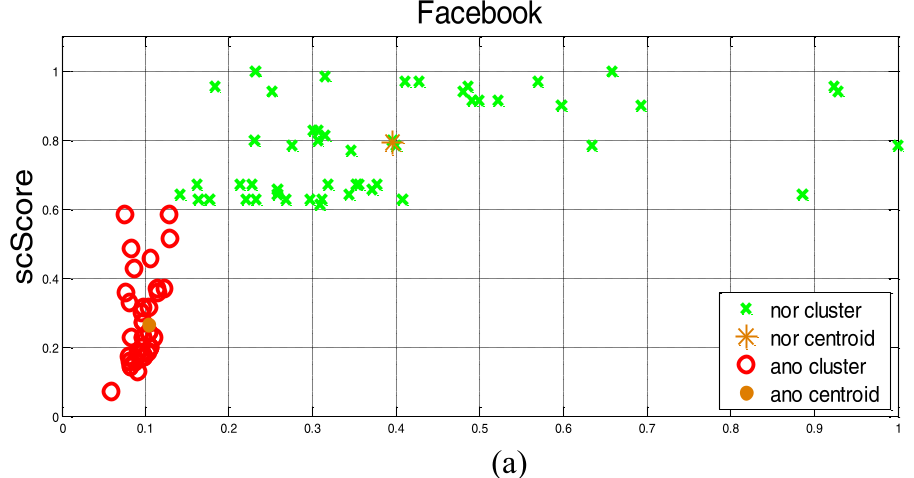 Visualization of user distributions into "Star" clusters across different networks.
Critical Insight: Why Does It Work?
The primary reason for this success is the relaxation of exact boundaries. Traditional methods like OddBall rely on the "Power Law" relationship between nodes and edges. However, if a sub-network is slightly "off" the power-law line but still within a reasonable range, these methods might trigger a false alarm. The Fuzzy Inference Engine treats these as "degrees of truth," effectively ignoring minor noise while focusing on extreme structural deviations.
Conclusion & Future Outlook
This paper proves that the "softness" of Fuzzy Logic is actually a scientific advantage when dealing with human-centric data like social networks. While the computationally intensive rule generation only needs to happen once, the resulting model can be scaled to analyze millions of new nodes in real-time.
Future Directions: The author suggests optimizing the Fuzzy Inference Engine further. Future iterations could integrate deep learning to automatically learn the membership functions, potentially moving beyond manual rule-tuning into a fully autonomous, adaptive security system.