
Extended Cultural Algorithm: Revolutionizing Rule Discovery through Social Intelligence
Rule Discovery with a Multi Objective Cultural Algorithm
The paper introduces an Extended Cultural Algorithm (ECA) for multi-objective optimization of classification rules. By integrating five specialized Knowledge Sources (KS) with intelligent agent technology, the framework achieves high classification accuracy (98.18%) and discovers a compact set of Pareto-optimal rules.
TL;DR
Rule mining is no longer a "blind" search. This paper introduces the Extended Cultural Algorithm (ECA), a framework that treats classification rule discovery as a multi-objective optimization problem. By mimicking social learning and utilizing organized "memory" in a Belief Space, the model achieves near-perfect accuracy (98.18%) on medical diagnostic data while producing highly interpretable rules.
Problem & Motivation: The Limits of Blind Search
Traditional evolutionary algorithms (EAs), while powerful, are essentially "memoryless." They explore the solution space through random mutations and crossovers, often losing valuable insights gained in previous generations. In the context of Classification Rule Mining, this leads to:
- Single-Objective Myopia: Focusing only on accuracy while ignoring rule coverage or simplicity.
- Inefficiency: Discarding useful "meta-knowledge" about the search landscape.
- Lack of User Interaction: Difficulty in guiding the search toward specific types of rules.
The authors argue that "Cultural Evolution" — where a society preserves its best behaviors in a shared space — is a superior metaphor for solving complex optimization problems.
Methodology: The Architecture of Culture
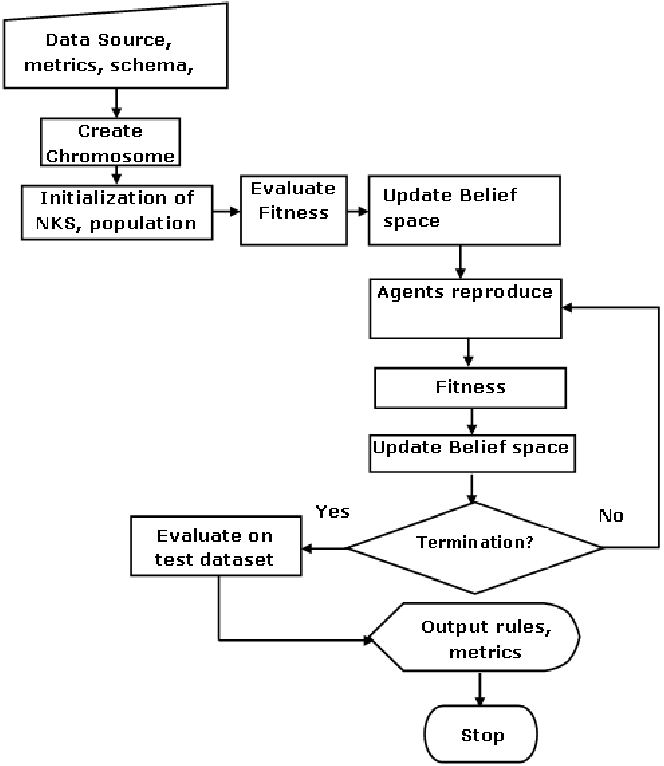
The core innovation is the Extended Cultural Algorithm (ECA). Unlike standard GAs, the ECA operates on two levels: a Population Space (where individuals evolve) and a Belief Space (where knowledge is stored).
1. The Wisdom of the Belief Space
The authors utilize five (plus one) specialized Knowledge Sources (KS) to guide the agents:
- Normative KS: Remembers the range of valid attribute values.
- Situational KS: Stores high-quality "exemplars" (leaders) for others to follow.
- Domain KS: Tracks the Pareto-optimal vectors (e.g., the best trade-offs between confidence and coverage).
- Topographical KS: Measures diversity to ensure the algorithm doesn't get stuck in local optima.
- History KS: Serves as the system's long-term memory of elite individuals.
- Rule KS (The Extension): Specifically designed to manage discovered classification rules.
2. Social Agents with Cognitive Traits
The "Influence Phase" is personalized. Agents are assigned traits that determine how they pick parents for the next generation:
- Risk Takers: Search across any KS at random.
- Cautious Agents: Only stick to the proven elites in the History KS.
- Imitators: Follow the specific examples found in the Situational KS.
Experiments & Results
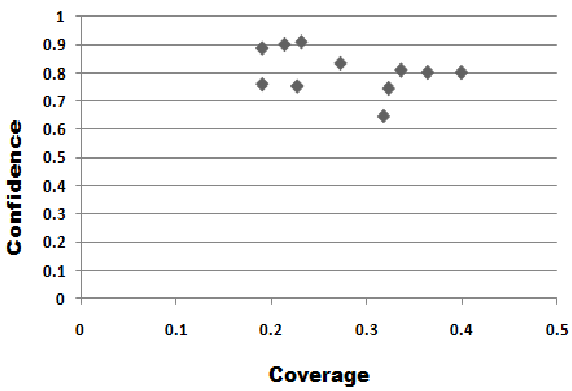
The model was validated using the Ljubljana Breast Cancer dataset. The goal was to find rules that are both highly accurate and widely applicable (optimizing both Confidence and Coverage).
- Unrivaled Accuracy: The ECA achieved a mean accuracy of 98.18%, significantly outperforming traditional greedy classifiers.
- Efficiency: The algorithm converged in just 25 generations with a population of 200, which is remarkably compact for such high accuracy.
- Pareto Frontiers: The system successfully identified a "Dominator" set — a small, elite group of rules (averaging 6.5) that represent the best possible trade-offs.
Deep Insight: Why It Works
The secret sauce lies in the Acceptance/Influence cycle. By storing "Meta-knowledge" (the how and where of good solutions) rather than just the solutions themselves, the ECA creates a targeted search. The addition of Topographical Knowledge is particularly clever — it explicitly penalizes similarity, forcing the algorithm to explore "novel" rules that might otherwise be overlooked.
Limitations & Future Work
The authors acknowledge that the current complexity is relative to the population size due to the pairwise similarity checks in the Topographical KS. Future work aims to transform this "Social Knowledge" into Collective Social Intelligence, potentially applying it to the realm of Artificial Immune Systems for cybersecurity.
Conclusion
This work demonstrates that rule mining is most effective when it is treated as a social process. By giving evolutionary agents a memory and distinct social personalities, the ECA provides a transparent, efficient, and highly accurate way to extract actionable knowledge from complex datasets.