
Beyond the Reply Tree: Harvesting Semantic Context for Rumor Detection
Rumor detection in social networks via deep contextual modeling
The paper introduces a "Semantic Graph" model for rumor detection that leverages self-attention to induce implicit semantic relations between main posts and replies. It achieves state-of-the-art performance on Twitter 15 and Twitter 16 datasets by combining deep contextual modeling with a unique information preservation mechanism.
TL;DR
Rumor detection on social media is no longer just about who replied to whom. This paper introduces a Semantic Graph approach that uses self-attention to identify hidden connections between posts, regardless of their position in a reply thread. By combining this with a novel Information Preservation strategy via multi-task learning, the authors set new SOTA benchmarks on classic Twitter datasets.
Contextualizing the Problem: The Limits of Topology
In the hyper-fast environment of Twitter (X), a rumor spreads not just through a chain of replies, but through a web of semantic interactions. Previous SOTA methods, such as Recursive Neural Networks (RvNN), were "topology-bound"—they processed information following the rigid tree structure of direct replies.
However, the authors identify two major gaps:
- Implicit Relations: Users often discuss the same sub-topic or provide corroborating evidence without directly replying to one another.
- Signal Dilution: As a model aggregates data from dozens of replies, the specific features of the Main Tweet—the actual source of the rumor—can become "washed out" in the final representation.
Methodology: Self-Attention & Latent Labels
The proposed "Semantic Graph" model shifts the focus from structural links to semantic similarities.
1. The Semantic Self-Attention Layer
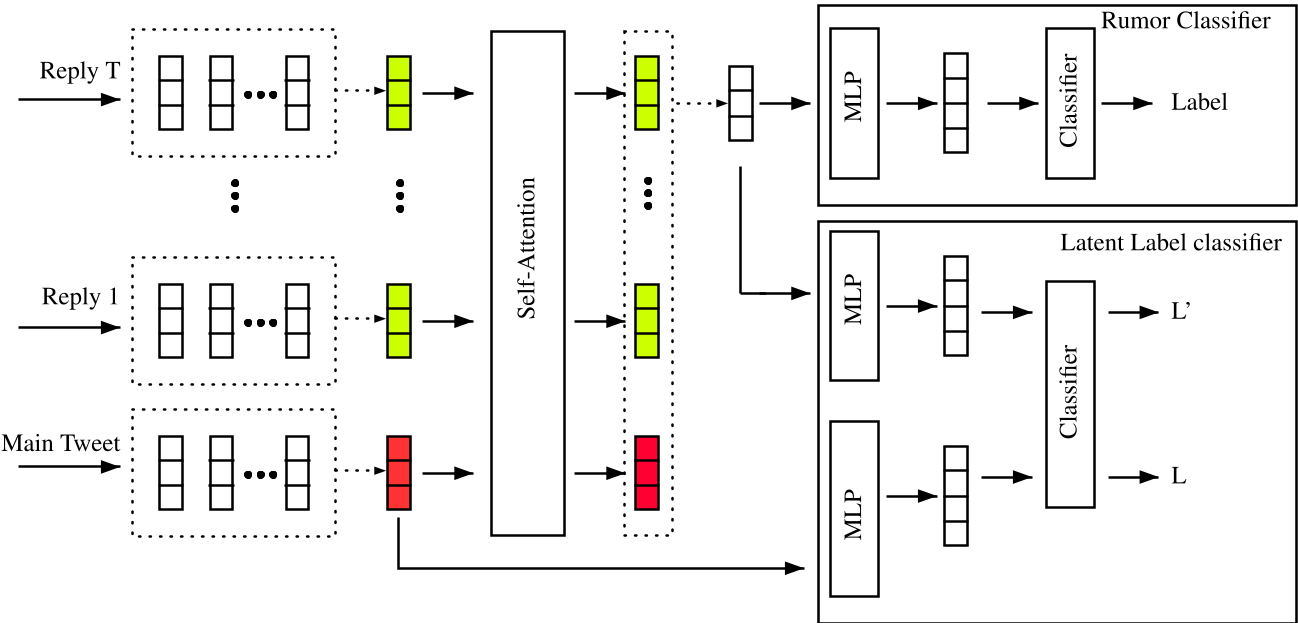
Instead of following a tree, the model treats every tweet in a thread as part of a fully connected graph. Using a Query-Key mechanism inspired by the Transformer, it calculates attention weights between every pair of tweets. This allows the representation of a reply to be influenced by other replies that are semantically related, even if they belong to different branches of the conversation.
2. Preserving the "Source of Truth"
To combat signal dilution, the authors introduce a Latent Label Prediction task. The intuition is clever: the global thread representation () and the main post representation () must both point to the same "latent" category.
- Why not just use L2 similarity? The authors tested this (the
Diffbaseline) and found it too restrictive. Forcing to be identical to erases the useful information found in the replies. The latent label approach acts as a "soft" constraint, ensuring the core "flavor" of the main tweet is preserved without overwriting context from the replies.
Experiments and Results
The model was tested against several baselines, including feature-engineered SVMs and deep learning models like GRU-RNN and RvNN.
- Performance: The Semantic Graph model achieved 77.0% accuracy on Twitter 15, a significant jump over the BU-RvNN (70.8%) and TD-RvNN (72.3%).
- The Power of Embeddings: Interestingly, while BERT and GPT results were strong, Glove embeddings performed slightly better in this specific task, likely due to better vocabulary overlap with the Twitter-specific nuances in the dataset.
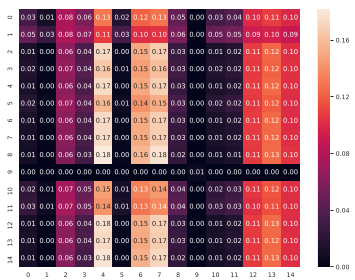 The heatmaps above reveal how replies can attend to each other semantically even without direct structural links.
Critical Insight: Why it Works
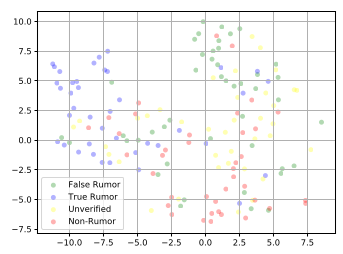
The t-SNE visualizations in the paper provide the "smoking gun." Without self-attention, the representations of different rumor classes (True Rumor, False Rumor, Unverified, Non-Rumor) are intermingled. With self-attention, the clusters become distinct. The semantic induction provides the Inductive Bias necessary to separate healthy skepticism from coordinated misinformation.
Conclusion & Limitations
By breaking the "tyranny of the tree structure," the authors have shown that the meaning of a conversation is more important than its format.
Future Outlook: While the current model treats the thread as a sequence/graph, it essentially ignores the temporal aspect—how a rumor evolves over minutes vs. hours. Integrating this semantic graph with a temporal attention mechanism could be the next frontier for real-time rumor intervention.