
Bridging the Traceability Gap: New S-Parameter Standards for 10-100 MHz
Establishment of S-parameter Traceability for 3.5 mm Coaxial Lines from 10 MHz to 100 MHz
The National Metrology Institute of Japan (NMIJ) established an SI-traceable S-parameter standard for 3.5 mm coaxial lines spanning 10 MHz to 100 MHz. The system employs a custom 300-mm-length air line as the primary standard, characterized via dimensional metrology and insertion loss measurements.
Executive Summary
TL;DR: Researchers at NMIJ have closed a critical gap in RF metrology by developing a 300-mm precision air line standard for 3.5 mm coaxial interfaces. By combining mechanical precision with Monte Carlo uncertainty analysis, they achieved SI-traceable S-parameter measurements from 10 MHz to 100 MHz, maintaining uncertainties as low as 0.001.
Background: Historically, S-parameter traceability has been robust at high microwave frequencies (using short air lines) and DC-to-low RF (using specialized loads). However, the 10-100 MHz range has remained a "no-man's land" where standard 75-mm air lines lack sufficient phase shift for accurate VNA calibration. This paper presents a foundational metrological solution.
The Motivation: Why 300 mm?
In VNA metrology, the Primary Standard is often an Air Line. At microwave frequencies, these lines are short and manageable. However, as frequency decreases, the wavelength increases. To perform a reliable Thru-Reflect-Line (TRL) calibration, the air line must provide a distinct phase shift.
Below 100 MHz, a standard 75-mm line is electrically "too short" to distinguish from a zero-length thru. The authors’ insight was to construct a stable, 300-mm air line—long enough to provide the necessary phase shift but requiring extreme mechanical precision to avoid introducing new errors through misalignment or sagging.
Methodology: Precision Engineering & Theoretical Modeling
The core of the work lies in the construction and characterization of the 300-mm air line.
1. Mechanical Assembly
The outer conductor was built from four 75-mm sections. To ensure a seamless interface, NMIJ developed an "original tool" that expands at the connection interface during tightening, keeping step differences below 0.02 mm and angular misalignment under 0.03°.
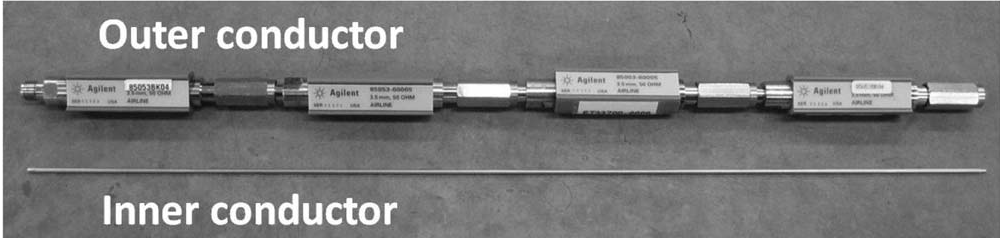 Fig 1. The custom 300-mm-length air line assembly used as the primary standard.
2. Dimensional Metrology
Dimensional measurements including Internal Diameter of Outer Conductor (IDOC) and Outer Diameter of Inner Conductor (ODIC) were mapped along the entire 300 mm length. These dimensions dictate the characteristic impedance ().
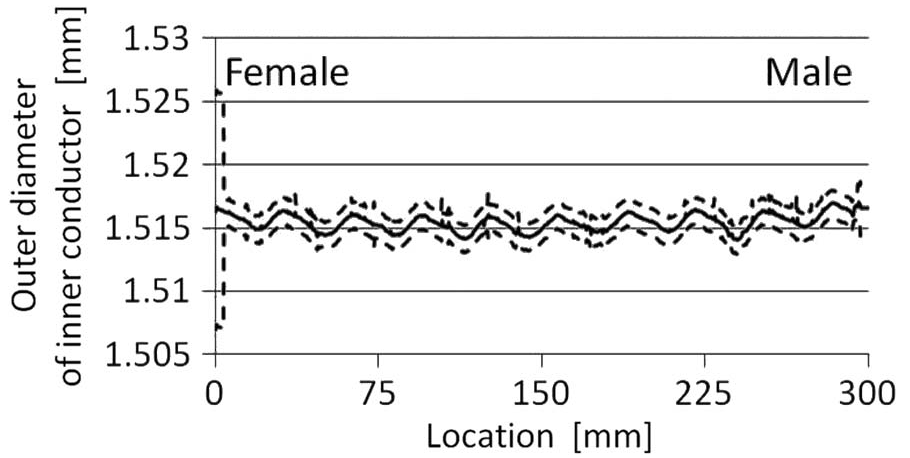 Fig 3. ODIC measurement results showing fluctuations and expanded uncertainty.
3. S-Parameter Calculation
Rather than simply measuring the line with another VNA (which would be circular logic), the S-parameters were derived theoretically from the dimensions and measured insertion loss using:
Monte Carlo simulations with 1 million trials were then used to propagate uncertainties from mechanical tolerances to the final S-matrix.
Experimental Results
The researchers used the air line to characterize a "Matched Load" via the Offset Load Method. This allows the VNA to transition from TRL calibration (difficult at low frequencies) to Thru-Reflect-Match (TRM) calibration.
- Uncertainty Performance: At 100 MHz, the expanded uncertainty for reflection coefficients was .
- Stability: The absolute value of the reflection coefficient remained stable across the 30-100 MHz band.
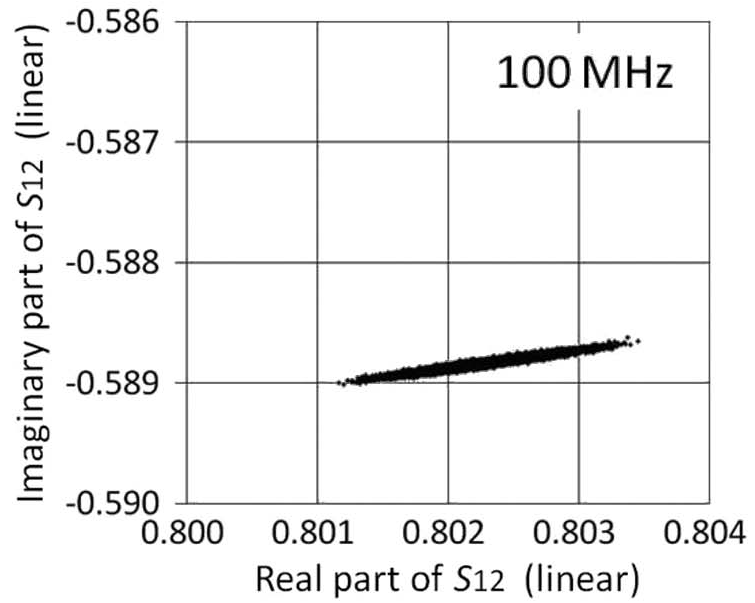 Fig 8. Monte Carlo trial distributions for S11 and S12 at 10 and 100 MHz.
Critical Insights & Conclusion
Takeaway: The success of this method hinges on the mechanical alignment of segmented air lines. By proving that four segments can act as a single electrical entity, NMIJ has enabled "modular" standards for low-frequency metrology.
Limitations: Below 10 MHz, the uncertainty begins to spike sharply (increasing 5x at 10 MHz compared to 100 MHz). This suggests that even a 300-mm line reaches its physical limit at the lower end of the RF spectrum, where other techniques like the NMIJ "original matched load" (DC-traceable) must take over.
Future Impact: This research establishes a complete traceability chain from 9 kHz to 33 GHz for NMIJ, providing a blueprint for other national labs to standardize the increasingly important 10-100 MHz industrial spectrum.