
SASA Framework: Why Your Social Media "Anonymity" is a Myth
SA Framework based De-anonymization of Social Networks
The paper introduces the SASA (Structure-Attribute Social-network Anonymization) framework, a de-anonymization approach that integrates network topology with user attribute data. Using a bipartite graph matching strategy and the KM algorithm, it achieves high-accuracy re-identification of "anonymized" social network users by leveraging auxiliary information.
TL;DR
Researchers have developed the SASA (Structure-Attribute) framework, a potent de-anonymization tool that proves simply removing your name from a dataset isn't enough. By combining network structure (who you know) with node attributes (your city, account creation time), the framework can re-identify "anonymous" users with high precision using a specialized bipartite matching algorithm.
Context: The Illusion of Anonymity
In the era of Big Data, social media companies often release "anonymized" datasets for research. The standard practice is naive ID removal—stripping names and handles. However, the SASA framework demonstrates that your social graph and your public metadata (like your city or behavior) act as a unique biometric signature. While prior attacks focused purely on the shape of the network, they often struggled with noise. SASA bypasses this by treating attributes as part of the structural backbone.
Problem & Motivation: The Weakness of Pure Structure
Existing de-anonymization methods (like -anonymization or simple seed-based propagation) often fail if the graph has been perturbed—meaning links were randomly added or deleted. These methods ignore the rich context surrounding a node. If two users have the same number of friends (structural symmetry), a structure-only attack might guess wrong. But if one user lives in "Chongqing" and the other in "Washington DC," the ambiguity vanishes.
Methodology: The SA Framework & Dual Similarity
The core innovation lies in modeling the social network as an SA Framework. Instead of just having "User nodes," the authors add "Attribute nodes" to the graph. If you live in London, there is an edge between the "You" node and the "London" node.
1. The Similarity Measurement
The framework calculates a composite score based on two factors:
- Attribute Similarity (): Uses binary column vectors and a Jaccard-like logic to see how many metadata bits match.
- Structural Similarity (): Compares the social degrees of neighbors in the anonymized vs. auxiliary graphs.
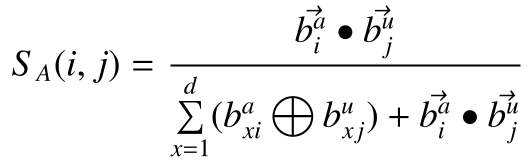 The mathematical definition of Attribute Similarity utilized in the framework.
2. The Matching Algorithm
The attack follows a two-stage process:
- Candidate Generation: Uses BFS to traverse the graph, narrowing down potential matches to a top- list to keep the complexity at .
- Global Matching: Employs the KM (Kuhn-Munkres) Algorithm to find the maximum weighted bipartite matching, ensuring the overall "fit" between the two graphs is maximized.
Experiments: Real-World Testing on Twitter
The authors crawled 7,910 Twitter users and 874,222 links, focusing on attributes like "city" and "account creation time."
Key Findings:
- Parameter Sensitivity: Setting (the number of candidates) was the "sweet spot." Below 8, they missed the real user; above 8, the computation time spiked without gaining much accuracy.
- Success Rate vs. Threshold (): The success rate is sensitive to the similarity threshold . If is too high, the algorithm becomes too picky and fails to find matches in noisy data.
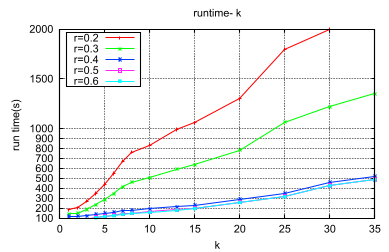 (a) Success rate variation with parameter k.
Critical Insight & Conclusion
The SASA Framework serves as a wake-up call for data privacy.
- The Takeaway: Privacy is not a binary state (anonymized vs. not). It is a gradient. By fusing social topography with even "insignificant" attributes like time zones, attackers can bridge supposedly disconnected datasets.
- Limitations: The algorithm relies on an "Auxiliary Graph"—meaning the attacker needs some prior knowledge. If the auxiliary data is completely different or non-existent, the attack fails.
- Future Work: This research paves the way for more sophisticated "Defense-in-Depth" strategies, such as adding specific types of noise to attributes (Differential Privacy) rather than just perturbing links.
In short: Your metadata is your identity. Even if you hide your name, your "shape" in the digital world remains visible.