
SAKE: Scaling Katz Centrality via Intelligent Graph Sampling
SAKE: Estimating Katz Centrality Based on Sampling for Large-Scale Social Networks
This paper introduces SAKE (Sampling-based Algorithm for Katz centrality Estimation), a novel framework for estimating the influence of vertices in large-scale social networks. It leverages multi-round Horvitz-Thompson sampling to approximate truncated Katz centrality, achieving significant speedups over iterative SOTA methods.
TL;DR
Katz centrality is a cornerstone for measuring node influence, but its or even complexity makes it a "luxury" for large-scale networks. SAKE (Sampling-based Algorithm for Katz centrality Estimation) changes the game by using a multi-round sampling strategy. It reduces the computational burden by up to 100x while providing a theoretical guarantee of unbiasedness and an -approximation of the true values.
Background: The Problem with Global Visibility
Traditional centrality measures like PageRank or Katz centrality are "global"—they require knowledge of the entire graph's adjacency structure. The original Katz formulation involves an infinite sum of walks: While iterative methods like Foster's reduce this to , they still bottleneck when the edge count reaches millions or billions. The motivation for SAKE is simple: Can we see the whole through a peephole? If we only sample a tiny fraction of the network, can we still accurately rank the most influential users?
Methodology: The Multi-Round Sampling Insight
The core innovation of SAKE is treating Katz centrality estimation as a statistical sampling problem. Instead of looking at all walks of length , SAKE uses a Multi-Round Sampling design:
- Iterative Sampling: It samples a small subset of vertices at each distance from the objective vertex.
- Horvitz-Thompson Correction: Since sampling introduces bias (short-range nodes are easier to find than long-range ones), the algorithm uses the Horvitz-Thompson estimator to re-weight edges by the inverse of their inclusion probability.
- Matrix-Vector Optimization: By reformulating the estimation into local matrix-vector products, the complexity drops from to , where is the (very small) sample size.
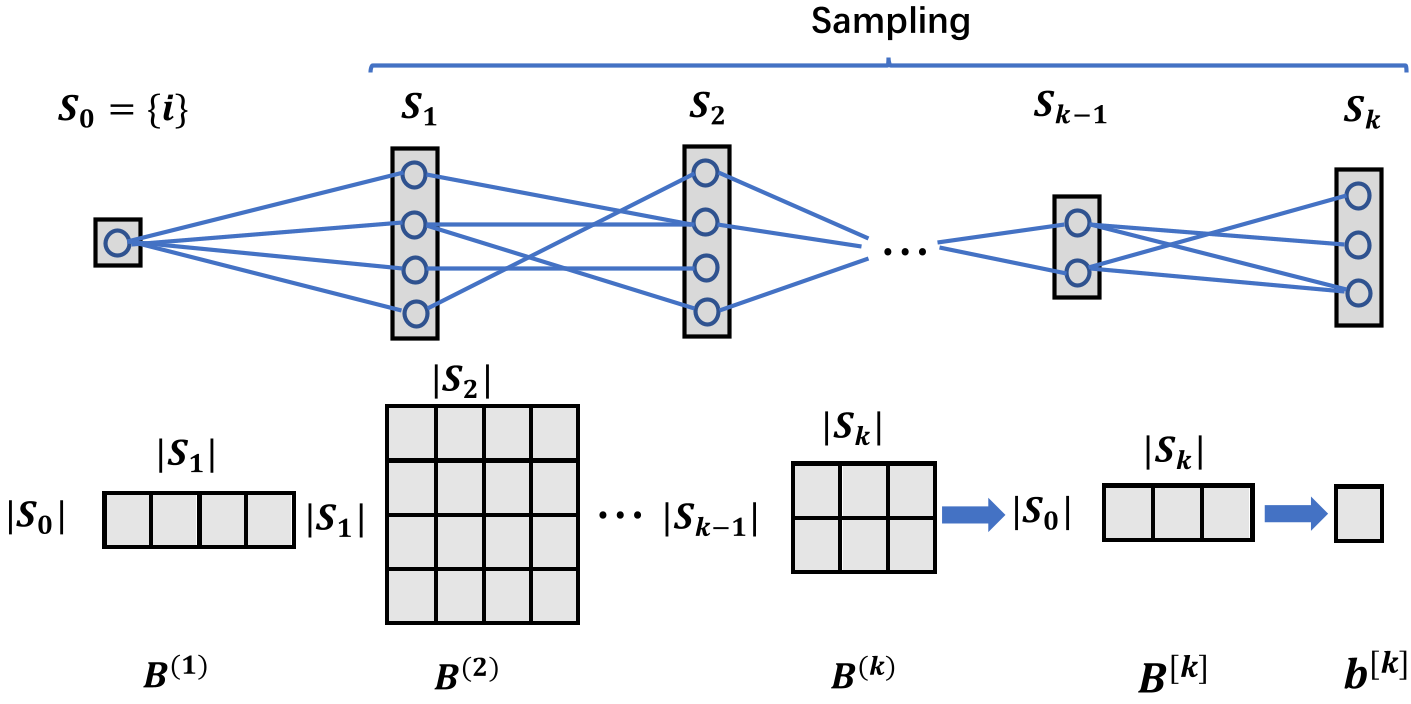 Figure 1: Illustration of the multi-round sampling process and the construction of sparse adjacency matrices.
The Unbiased Guarantee
One of the paper's strongest contributions is the proof of Theorem 4.1. It demonstrates that the expectation of SAKE's estimator is exactly equal to the true truncated Katz centrality. By repeating the sampling times, the error is bounded by the Hoeffding inequality, providing a robust -approximation.
Performance: 100x Faster, 97% Precise
The authors tested SAKE against standard benchmarks (Foster and Nathan) on datasets like Wikipedia and Livejournal.
- Efficiency: SAKE achieved up to 100x speedup compared to personalized Katz methods and 10x compared to iterative neighbors-based methods.
- Convergence: Even with a 1% sampling ratio (), the algorithm converges to the true centrality value quickly as the walk length reaches 6.
- Ranking Accuracy: In terms of "Influence Discovery," SAKE maintained a Precision of >97% for the top-100 influential nodes, proving that exact values are not necessary for effective ranking.
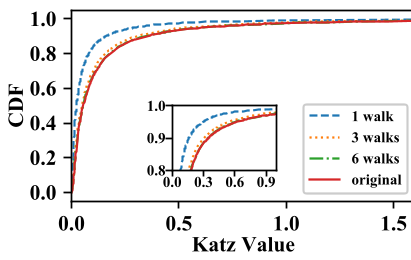 Figure 2: Convergence of truncated Katz centrality. As the number of walks increases, the estimation perfectly tracks the ground truth distribution.
Deep Insight: Why It Works
The success of SAKE suggests that social networks have a "sampling-friendly" topology. Because Katz centrality penalizes longer walks exponentially (via the attenuation factor ), the "influence" is largely determined by local and semi-local structures. SAKE exploits this by sampling densely in the local neighborhood and using statistical weights to represent the sparse, distant connections.
Critical Analysis & Conclusion
Takeaway: SAKE is a significant step toward practical "real-time" social network analysis. It bridges the gap between rigorous matrix theory and scalable data mining.
Limitations:
- The current method focuses on node sampling. In extremely sparse graphs, node sampling might miss critical bridge edges. A hybrid edge-node sampling approach could further enhance robustness.
- The "attenuation factor" must be carefully chosen () to ensure convergence, which still requires some global knowledge of the graph's spectral radius.
Future Work: The methodology behind SAKE is naturally extensible to other eigenvalue-based metrics like PageRank and HITS. We expect this "sampling-first" paradigm to eventually replace "full-graph" iterations in dynamic, large-scale graph databases.