
When Saliency Meets Sentiment: Bridging the Gap Between Attention and Emotion
When saliency meets sentiment: Understanding how image content invokes emotion and sentiment
This paper introduces a systematic framework to investigate the relationship between visual saliency and sentiment perception. By combining state-of-the-art saliency detection (VGG-based) and sentiment classification models, the authors analyze how specific scene attributes—such as faces and indoor vs. outdoor settings—influence whether a localized salient object dictates the overall emotional tone of an image.
TL;DR
Why does a photo of a smiling person make us feel happy instantly, while a landscape requires a "broader" look to feel its serenity? This paper from the University of Rochester explores the "black box" of visual sentiment by analyzing the interaction between salient objects and overall image sentiment. The researchers discovered that while human faces and indoor objects strongly anchor an image's emotion, natural landscapes evoke sentiment in a more holistic, non-localized way.
Problem & Motivation: Beyond the Black Box
Recent years have seen CNNs (like VGG and ResNet) achieve high accuracy in sentiment tasks. However, these models rarely tell us why an image is perceived as "positive" or "negative."
The authors identify a gap between neuroscience and computer vision:
- The Automaticity Debate: Is emotional perception independent of attention, or does it rely on what we focus on first (saliency)?
- Localization: Does the most "eye-catching" object in a photo necessarily represent the emotional soul of the entire scene?
Methodology: The Framework of Agreement
The researchers developed a pipeline to measure Sentiment Agreement Rate (SAR). The core idea is simple: if the sentiment score of a detected salient region is nearly identical to the sentiment score of the full image, they "Agree."
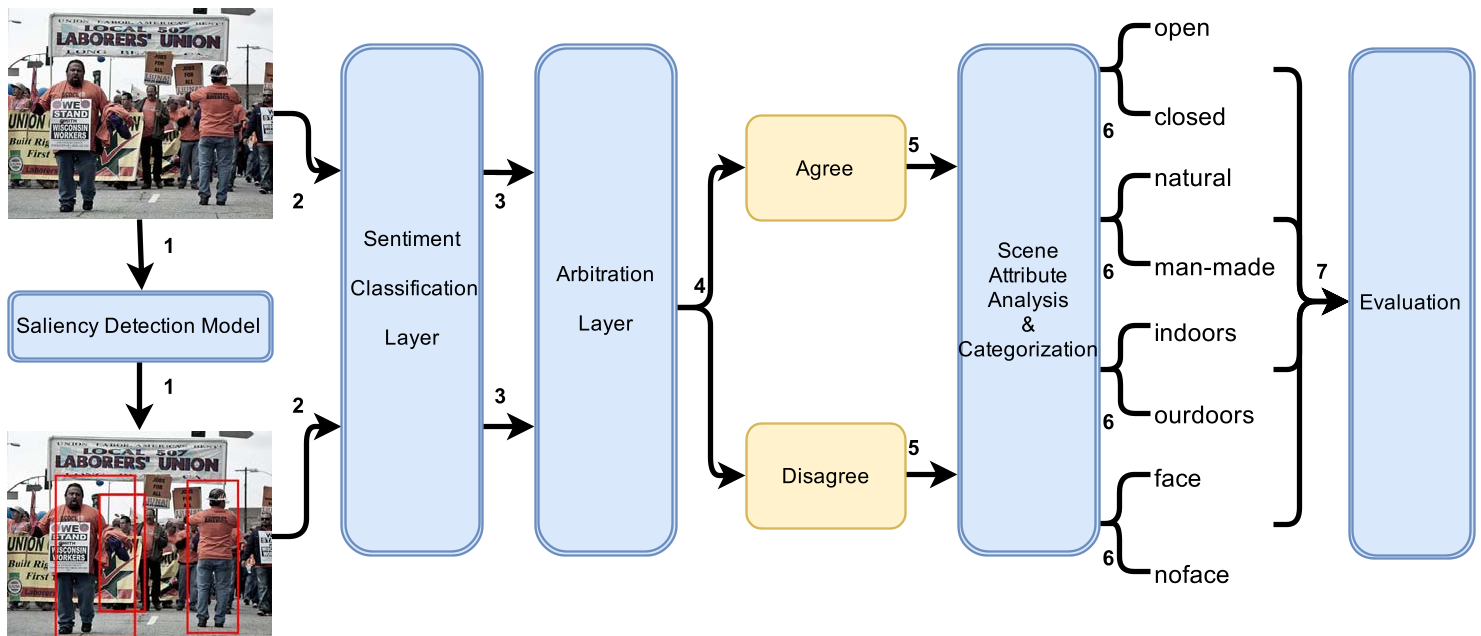
The framework categorizes images across four meta-dimensions:
- Open vs. Closed: Vast landscapes vs. close-up subjects.
- Natural vs. Man-made: Forests vs. Skyscrapers.
- Indoor vs. Outdoor.
- Face vs. No-face.
By using Places-CNN for scene attributes and Face++ for human features, the authors could statistically analyze which types of images rely on localized saliency for emotional impact.
Key Insights: Faces Dominate, Nature Is Holistic
Using a metric called the Discrimination Ratio (DR)—a modified statistic—the data reveals striking patterns:
1. The Power of the Face
Images containing faces showed the highest correlation with sentiment agreement. If there is a face in the salient region, the human brain (and the model) almost exclusively uses that face to judge the entire image's sentiment.
2. Indoor vs. Outdoor
"Closed" and "Indoor" scenes tend to have higher sentiment agreement. In these environments, the emotional "anchor" is usually a specific object (e.g., a birthday cake, a broken window).
3. The "Natural" Exception
In "Natural" and "Open" (outdoor) scenes, the salient objects often disagree with the overall sentiment.
- Insight: In a vast landscape, the sentiment is often "global." A single salient rock or tree doesn't represent the peace or loneliness of the whole valley; the emotion is in the spatial layout and color palette (the "Spatial Envelope").
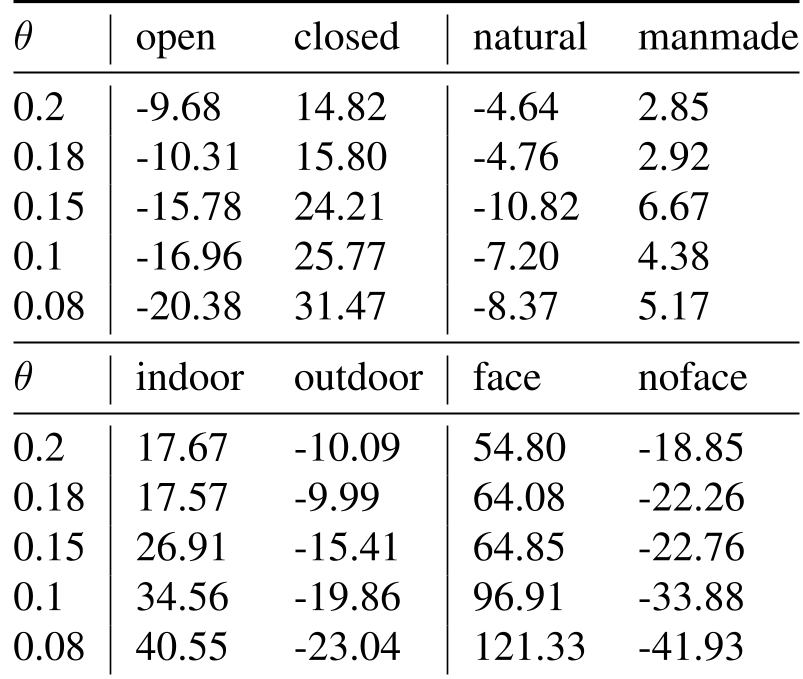 Table 1: Higher DR values for 'Face' and 'Indoor' attributes show they are strong predictors of saliency-sentiment alignment.
Critical Analysis & Conclusion
This work provides a crucial bridge between low-level vision (saliency) and high-level semantics (sentiment).
Takeaways for AI Practitioners:
- Context Matters: If you are building a sentiment engine for social media, your model needs a "branch" for facial expressions and a separate "branch" for global scene statistics.
- Saliency is not enough: You cannot simply "crop" the most salient part of an image and expect to keep the same emotional meaning, especially for nature photography.
Limitations: The study relies on traditional saliency models which may be biased toward high-contrast edges rather than semantic importance. Furthermore, the "Agree/Disagree" binary might oversimplify complex images where multiple conflicting emotions exist.
Future Work: The authors suggest that future sentiment classifiers should explicitly incorporate saliency maps as an input feature, potentially using them as a soft-attention mechanism to guide the model toward emotionally "heavy" regions.