
Turning Curiosity into Data: Crowdsourcing 3D Saliency via Multitouch Interaction
Discovering salient regions on 3D photo-textured maps: Crowdsourcing interaction data from multitouch smartphones and tablets
The paper presents a novel crowdsourcing system to detect salient regions on 3D photo-textured maps using multitouch interaction data from smartphones and tablets. Key methods include a Frustum-based time-tracking model and a Hidden Markov Model (HMM) to infer interest from camera velocity, achieving high correlation with human gaze-tracking ground truth.
TL;DR
Researchers have developed a way to "mind-read" what people find interesting in 3D maps without asking them a single question. By analyzing how thousands of users move, zoom, and tilt their cameras within a mobile app, they've created saliency maps that rival or exceed traditional computer vision algorithms and correlate strongly with actual human eye-tracking data.
Background: The Big Data Bottleneck in the Deep Sea
Autonomous Underwater Vehicles (AUVs) are currently generating high-resolution 3D reconstructions of the seafloor at a rate that far outstrips human capacity for review. While a two-week mission can yield hundreds of thousands of images, the "needle in the haystack"—the unique coral, the rare species, or the geological anomaly—remains hidden. Traditional computer vision (CV) saliency models often fail here because they don't understand 3D depth or the "intent" behind human exploration.
The "SeafloorExplore" Approach
Instead of paying workers to label images, the authors released SeafloorExplore, an educational app for iOS. As users explored detailed 3D models of the ocean floor, the app silently logged their interaction parameters:
- : The point on the terrain the camera is focused on.
- : The zoom distance.
- : Tilt and rotation angles.
- : The velocity of the "gaze" across the 3D surface.
The Core Methodology: Tracking Intent
The paper introduces two sophisticated ways to turn these logs into heatmaps:
- Frustum-based Saliency: This keeps a counter for every vertex in the 3D model. If a point is in the camera's view (within the frustum), its counter increases by the duration of the view. The intuition: If people look at it often, it’s probably important.
- HMM-based Saliency: This is the "smarter" approach. It treats camera movement as a time-series. A 2-state Hidden Markov Model is trained to distinguish between "exploratory motion" (high velocity, searching) and "focused interest" (low velocity, orbiting a point).
 Figure: The spherical camera model used to capture user interaction in 3D space.
Experiments: Validating against the "Gold Standard"
To prove this works, the team set up a rig using near-infrared eye-trackers. They recorded where users actually looked versus where the app logs predicted they were interested.
They tested this across three distinct underwater ecosystems:
- Geebanks: Rich coral textures.
- Ningaloo: Sponges and "objects" on sand.
- St. Helens: Volcanic boulder fields.
Performance Highlights
The HMM approach consistently beat traditional visual saliency models like Itti-Koch or spectral residuals. Why? Because humans often ignore "visually loud" things (like white sand) in favor of "structurally interesting" things (like a small urchin) that a 2D algorithm might miss.
 Figure: Comparison between different saliency methods. Note how the HMM (g) and Frustum (f) methods align more closely with Human Gaze (h) than traditional CV methods (b-e).
The "Power of the Crowd"
A critical discovery of this work is the data threshold. The researchers found that once you hit approximately 10,000 interactions, the saliency maps become highly stable. As more users join the "crowd," the noise of individual random browsing is filtered out, leaving a clear signal of collective human curiosity.
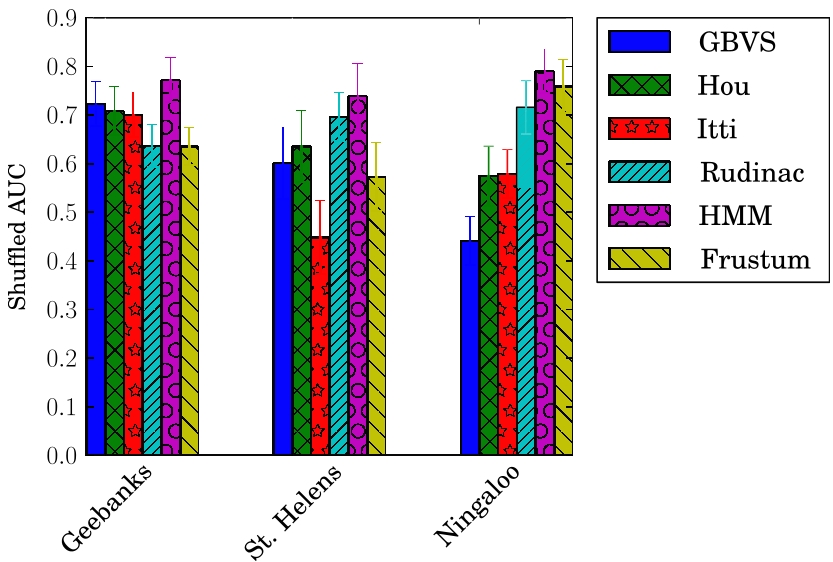 Figure: AUC Performance increases steadily as the number of crowdsourced samples grows.
Critical Insight: Why This Matters
The true value of this work lies in its modality-agnostic nature. Traditional visual saliency requires images; this method only requires interaction. This means we could use it to find "interesting" regions in:
- Untextured LiDAR scans or point clouds.
- Medical 3D volumes (e.g., MRI scans explored by radiologists).
- Commercial 3D urban maps (identifying popular storefronts or viewpoints).
While it requires more computation than a simple image filter, the ability to tap into the "distilled intelligence" of thousands of casual users makes it a formidable tool for the future of big data exploration.
Conclusion
Johnson-Roberson et al. have demonstrated that browsing data isn't just "exhaust"—it's a valuable signal. By framing exploration as a Hidden Markov process, they’ve bridged the gap between raw interaction and biological attention, providing a blueprint for the next generation of 3D data-mining.