
Sampling Bias in LinkedIn: Why Your Professional Data Might Be Skewed
Sampling Bias in LinkedIn: A Case Study
This paper presents a case study on sampling bias in LinkedIn, specifically examining how representativeness varies across STEM graduates. Using a manual verification method for 1,989 graduates from a major public university, the authors evaluate how academic majors, graduation year, gender, and GPA influence LinkedIn participation rates.
TL;DR
Is LinkedIn a mirror of the professional world? Not exactly. This study of 1,989 STEM graduates reveals that your major is the biggest predictor of whether you have a profile. While tech-heavy majors like Information Science have high participation (~51%), life sciences like Biochemistry lag significantly (~30%). Factors like GPA and gender, however, play a surprisingly minor role.
The "Easy Data" Trap
In the era of Big Data, researchers love LinkedIn. It offers a massive, accessible repository of career trajectories and professional skills. However, as the authors of "Sampling Bias in LinkedIn: A Case Study" argue, this data is only useful if we understand who is missing from the picture. If a study assumes LinkedIn represents all "professional workers" equally, it risks drawing conclusions that only apply to software engineers and tech consultants.
Methodology: Human-in-the-Loop Verification
To uncover the truth, the researchers didn't just scrape data; they started with a ground-truth dataset of known graduates (2002-2014) from a major public university and manually verified their presence on LinkedIn.
- The Sample: 7 STEM majors (Biology, CS, Chemistry, etc.).
- The Metric: Percentage of graduates with a detectable, matching LinkedIn profile in 2015.
- The Statistical Tool: One-tail randomization tests to compare proportions.
Key Insight 1: The "Major" Divide
The most striking finding is the disparity between disciplines. LinkedIn is fundamentally a tech-centric ecosystem.

As shown in the data, the participation rate for Information Science and Technology (IST) is significantly higher than for Biochemistry. This suggests that "LinkedIn data" is inherently biased towards certain industry cultures. If you are analyzing "career success" using LinkedIn, you are mostly analyzing the career success of people in fields where LinkedIn is the de facto networking tool.
Key Insight 2: The Myth of the "GPA Bias"
One might assume that higher-achieving students (higher GPA) are more likely to create professional profiles to show off. The study largely debunks this as a universal rule.
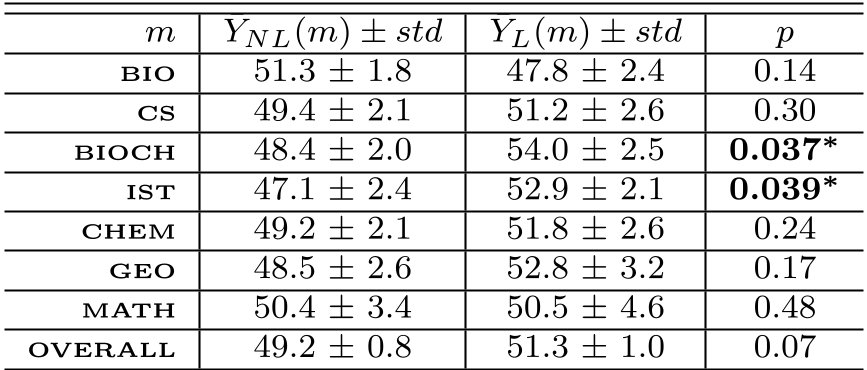
While LinkedIn members in IST and BIOCH showed a slight statistically significant increase in GPA, the overall population did not show a strong correlation. Talent exists both on and off the platform; LinkedIn is not necessarily a "filter" for the highest-performing students, but rather a reflection of professional intent.
Key Insight 3: Stability Over Time and Gender
Surprisingly, the study found that LinkedIn participation is remarkably stable across graduation years (from 2002 to 2014) and showed no broad gender bias. This is good news for researchers: it suggests that LinkedIn is equally representative of various age cohorts and genders within the professional STEM workforce.
Critical Analysis & Conclusion
This paper serves as a vital cautionary tale for data scientists. The core contribution is the identification of Major Bias.
Limitations:
- The data is from 2015; LinkedIn's penetration has likely increased since then.
- The study is limited to STEM fields; the bias might be even more pronounced in trades or creative arts.
The Takeaway: If you are building a recruitment AI or a professional trend model, you cannot treat a "Biology" profile and a "Computer Science" profile as equally representative samples of their respective fields. To avoid "Invisibility Bias," we must normalize our data against the real-population participation rates identified in studies like this.