
Sampling the Giants: Why We Can't Get an Unbiased View of Twitter
10431_Sampling online social networks an experimental study of twitter.
This paper presents an experimental study of popular sampling techniques—Breadth-First Search (BFS), Random Walk (RW), and Unbiased Sampling for Directed Social Graphs (USDSG)—applied to a massive 2012 Twitter dataset (505M nodes, 23B arcs). It evaluates their effectiveness in discovering popular users versus obtaining an unbiased representation of the overall user distribution.
TL;DR
Using a massive 2012 dataset of 505 million Twitter users, this study reveals that standard graph traversal techniques (BFS, Random Walk) are heavily biased toward popular users. While this makes them great for "influencer hunting," it makes them dangerous for researchers seeking a representative view of the average user. Even methods claimed to be "unbiased" fail on real-world directed social graphs.
Background Positioning
In the landscape of social network analysis, this work serves as a critical empirical reality check. Published at SIGCOMM '14, it utilizes a rare "ground truth" (a full graph crawl) to expose the hidden biases in the sampling tools that thousands of sociologists and computer scientists use daily.
The Problem: The "Wall" of Large-Scale Data
As OSNs like Facebook and Twitter grew into the billions, full-scale crawling became impossible due to:
- API Restrictions: Authentication requirements and rate limits.
- Scale: Storing and processing 23 billion arcs is computationally expensive.
- Directed Complexity: Unlike Facebook's "friendship" (undirected), Twitter is "follow-based" (directed), which creates asymmetric flows that break traditional sampling logic.
Methodology: Testing the Traversal Heuristics
The authors tested three primary flavors of sampling across three directions (followers, followings, bidirectional):
- Breadth-First Search (BFS): The standard "crawler" approach.
- Random Walk (RW): Moving from node to node via random neighbors.
- USDSG: A modified random walk designed to counteract the degree-bias by discarding moves with specific probabilities.

Experimental Insights: Influencers vs. The Masses
1. The Power of the "Popularity Bias"
If your goal is to find the most famous people on Twitter, Random Walk is your best friend. The study found that RW is naturally "sucked into" high-degree hubs.
- Finding the Top 1,000: RW found all top 1,000 users after visiting only 0.06% of the total nodes.
- BFS Performance: Highly dependent on the "seed" (starting point). If you start near a popular user, BFS is fast; otherwise, it lags.
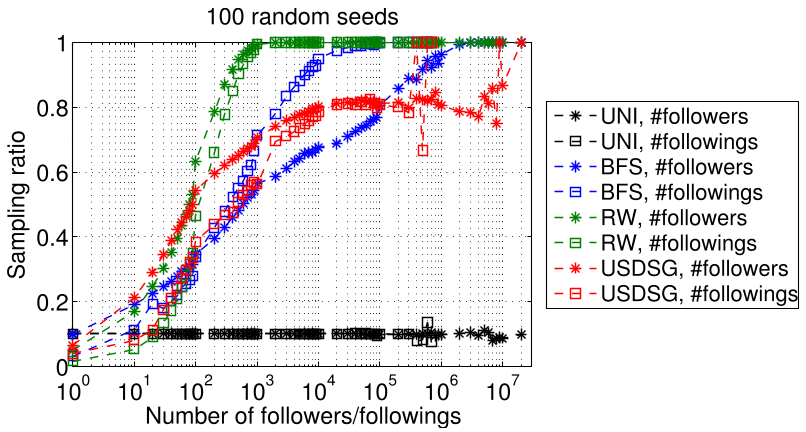
2. The Failure of "Unbiased" Sampling
The most striking result is found in Figure 2 (implied by text). When comparing the samples to a true Uniform Random Sample (UNI), all traversal methods over-represented high-degree nodes.
- The USDSG Paradox: Even though USDSG was designed to be unbiased, it still skewed toward high-degree nodes in the real Twitter graph.
- Interpretation: The "tightness" and structural clusters of a real directed graph are more complex than the theoretical models these algorithms were built on.
Critical Analysis & Conclusion
Takeaway
There is no "free lunch" in graph sampling. If you crawl a network by following links, you are statistically destined to find the "shouting" nodes (popular users) while missing the "silent" majority (low-degree nodes).
Limitations
The study relies on 2012 data. Modern Twitter (X) has evolved significantly in terms of bot density and private accounts, which would likely further complicate these sampling traversals. Furthermore, the study suggests that Random ID Generation is the only way to get a true unbiased sample, yet platforms are increasingly masking IDs to prevent exactly this.
Future Outlook
For future research, the industry needs "topology-aware" sampling—algorithms that don't just walk blindly but understand the macroscopic anatomy of directed graphs to correct for local clustering and "hub-traps."
More technical details can be found on the soTweet Project Page.