
SANA-WM: Revolutionizing Minute-Scale World Modeling with Hybrid Linear DiT
SANA-WM: Efficient Minute-Scale World Modeling with Hybrid Linear Diffusion Transformer
SANA-WM is a 2.6B-parameter open-source world model developed by NVIDIA for high-fidelity, minute-scale 720p video generation with precise 6-DoF camera control. It utilizes a Hybrid Linear Diffusion Transformer (DiT) architecture, achieving visual quality comparable to industrial baselines (like LingBot-World) while maintaining high efficiency, enabling 60s video generation on a single GPU.
Executive Summary
World models are the "engines" of the next generation of AI, providing simulated environments for embodied agents and robotics. However, generating high-resolution (720p), long-duration (60s+) videos with precise physical control has historically been the domain of tech giants with thousands of GPUs.
SANA-WM (SANA World Model), a 2.6B parameter model from NVIDIA, disrupts this status quo. By shifting from standard "heavy" Transformers to a Hybrid Linear Diffusion Transformer, SANA-WM achieves industrial-grade quality while being remarkably efficient: it trains in two weeks on 64 GPUs and runs inference on a single RTX 5090.
The Problem: The Complexity Wall
Generating a one-minute 720p video involves processing an immense number of tokens. Standard Softmax Attention has a quadratic cost (), meaning that as the video gets longer, the memory required explodes.
Existing solutions often resort to:
- Autoregressive (AR) Rollouts: Generating short chunks, but these "drift" over time, losing scene identity.
- Massive Scaling: Using 10B+ parameter models, which makes them inaccessible to most researchers.
Methodology: The Architecture of Efficiency
The "secret sauce" of SANA-WM lies in its three-pronged approach to architecture and data.
1. Hybrid Linear Attention (GDN + Softmax)
Instead of using pure Softmax attention, SANA-WM uses Gated DeltaNet (GDN) blocks. GDN treats the video generation like a recurrence (an RNN-like state), keeping memory constant regardless of the video length. To prevent the "forgetting" typical of RNNs, the authors interleave every fourth block with a standard Softmax attention layer to act as an "anchor" for long-range spatial memory.
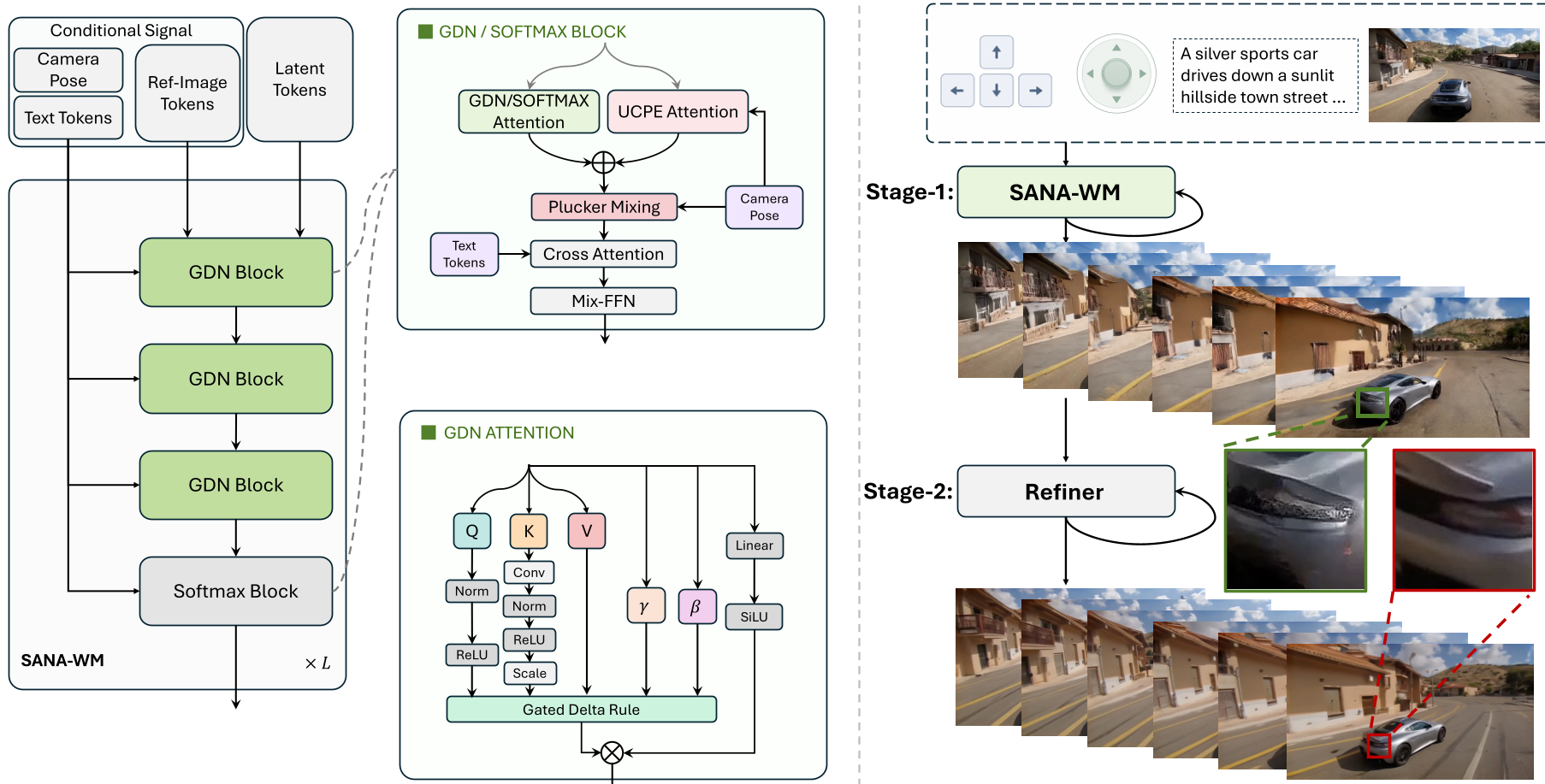
2. Dual-Branch Camera Control
Controlling a camera in 3D space (6-DoF) is hard at high compression. SANA-WM uses a Coarse-to-Fine strategy:
- Coarse Branch: Uses UCPE (Unified Camera Positional Encoding) to handle the global "path" of the camera.
- Fine Branch: Uses Plücker Mixing, embedding raw-frame raymaps into the model to capture micro-jitter and precise rotations within each video stride.
3. The Two-Stage Refiner
The first stage focuses on the "structure" of the world and motion. A second, dedicated Long-Video Refiner then "paints" high-fidelity details over the sequence. This decoupled approach allows the base model to focus on temporal logic while the refiner handles visual "crunchiness."
Experiments: Breaking Records on a Budget
SANA-WM was evaluated on a new 60-second benchmark. It outperformed industrial-scale models in Action Following (how well the video follows the designated camera path).
| Metric | SANA-WM (720p) | LingBot-World (480p) | HY-WorldPlay (480p) |
|---|---|---|---|
| GPU Requirement | 1 H100 | 8 H100 | 8 H100 |
| Throughput (vids/hr) | 22.0 | 0.6 | 1.1 |
| Rotational Err (↓) | 4.50° | 10.47° | 17.89° |

Deep Insights & Takeaways
Why does this work? Primary credit goes to the Algebraic Stabilization of the GDN. Standard linear attention often suffers from "spatial explosion" where feature values grow out of control. SANA-WM introduces a specific key-scaling mechanism () that ensures the recurrent transition remains non-expansive, providing the stability needed for 1,000-frame generations.
The Takeaway: SANA-WM proves that you don't need a 100B parameter model to simulate the world. By combining efficient sequence modeling (GDN) with geometric priors (Plücker/UCPE), we can achieve accessible, high-performance world modeling. This is a massive win for the Open Source community and Embodied AI researchers.
Limitations: While efficient, the model still relies on a "refiner" for the highest quality, and extremely dynamic scenes (many moving objects) can still cause some structural drift.