
SANA-WM: Revolutionizing Minute-Scale World Modeling on a Single GPU
SANA-WM: Efficient Minute-Scale World Modeling with Hybrid Linear Diffusion Transformer
SANA-WM is an open-source 2.6B-parameter video world model capable of generating high-fidelity, 720p, minute-scale videos with precise 6-DoF camera control. It utilizes a Hybrid Linear Diffusion Transformer (GDN + Softmax) and a two-stage refinement pipeline, achieving SOTA action-following accuracy and visual quality with significantly lower training (15 days on 64 H100s) and inference costs.
The quest for a "World Model"—an AI that can simulate consistent, interactive environments—has long been a playground for industrial giants with thousands of GPUs. However, NVIDIA's latest release, SANA-WM, challenges this status quo. By synthesizing 720p, minute-long videos with precise 6-DoF (6 Degrees of Freedom) camera control on a single RTX 5090, SANA-WM brings high-fidelity simulation from the data center to the desktop.
TL;DR
SANA-WM is a 2.6B world model designed for efficiency. It solves the twin problems of computational cost and long-term drift. By combining a hybrid linear DiT (Diffusion Transformer) with a robust camera-control branch, it achieves industry-leading action-following accuracy and visual quality while being 36 times faster than previous architectures.
The Core Problem: The Memory Wall and Temporal Drift
Modeling a full minute of 720p video involves millions of tokens. Standard Softmax Attention hits a "memory wall" because its cost grows quadratically with video length. Meanwhile, purely linear or recurrent models often suffer from "forgetting," where the scene collapses or morphs into something unrecognizable after 30 seconds.
Furthermore, most open-source models struggle with Metric-Scale Control. They might understand "pan left," but they lack the precision required for robotics or embodied AI, where specific 3D coordinates (6-DoF) are essential.
Methodology: The Architecture of Efficiency
SANA-WM’s breakthrough lies in its Hybrid Linear Diffusion Transformer.
1. Hybrid Linear Attention (GDN + Softmax)
Instead of relying solely on expensive Softmax attention, authors use Gated DeltaNet (GDN). GDN utilizes a recurrent state that stays constant in size regardless of video length, acting like a high-speed "memory" that updates frame-by-frame. To prevent the drift common in recurrent models, they interleave a standard Softmax block every four layers to "anchor" the global spatial features.
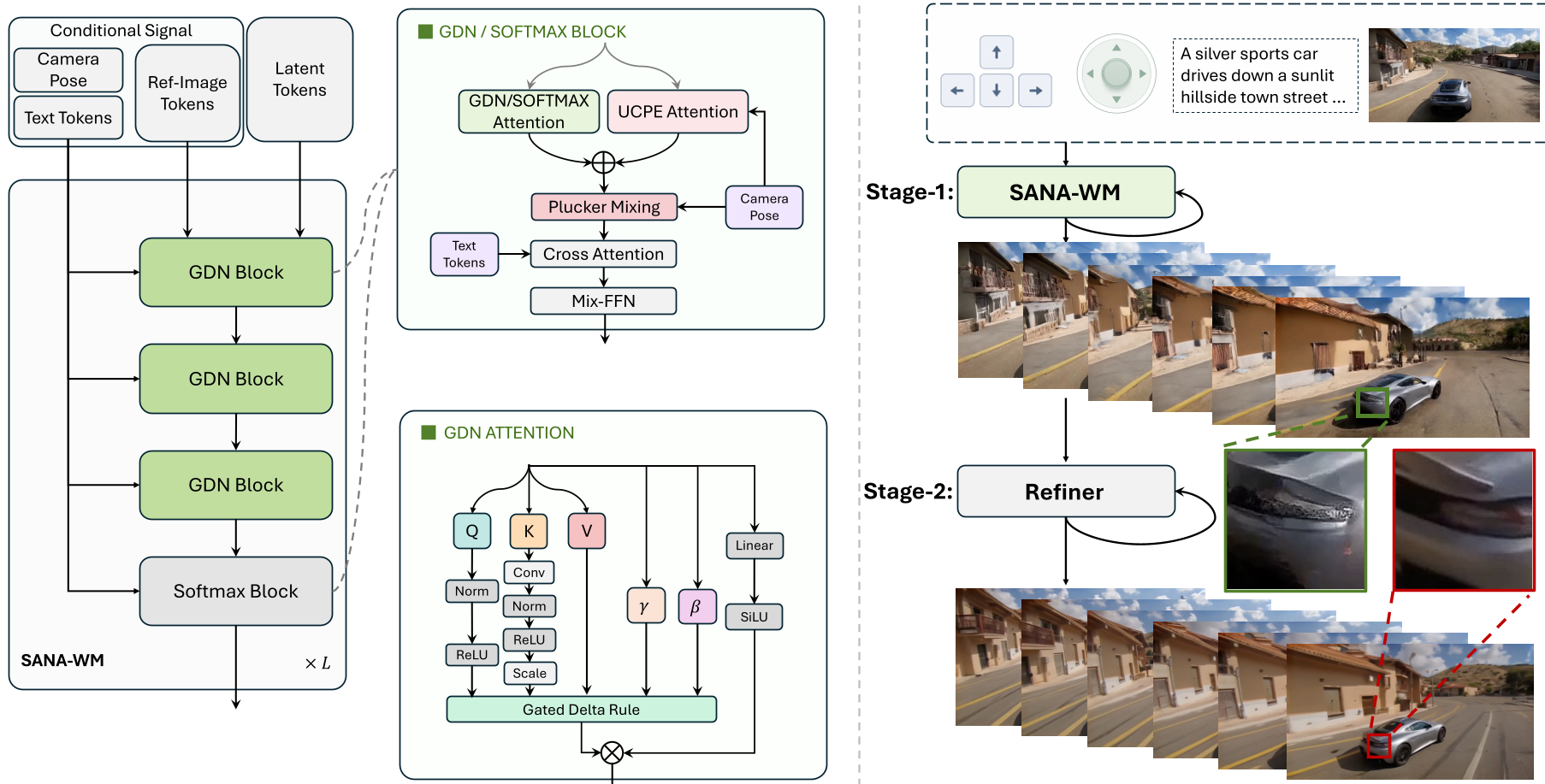 Figure 1: The SANA-WM backbone. Notice the alternating GDN and Softmax blocks alongside the geometry-aware UCPE branches.
2. Dual-Branch Camera Control
To ensure the video follows a specific path, SANA-WM uses two distinct layers of control:
- Coarse Branch (UCPE): Captures the global 6-DoF trajectory using Relative Positional Encoding.
- Fine Branch (Plücker Mixing): Operates inside each VAE temporal stride to compensate for micro-motions that the latent compressor might otherwise blur.
Experimental Results: SOTA on a Single GPU
The performance stats are staggering. SANA-WM doesn't just match industrial baselines like LingBot-World; it often exceeds them in Action-Following Accuracy.
| Metric | LingBot-World (14B) | SANA-WM (2.6B) |
|---|---|---|
| Throughput (Videos/hr) | 0.6 | 22.0 |
| GPU Req. | 8x H100 | 1x H100 / RTX 5090 |
| Rotation Error (↓) | 10.47° | 4.50° |
Visual Persistence and Revisit Memory
One of the hardest tasks for a world model is "revisiting"—returning to a previously seen spot and seeing the same objects. SANA-WM’s Second-Stage Refiner fixes the artifacts generated by the base model, ensuring that the scene remains consistent even after a full minute of complex maneuvering.
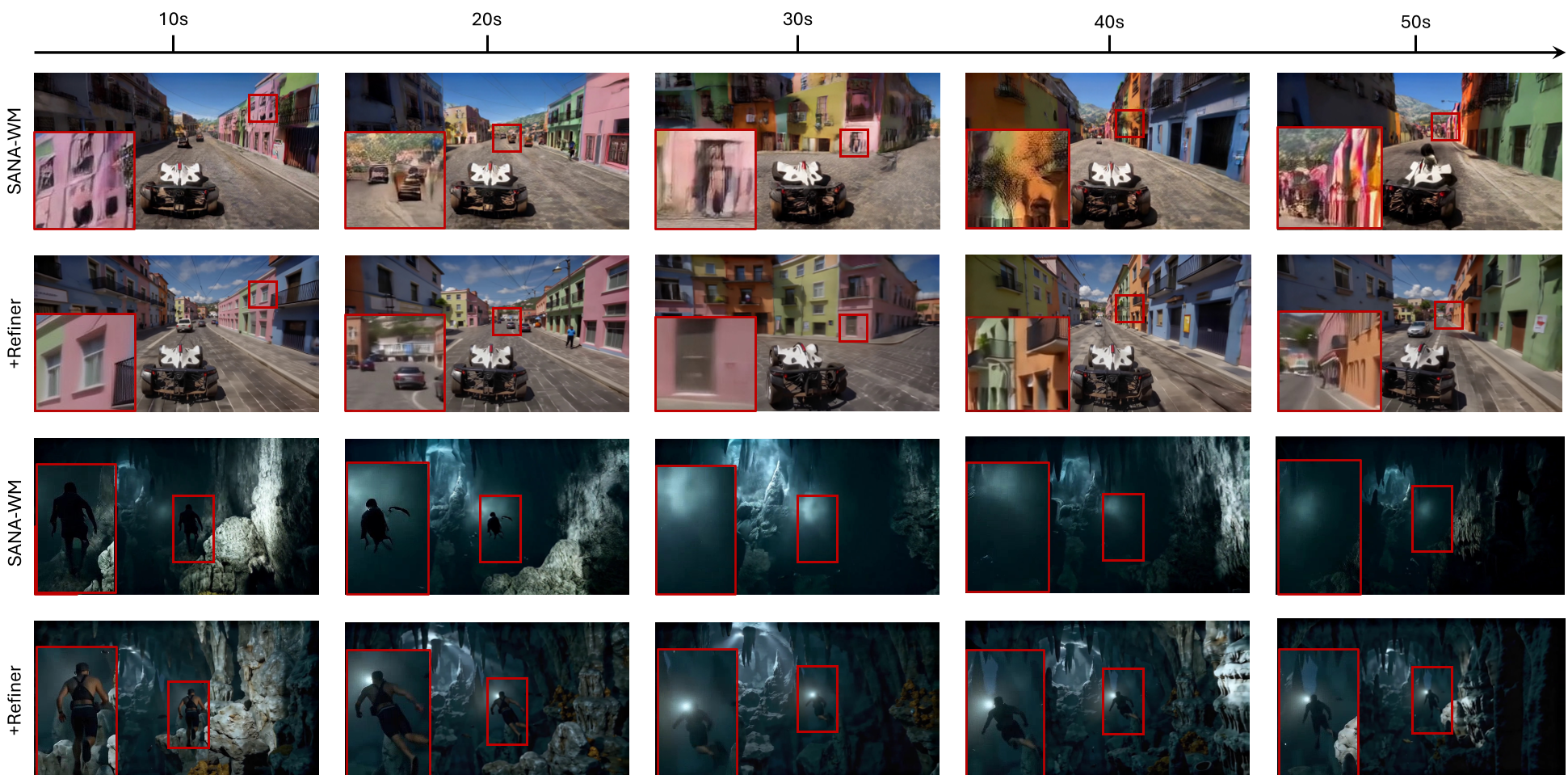 Figure 2: The Refiner in action. Red boxes highlight how the refiner sharpens structures and maintains identity over 50+ seconds.
Critical Insight: Why This Matters
The real value of SANA-WM isn't just the 720p resolution; it's the democratization of world modeling.
- Metric-Scale Data: By providing a robust annotation pipeline to extract true 3D poses from public videos, the authors have solved the "data poverty" issue in camera-controlled video generation.
- Edge Compute Potential: Deployment on an RTX 5090 using NVFP4 (4-bit floating point) quantization suggests that real-time interactive simulation is just around the corner.
Limitations
While highly efficient, SANA-WM still lacks explicit 3D memory (like a voxel grid). In extremely complex or dynamic scenes with multiple moving agents, it can still drift. However, as a foundation for embodied AI, it sets a new standard for performance-per-watt.
Conclusion
SANA-WM proves that we don't need trillions of parameters to simulate the world. Through clever architectural hybridism and precise geometric conditioning, it provides a practical, open-source path toward long-horizon, interactive AI environments.
For those interested in building their own worlds, the SANA-WM weights and the robust annotation pipeline are available on GitHub.