
SAROS: Bridging the Gap Between Social Logic and Power Constraints in Opportunistic Networks
SAROS: A social-aware opportunistic forwarding simulator
SAROS is a social-aware opportunistic forwarding simulator developed in Visual C# specifically for evaluating heterogeneous networking environments. It bridges the gap between theoretical social-aware algorithms and realistic deployment constraints by integrating interest distributions, complex power consumption models, and diverse mobility traces.
TL;DR
SAROS (Social AwaRe Opportunistic Forwarding Simulator) is a purpose-built discrete-event simulator designed to solve the lack of realism in existing DTN (Delay Tolerant Network) tools. It integrates real-world human mobility traces, sophisticated battery models, and social interest vectors to provide a high-fidelity environment for testing opportunistic forwarding protocols.
Background & Motivation: The Reality of "Challenged" Networks
As mobile data demand skyrockets, infrastructure often fails to keep up, leading to the "bandwidth demand-supply gap." While opportunistic networking (using mobile devices as data carriers) offers a solution, evaluating these protocols is notoriously difficult.
The authors identify a critical flaw in current simulators like ONE or NS2: they often overlook the "human" element—interests and social ties—and the "hardware" element—battery life. A protocol that delivers 100% of messages is useless if it kills the user's phone battery in 30 minutes. SAROS was built to fix this.
Methodology: The Five Pillars of SAROS
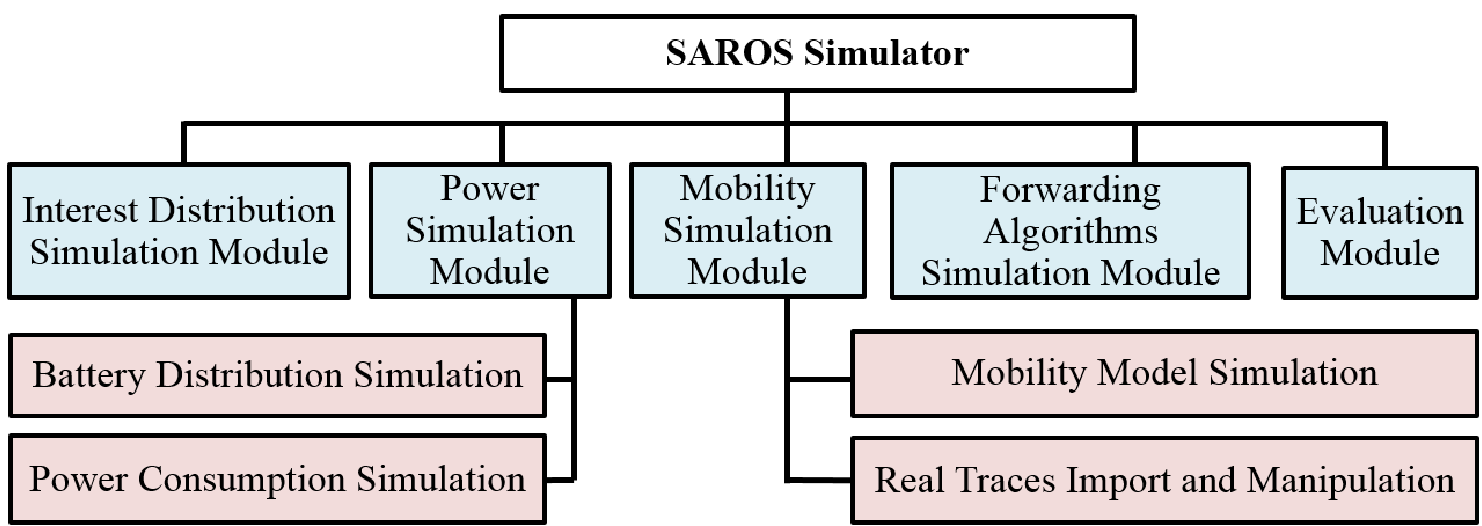
SAROS is built on a modular architecture that captures the complexity of real-world interactions:
1. The Modular Architecture
The system is divided into functional blocks that handle everything from how users move to how they decide to forward a packet.
2. Physical Realism: Power and Mobility
- Power Simulation: Unlike simple linear models, SAROS uses the Kinetic Battery Model (KiBaM), which accounts for the "recovery effect" of Li-ion batteries. It also imports usage profiles (Casual, Business, etc.) to simulate different levels of background battery drain.
- Mobility Traces: SAROS isn't limited to random walks. It imports real-world datasets from SIGCOMM09 and INFOCOM06, as well as shopping mall and university campus traces, capturing how humans actually congregate.
3. Human Realism: Interest and Social Graphs
SAROS allows researchers to define user interests. Are they interested in a specific session at a conference? Or a specific shop in a mall? This "Interest Awareness" is crucial for modern protocols like ProfileCast and SocialCast, which are pre-implemented in the simulator.
Experiments & Deep Insights
The true value of SAROS lies in its multidimensional evaluation. Instead of just looking at the "What" (Delivery Ratio), it looks at the "Efficiency" and "Social Effectiveness" of algorithms.
Performance Comparisons
The simulator tracks the cost vs. delivery ratio, helping researchers find the "sweet spot" where a protocol is effective without being spammy or energy-intensive.
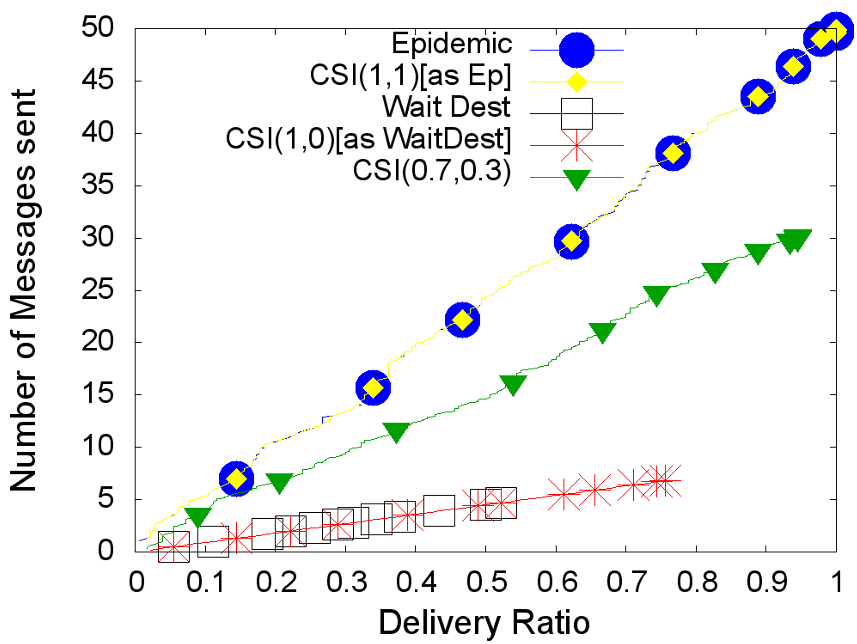
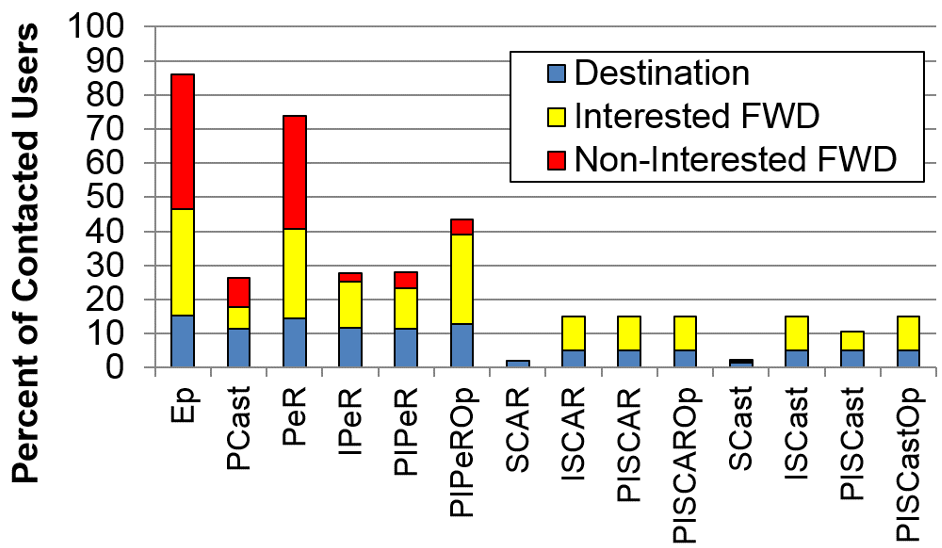
The authors also emphasize Interest-based Effectiveness. By analyzing the F-measure and the ratio of interested vs. uninterested forwarders, SAROS can determine if a protocol is actually reaching the right people.
Critical Analysis & Conclusion
SAROS represents a significant step forward for the DTN community. By providing a unified playground that includes Social Rank, Interest Similarity, and Battery Fairness, it forces researchers to design more sustainable and socially-intelligent algorithms.
Key Takeaways:
- Multidimensional Metrics: The use of Spider graphs to compare Fairness, Cost, and Delivery Ratio is a gold standard for future research.
- Validation: The simulator was validated against original SOTA papers (BubbleRap, PeopleRank), ensuring that its synthetic environments accurately reflect peer-reviewed results.
- Future Work: The authors plan to open-source SAROS, which could potentially make it the new benchmark for social-aware opportunistic network research.
Limitations: While SAROS includes diverse traces, it still relies on discrete-event simulation, which may not capture the fine-grained physical layer interference found in tools like NS3. However, for high-level social forwarding, it remains a superior choice.