
Designing Social Harmony: Dynamic AI for Collaborative Environmental Games
“Let's save resources!”: A dynamic, collaborative AI for a multiplayer environmental awareness game
This paper presents a collaborative AI module designed for a robotic tutor in "EnerCities," a multiplayer serious game focused on environmental sustainability. The system utilizes a search-based action planner and social modeling to enable the robot to play effectively alongside humans while providing pedagogical guidance.
TL;DR
Researchers have developed a sophisticated AI module for a robotic tutor designed to play the environmental awareness game EnerCities. Unlike standard game AI that seeks to "win" at any cost, this module uses dynamic strategy vectors and social imitation to collaborate with human players, balancing ecological health with social alignment and pedagogical value.
Background: The Complexity of Collaboration
In the context of the EMOTE project, the goal isn't just to build a city; it's to teach children about the delicate trade-offs between economic growth and environmental preservation. The game EnerCities (EC) serves as the medium. However, converting it to a multiplayer version (MCEC) introduced a massive technical hurdle: how does an AI prioritize actions when there is no single "winning" number, and its partners are unpredictable humans?
The Problem: Beyond Simple Maximization
Most AI agents fail in collaborative serious games because they lack Inductive Bias toward social cooperation. In MCEC:
- High Search Complexity: With an average branching factor of 88.4 and depth of 23.8, the state space is roughly nodes—too large for exhaustive search in real-time.
- Conflicting Goals: Boosting the "Environment" score often drains "Money," requiring a delicate negotiation between roles (Mayor, Economist, Environmentalist).
- Human Factors: If the robot plays too perfectly or shifts the strategy away from the human group, the "empathic link" is broken.
Methodology: The Architecture of an Empathic Tutor
The authors proposed a multi-layered AI architecture that bridges the gap between raw game logic and social interaction.
1. The Strategy Vector ()
The core of the decision-making process is a weighted vector: This vector allows the AI to "value" different aspects (oil, wellbeing, money) dynamically. By changing these weights, the AI’s personality shifts from a "Greedy Capitalist" to a "Green Activist."
2. Action Planner with Forward Pruning
To handle the complexity, the team implemented a heuristic-based search. It performs a 1-depth look-ahead to find the most promising branches and then explores deeper using a forward pruning approach similar to an optimized MIN-MAX, but focused on collaborative gains rather than adversarial loss.
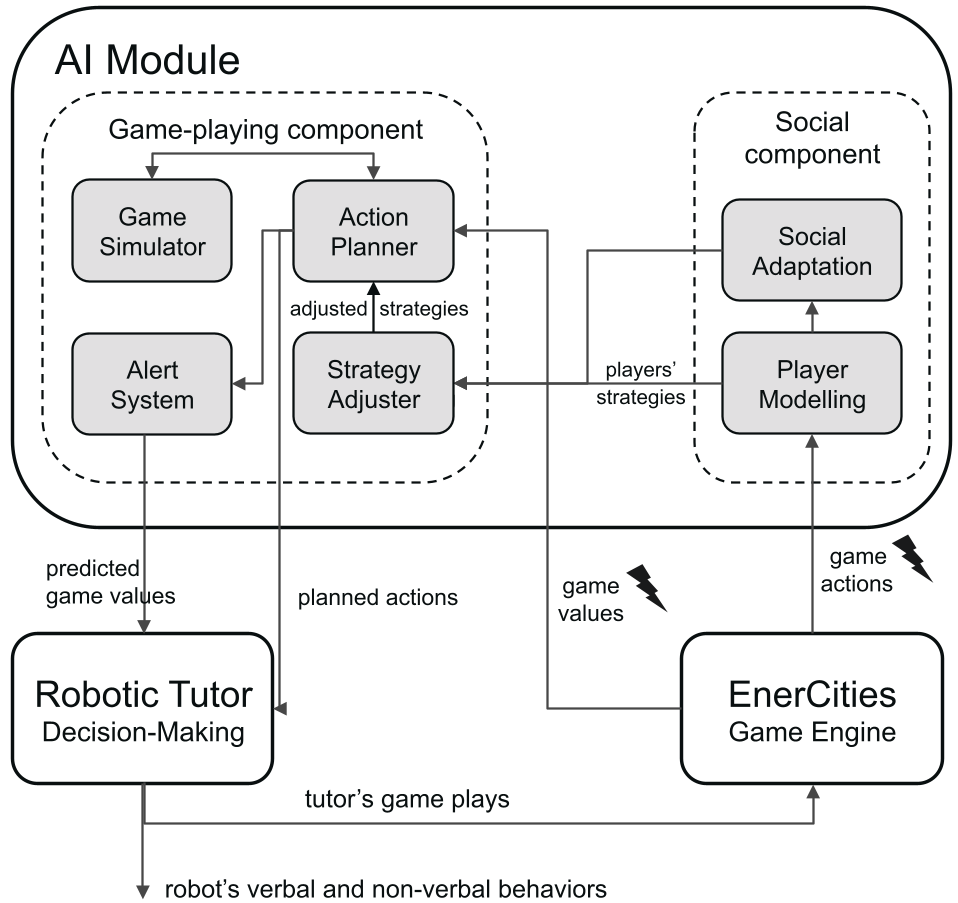 Fig 1: The architecture highlights the interaction between the Social Component (imitation) and the Game-playing components (planning).
3. Theory-of-Mind (ToM) & Social Imitation
This is the "secret sauce." The AI doesn't just plan its own moves; it models the humans. Using a learning rate , it estimates the human players' strategies based on their recent moves and then uses Social Adaptation to move its own strategy vector closer to the group's "action tendency."
Experiments: Performance & Adaptability
The module was tested across different profiles: Balanced, Life-Quality, Score-Greedy, and Spender.
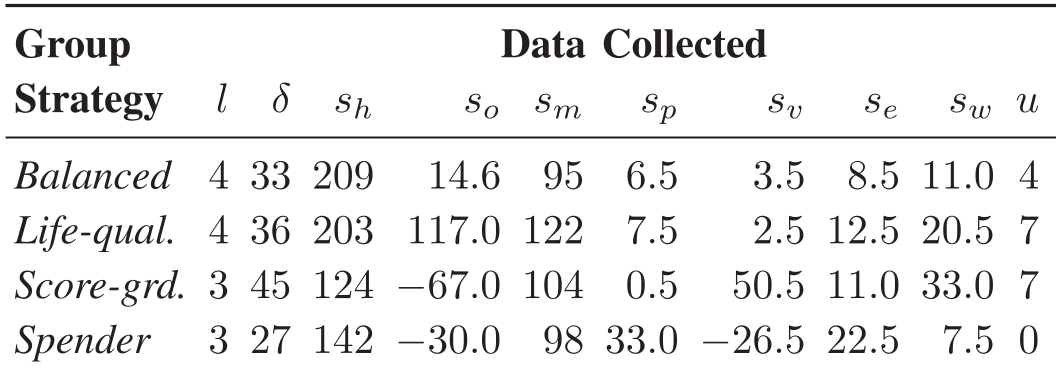 Table 1: Comparison of different strategy profiles and their impact on city health.
The results revealed a crucial insight: The "Life-Quality" strategy not only maintained sustainability but also outperformed others in long-term resource management (e.g., higher oil and money buffers). More importantly, in human interaction trials, the robot's ability to explain its reasoning based on these vectors significantly increased perceived "intelligence" and "aliveness."
Critical Analysis & Future Outlook
Takeaway
This research proves that "optimal play" in social settings is a moving target. The value of this AI module lies in its Self-Regulatory Mechanism—the ability to feel the "hormonal" pressure of a failing resource (like oil) and shift its strategy before a crisis occurs.
Limitations
- Heuristic Reliance: The 1-step look-ahead for human modeling assumes humans are also short-term maximizers, which isn't always true for strategic players.
- Fixed Parameters: The adjustment functions () are predefined; future work could make these learnable via Reinforcement Learning.
Conclusion
As we move toward a future of embodied AI assistants, moving past "winning the game" to "winning the partnership" is essential. The EMOTE project's robotic tutor provides a blueprint for how AI can use mathematical strategy vectors to simulate human-like empathy and collaboration.