
SCODA: Bridging Content and Structure for Scalable Community Outlier Detection
A Scalable Algorithm for Detecting Community Outliers in Social Networks
This paper introduces SCODA (Scalable Community Outlier Detection Algorithm), a novel framework for identifying "community outliers" in social networks by integrating node content and topological structure. It leverages a modified Squeezer algorithm for efficient clustering and proposes the Community Outlying Factor (COF) to quantify structural deviations relative to found communities.
TL;DR
Social networks present a unique challenge: an individual might look normal globally but appear highly anomalous within their specific social context. This paper introduces SCODA, an algorithm that detects these "Community Outliers" by first clustering nodes based on their attributes (Content) and then identifying those with strange connection patterns (Structure). It achieves SOTA F1-scores while maintaining Linear Scalability (), making it suitable for graphs with millions of nodes.
The "Rising Star" Problem: Why Global Detection Fails
Most outlier detection algorithms search for "loners"—nodes far from any cluster. But in social networks, the most interesting anomalies are often well-connected. Consider a "Rising Star": a young entrepreneur (low-income attributes) who primarily interacts with elite venture capitalists (high-income community).
To a global detector, this person looks like a normal low-income individual. To a structure-only detector, they look like a well-connected socialite. Only by coupling content and structure can we see the mismatch: Why does this specific person link so heavily outside their attribute-defined group?
Methodology: The Two-Phase Approach
Phase I: MSqueezer (Content Clustering)
The authors use an enhanced version of the Squeezer algorithm to group nodes. The brilliance here is the Dynamic Similarity Threshold (). Instead of asking the user to guess a threshold, SCODA uses Chebyshev’s Inequality to calculate on the fly based on the mean () and standard deviation () of existing clusters.
This ensures that the "context" (communities) is defined purely by the data distribution, reducing human bias.
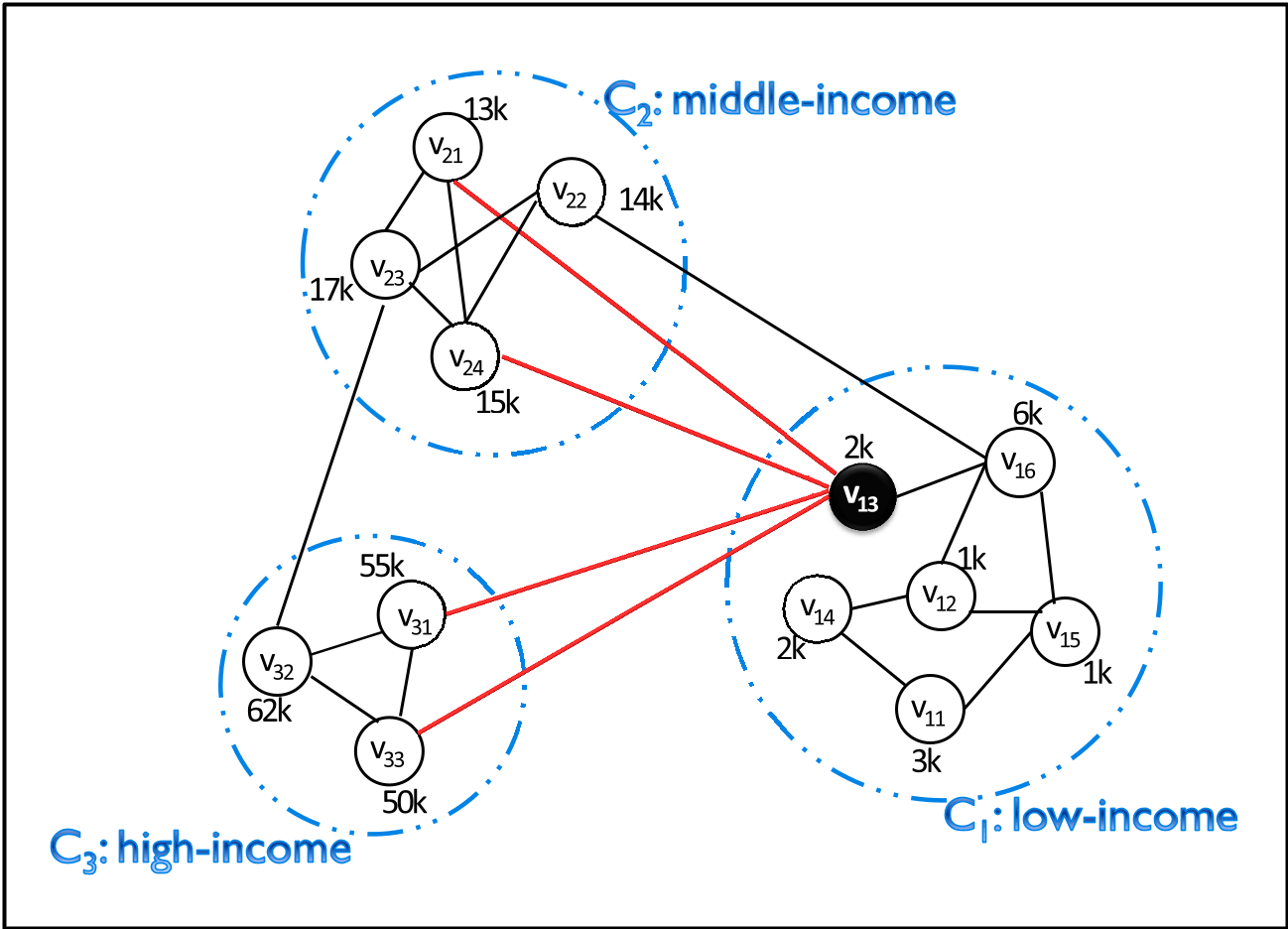 Figure 1: Node v13 is a community outlier—it belongs to the low-income group by attributes but links mostly to high-income groups.
Phase II: Community Outlying Factor (COF)
Once communities are formed, SCODA calculates the Community Outlying Factor (COF) for every node. The logic is simple yet powerful:
- Intra-link Density: How much do you talk to "your own kind"?
- Inter-link Density: How much do you talk to "outgroups"?
A high COF indicates a node that is "extroverted" toward other communities while being "introverted" or disconnected within its own attribute-based community.
Experimental Performance
The authors tested SCODA against CA (distance-based) and CODA (probabilistic HMRF).
- Accuracy: On synthetic datasets (SYN1/SYN2), SCODA achieved an F1-measure of 0.80 - 1.00, consistently outperforming the hidden Markov random field approach, which can get stuck in local optima.
- Scalability: This is SCODA’s "killer feature." While probabilistic models grow exponentially or quadratically with graph size, SCODA's processing time stays linear.
Note: The algorithm scales linearly, processing 400,000+ nodes in roughly 100 seconds.
Critical Insight & Conclusion
The core value of SCODA lies in its minimalism. By requiring only one parameter—the number of outliers —it eliminates the "parameter-tuning hell" common in graph mining.
Takeaway for Practitioners: If you are working with large-scale user data where you have both profile metadata and interaction logs, SCODA provides a robust template for finding "bridge-builders" or "contextual frauds" without the computational overhead of Deep Graph Neural Networks.
Limitations: The algorithm assumes that communities are primarily driven by content similarity. If a network has "hidden" communities that don't reflect in node attributes, the first phase of SCODA might create a misleading context for the second phase.