
Lexis Answers: Scaling AI for the High-Stakes World of Legal Question Answering
A scalable approach to legal question answering
Lexis Answers is a large-scale legal Question Answering (QA) system integrated into the Lexis Advance production platform. It utilizes a hybrid approach combining NLP pipelines, Rule-based systems, and Machine Learning to extract direct answers from proprietary legal corpora, specifically targeting legal definitions and elements of legal concepts.
TL;DR
Lexis Answers is a production-grade legal QA system that moves beyond simple keyword matching to deliver direct "Answer Cards" for complex legal queries. By combining a large-scale NLP pipeline with a deep legal ontology, the system achieved a 21% boost in search relevance (DCG) and provides a scalable framework for extracting legal definitions and concepts directly from proprietary case law.
Background: Beyond the Keyword Box
In legal research, the cost of a "miss" or a "hallucination" is exceptionally high. While the industry has long relied on keyword-based retrieval (Boolean search), the cognitive load on lawyers to sift through hundreds of documents is immense. Lexis Answers represents a shift toward Intent-Based Retrieval, where the system recognizes a legal question and provides a curated answer extract alongside traditional results.
The Core AI Challenges in Law
The paper identifies three primary hurdles that prevent standard QA models from working in a legal context:
- Contextual Irrelevance: Distinguishing substantive law from "reported speech" (e.g., a court quoting a rejected argument).
- Legal Disambiguation: Concepts like "Fraud" or "Negligence" change fundamentally depending on whether the context is Tort, Contract, or Criminal law.
- The Information Gap: Legal texts often omit the "burden of proof" or "responsible party" when it is implied by the document structure, requiring the AI to infer metadata that isn't explicitly in the sentence.
Methodology: The NLP Pipeline
The system doesn't just "read" text; it decomposes it. The Lexis Answers pipeline follows a structured path:
- Extraction: Zones of documents likely to contain definitions or elements are identified.
- Semantic Parsing: NLP tools convert raw text into structured semantic and syntactic data.
- Ontology Mapping: A proprietary legal information ontology clarifies the "legal purpose" of the text, ensuring the answer matches the specific jurisdiction and legal branch.
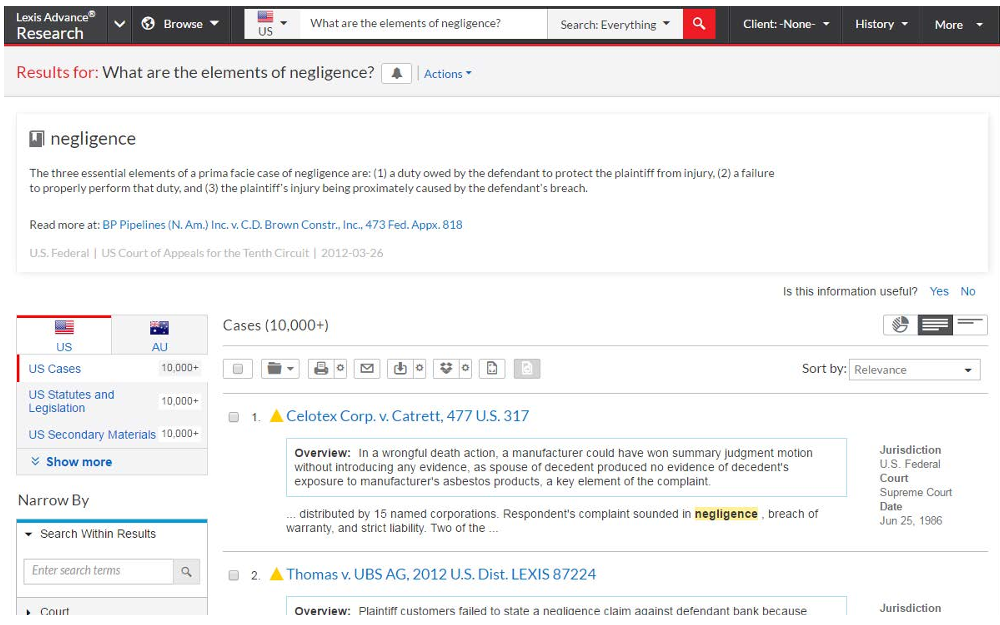 Figure 1: An answer card in Lexis Answers showing the elements of negligence extracted from case law.
Experiments & Results
LexisNexis eschewed standard automated metrics like BLEU or ROUGE in favor of Expert Annotation, which is the gold standard in legal tech.
- Human Evaluation: On a 4-point Likert scale (gauging accuracy, relevance, and thoroughness), the system scored 3.01, indicating high utility for professional use.
- Search Optimization: By re-ranking search results based on the identified intent, the system improved the Discounted Cumulative Gain (DCG) by 21%. This proves that understanding the "question" helps even when the user still wants to see the source documents.
Critical Analysis & Conclusion
The genius of the Lexis Answers approach lies in its hybridity. It acknowledges that while ML can scale, it requires the "guardrails" of expert-built taxonomies and controlled vocabularies to meet the rigorous standards of the legal profession.
Limitations: The current system focuses primarily on definitions and elements of concepts. It does not yet fully solve the "multi-concept" query problem where multiple legal relationships intersect.
Future Outlook: As we move toward more generative architectures, the structured pipeline established here provides the necessary "grounded truth" to prevent hallucinations in future LLM-based legal assistants.