
Beyond Static Graphs: OSNs as Complex Adaptive Systems
Understanding and modeling the complex dynamics of the online social networks: a scalable conceptual approach
This paper presents a scalable conceptual approach to modeling Online Social Networks (OSNs) as Complex Adaptive Systems (CAS). It synthesizes methods from network theory, statistical physics, and dynamical systems to capture the co-evolution of network topology and node states in socio-technical ecosystems.
TL;DR
Online Social Networks (OSNs) are not just graphs; they are living, breathing Complex Adaptive Systems (CAS). This review paper argues that to understand modern social dynamics, we must move past static snapshots and embrace Adaptive Networks—where what you believe and who you know evolve simultaneously through non-linear feedback loops.
The "Static" Fallacy in Social Modeling
Most prior research in social network analysis treats the underlying graph as a fixed stage upon which the "drama" of information diffusion plays out. However, the authors point out a critical flaw: in the digital age, the stage and the actors change each other in real-time. If you disagree with a friend's political post (node state change), you might unfollow them (topological change). This co-evolution means that social systems are rarely in equilibrium; they are stochastic, non-linear, and perpetually shifting.
Methodology: The Toolkit of Complexity
The paper synthesizes a "piecemeal" but rigorous framework using several high-level concepts:
1. Adaptive Network Dynamics
The core insight is the Adaptive Network, where the dynamics on the network (opinions) and the dynamics of the network (links) are inseparable.
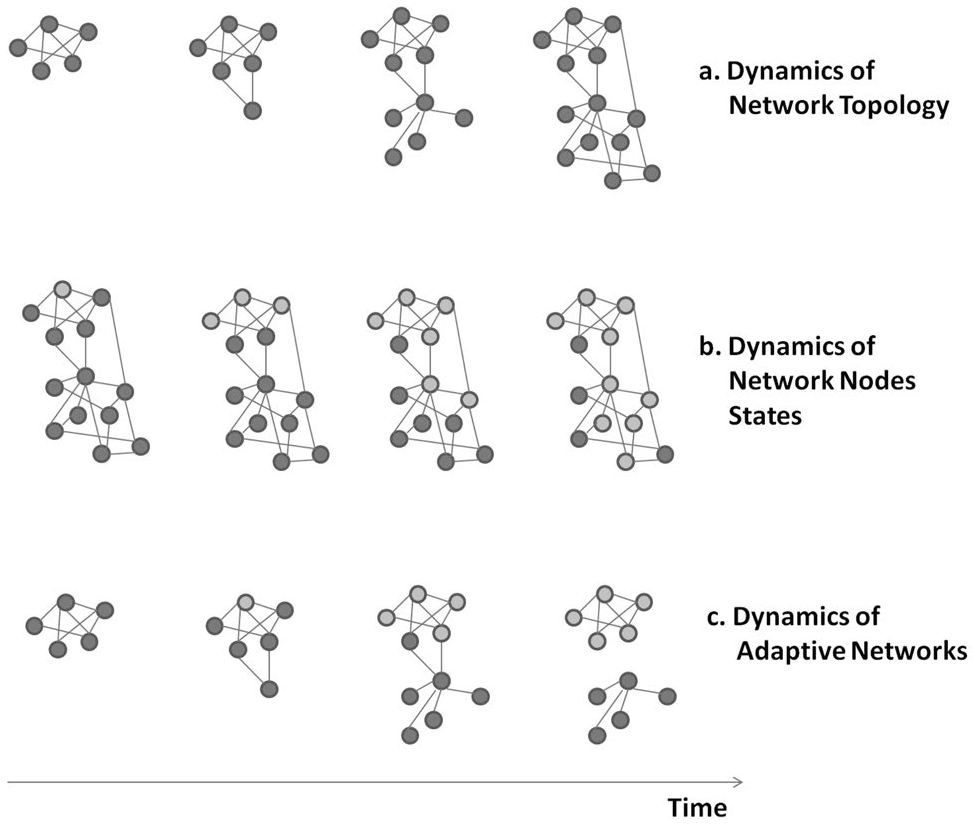 Figure: The feedback loop where network topology influences node states, which in turn rewires the topology.
2. The Mathematical Spectrum
The authors bridge the gap between deterministic and stochastic modeling:
- Deterministic ODEs: Useful for modeling "homophily" (the tendency to associate with similar others). If the attitudinal difference between users exceeds a certain "epsilon," the bond weakens.
- Stochastic Equations: Using Langevin and Fokker-Planck equations, the authors describe "Social Force" and "Social Contagion," treating the spread of an idea like the diffusion of a particle in a fluid.
- Neural Models: Surprisingly, the paper highlights the use of Integrate-and-Fire neurons to model decision-making—users "accumulate" social influence until they reach a threshold and "fire" a post or a like.
Experiments and Emergent Results
The paper showcases how these models move from theory to reality. In one example, the authors replicate a model of attitude formation where links represent coupling strength.
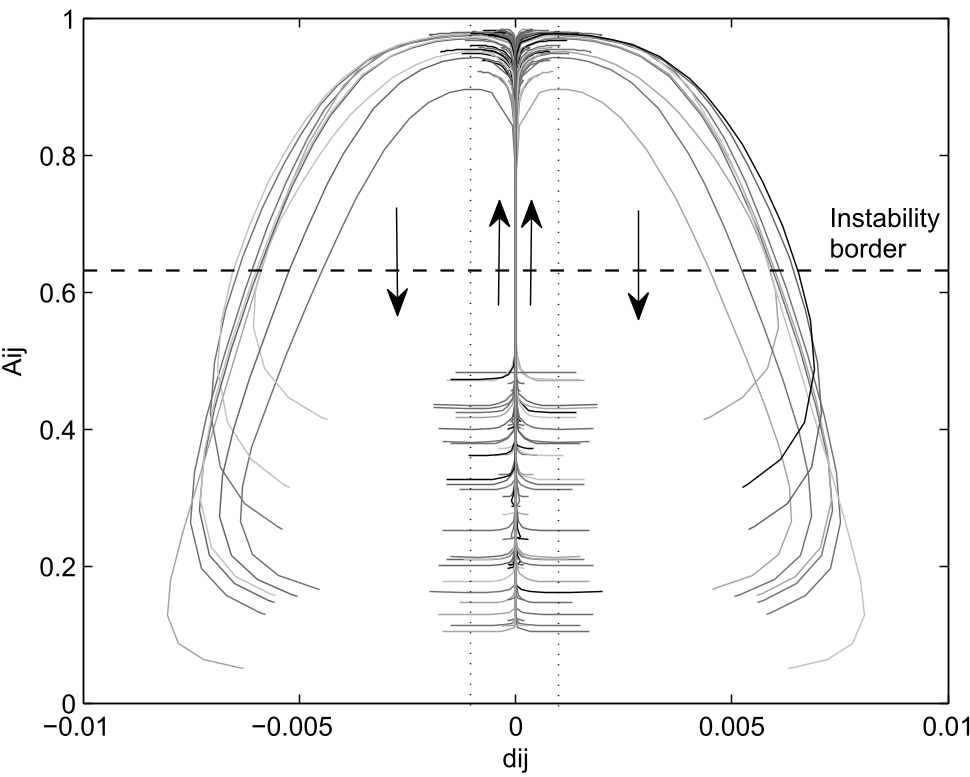 Figure: Evolution of attitudinal differences and coupling strengths. When agents become too different (d > ε), links weaken, driving the system into a cycle of instability and self-organization.
Furthermore, the paper references Molecular Models (like the Lennard-Jones potential) applied to e-mail networks. By treating individuals as "molecules," researchers can predict the structural evolution of professional communities with high accuracy.
Critical Insight: The Multilayer Challenge
A modern individual doesn't exist on just one network. We are part of Multilayer Networks—interacting on Twitter, LinkedIn, and offline simultaneously. The authors emphasize that information "leaks" across these layers, creating a supra-structure that traditional single-layer analysis cannot decode.
Conclusion and Future Outlook
This work serves as a manifesto for a Socio-technical approach to AI and data science.
- Self-Organization: Communities form without "masterminds."
- Emergence: Trends and collective "moods" (like market panics) are more than the sum of individual intentions.
The limitation remains the sheer computational cost of simulating millions of agents with high-fidelity behavioral rules. However, as we move toward 2026, the integration of real-time mobile data with these complexity-theoretic models offers our best chance at predicting the "invisible hand" of the digital world.