
FriendLink: Bridging Local Heuristics and Global Topology for Scalable Friend Recommendations
Scalable Link Prediction in Social Networks Based on Local Graph Characteristics
This paper introduces FriendLink, a scalable and efficient link prediction algorithm for Online Social Networks (OSNs) that utilizes bounded-length path traversal. By bridging the gap between local measures (like Common Neighbors) and global measures (like Katz or RWR), it achieves SOTA performance in friend recommendation accuracy on real-world datasets like Hi5 and Epinions.
TL;DR
In the era of massive Online Social Networks (OSNs), predicting "who will follow whom" is a multi-billion dollar problem. Most platforms rely on simple "Friend of a Friend" (FOAF) logic, which is fast but shallow. Conversely, global mathematical models are accurate but crash when faced with Facebook-scale data. FriendLink solves this by intelligently traversing paths of a specific, bounded length (up to 3-6 hops), capturing the "Small World" essence of social connectivity without the computational nightmare.
The Gap: Why Your "People You May Know" is Limited
Most recommendation engines suffer from two extremes:
- Local Myopia: Algorithms like Jaccard Coefficient or FOAF only look at common neighbors (length-2 paths). If you and a potential friend have no common friends but share several chains of length 3, you'll never see the recommendation.
- Global Paralysis: Methods like Katz Status Index or Random Walk with Restart (RWR) analyze the entire graph structure. While theoretically perfect, they require matrix inversions that are mathematically impossible to perform in real-time on graphs with millions of users.
FriendLink identifies the "Sweet Spot": leveraging the Small World Hypothesis which suggests most nodes are connected by short chains. By focusing on paths of length , we can capture deep social signals efficiently.
Methodology: The FriendLink Architecture
The core innovation of FriendLink is its ability to enumerate and weight paths of varying lengths without falling into the trap of infinite recursion or global matrix calculations.
1. Path Bounding & Concatenation
Instead of a full matrix inversion, FriendLink iteratively combines paths. It starts with the adjacency matrix and, for each step up to , concatenates paths to identify connections of increasing distance.
2. The Weighting Intuition: Attenuation Factors
Not all paths are created equal. A "friend of a friend" is a stronger signal than a "friend of a friend of a friend." The authors tested various attenuation factors and found that a simple decay (where is path length) provides the best balance for social relevance.
Note: The algorithm replaces standard matrix multiplication with a specific path-concatenation function and a similarity scoring mechanism based on path length and node count.
Quantitative Performance: High Precision, Low Latency
The authors evaluated FriendLink against two major benchmarks: Hi5 (63K nodes) and Epinions (49K nodes).
Accuracy (The "Small World" Advantage)
On the Epinions dataset, which exhibits strong small-world characteristics (high clustering, low average distance), FriendLink achieved a 55% precision for the top-ranked recommendation.
- Vs. Local: It crushed FOAF because it could "see" the length-3 bridges that FOAF misses.
- Vs. Global: It outperformed Katz and RWR because global models often "dilute" local signal with distant noise.
Efficiency & Scalability
FriendLink demonstrated a clear speed advantage over global methods:
- Hi5 Dataset: FriendLink (340s) vs. Katz (617s).
- Epinions Dataset: FriendLink (245s) vs. RWR (380s).
Illustration of Precision-Recall curves where FriendLink consistently sits at the "frontier" of performance.
Engineering for Scale: The MapReduce Vision
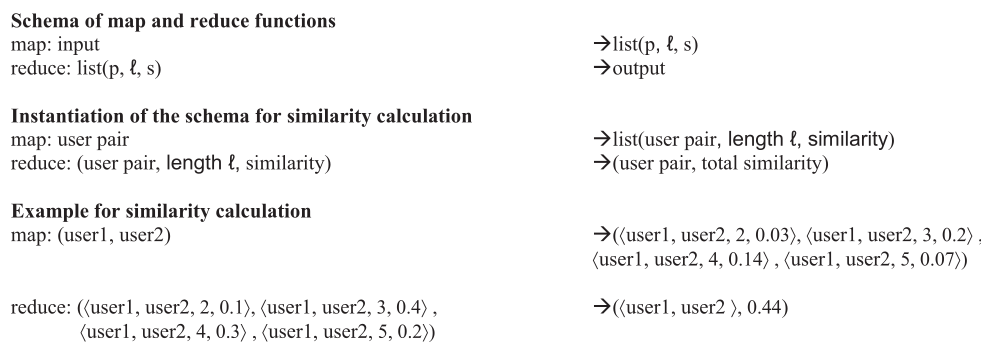
A key highlight of the paper is the proposal for a MapReduce implementation. In a distributed environment:
- Mapper: Machines calculate similarities for specific path lengths for pairs of users across different partitions of the graph.
- Reducer: Collects these partial scores and aggregates them into a final similarity score.
Critical Analysis & Conclusion
Takeaway: FriendLink proves that in social network analysis, "knowing your neighborhood" up to the 3rd or 4th degree is often more valuable—and significantly cheaper—than knowing the entire world.
Limitations:
- The current model assumes an unweighted graph for its primary evaluation; while weights can be added, the complexity of path enumeration increases.
- The computational cost still grows with (where is average degree). On extremely dense graphs, even might become heavy.
Future Outlook: The integration of temporal features (when was a link formed?) and content features (do they tag the same photos?) with FriendLink's structural traversal could define the next generation of hyper-accurate social recommenders.