
GEM: Overcoming the Scalability Wall in Social Network Clustering
Scalable and Memory-Efficient Clustering of Large-Scale Social Networks
The paper introduces GEM (Graph Extraction and weighted kernel k-Means), a scalable graph clustering algorithm designed for massive social networks. By extracting a representative skeleton graph based on high-degree vertices and applying an online weighted kernel k-means refinement, GEM achieves state-of-the-art results on networks with up to 50 million vertices.
TL;DR
Clustering massive social networks (10M+ nodes) is notoriously difficult for traditional multilevel algorithms like METIS. GEM (Graph Extraction and weighted kernel k-Means) breaks this bottleneck by replacing complex coarsening layers with a simple, high-degree "skeleton" extraction. It delivers better cluster quality, cuts memory usage significantly, and enables massive parallel scalability, processing a 50-million-node Twitter graph in a fraction of the time required by previous SOTA methods.
The "Power-Law" Trap in Multilevel Frameworks
For years, the gold standard for graph clustering has been the multilevel framework: Coarsen the graph via edge contraction, partition the tiny core, and project/refine back to the original. While effective for mesh-like graphs (e.g., finite element analysis), this approach fails on Social Networks due to their Power-Law degree distribution.
In social networks, most nodes have very low degrees and are connected to a few "super-hubs." During coarsening, once these hubs are merged, thousands of low-degree nodes are left "orphaned" with no unmarked neighbors to merge with. This leads to:
- Poor Reduction Ratios: The graph doesn't actually get much smaller.
- Memory Bloat: Storing multiple levels of massive, dense graphs consumes hundreds of gigabytes.
- Parallel Friction: Coordinating edge contractions across distributed processes requires heavy communication.
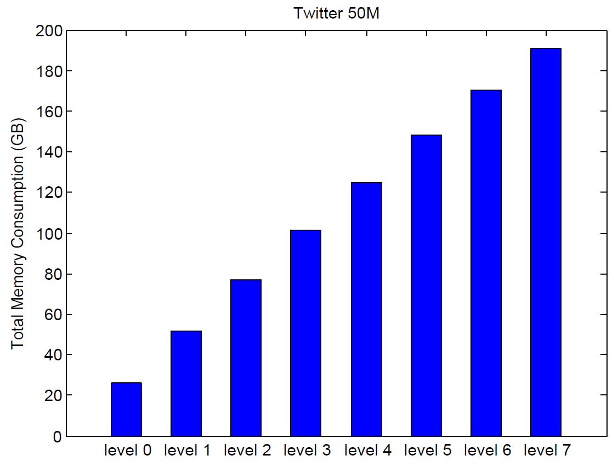 Figure 1: Traditional coarsening (Metis) fails to significantly reduce the graph size in social networks.
The GEM Intuition: Extract the Skeleton
Instead of merging nodes bottom-up, GEM works top-down based on the hierarchical nature of influence. If you cluster the "influencers" (high-degree nodes), you effectively capture the community structure of the entire network.
1. Graph Extraction
GEM identifies vertices with degrees above a threshold to form a skeleton graph. Experimental evidence (Figure 2 in the paper) shows that removing these high-degree nodes causes the network to collapse instantly, whereas removing random nodes has little effect. This proves that high-degree nodes are the "backbone" of connectivity.
2. Down-Path Walk Seeding
To initialize clusters, GEM avoids expensive distance calculations. It uses a Down-Path Walk: starting at a vertex and moving to lower-degree neighbors. This naturally lands the "seeds" in diverse, local regions of the hierarchy, ensuring clusters are well-separated from the start.
3. Online Weighted Kernel k-Means
Instead of batch updates (which often lead to empty clusters), GEM calculates the exact objective change for every vertex movement. By assigning a vertex to the cluster that yields the greatest decrease in the Normalized Cut objective, the algorithm ensures steady convergence and higher cluster quality.
Experimental Results: Speed and Efficiency
The authors tested GEM against METIS and Graclus on massive datasets, including a Twitter graph with 51 million vertices and 1.6 billion edges.
- Speed: On the Twitter 50M graph, GEM completed the task in 3 hours, while KMetis took 19 hours.
- Memory: GEM's memory footprint is a fraction of METIS's because it doesn't store a hierarchy of coarsened graphs; it only deals with the original and a 10% skeleton.
- Parallel Performance (PGEM): PGEM demonstrated near-linear or even super-linear speedup. On a 10M node graph, it reached a 150x speedup with 128 processes, whereas ParMetis plateaued at less than 10x.
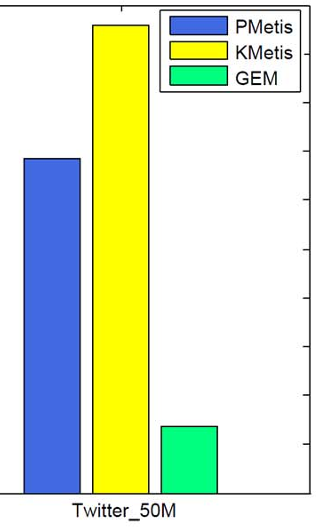 Figure 2: Running time comparison showing GEM's massive efficiency gains as graph size increases.
Critical Analysis & Conclusion
GEM’s success stems from its Theoretical Alignment with the physics of social networks. By acknowledging that not all nodes are created equal, it avoids the "merging" overhead of multilevel schemes.
Takeaways:
- Skeletonization > Coarsening: For power-law graphs, extracting a representative backbone is more efficient than iterative contraction.
- Online Local Search: Moving nodes based on delta-objective changes is superior to batch k-means for maintaining balanced, non-empty clusters.
Limitations: The 10% extraction threshold is a hyperparameter. While 10% works for today's social networks, highly sparse or differently structured graphs might require tuning. However, the framework remains a powerful alternative for anyone dealing with "billion-edge" network analysis.