
ContextMF: Decoding Why We 'Share' - Scaling Social Recommendations with Dual Context
SCALABLE RECOMMENDATION WITH SOCIAL CONTEXTUAL INFORMATION
The paper proposes ContextMF, a novel social recommendation framework based on probabilistic matrix factorization. It achieves SOTA performance by fusing two distinct social contextual factors—individual preference and interpersonal influence—into a unified latent space, significantly outperforming traditional collaborative filtering and recent social regularization methods.
TL;DR
Why do you retweet a post? Is it because the topic fascinates you, or because your favorite tech lead shared it? ContextMF argues it’s both. By integrating Individual Preference (content-driven) and Interpersonal Influence (sender-driven) into a scalable Matrix Factorization framework, this work achieves up to a 24% improvement in RMSE and introduces an incremental algorithm for real-time deployment on massive datasets like Renren and Twitter.
Problem & Motivation: The Complexity of Social Adoption
Traditional Recommender Systems (RS) often treat users as isolated islands, relying solely on historical ratings. Social Recommendation (SR) attempted to fix this by adding "friendship" links, but they often missed the why behind social actions.
The authors identify a critical gap: Social Contextual Information. In a social feed, your decision to adopt an item is a tug-of-war between:
- Individual Preference: Your intrinsic interest in the item's topic (e.g., you love Python coding).
- Interpersonal Influence: The social weight of the person who sent it to you (e.g., a close colleague vs. a random bot).
Previous SOTA methods like SoReg only constrained user features based on social neighbors, ignoring the specific content of items or the strength of specific interactions.
Methodology: The ContextMF Framework
The core innovation lies in treating "influence" not just as a static link, but as a latent variable that interacts with preference.
1. The Probabilistic Model
The authors factorize the user-item interaction matrix into a complex interplay of three latent matrices:
- (User Features): Capturing the latent interests of users.
- (Item Features): Capturing the latent properties of content (processed via LDA).
- (Influence Matrix): Quantifying how much user influences user .
The prediction is modeled as: Where is the item sender matrix and denotes the Hadamard (element-wise) product. This mathematically represents the intuition that an adoption happens only when both influence and preference align.
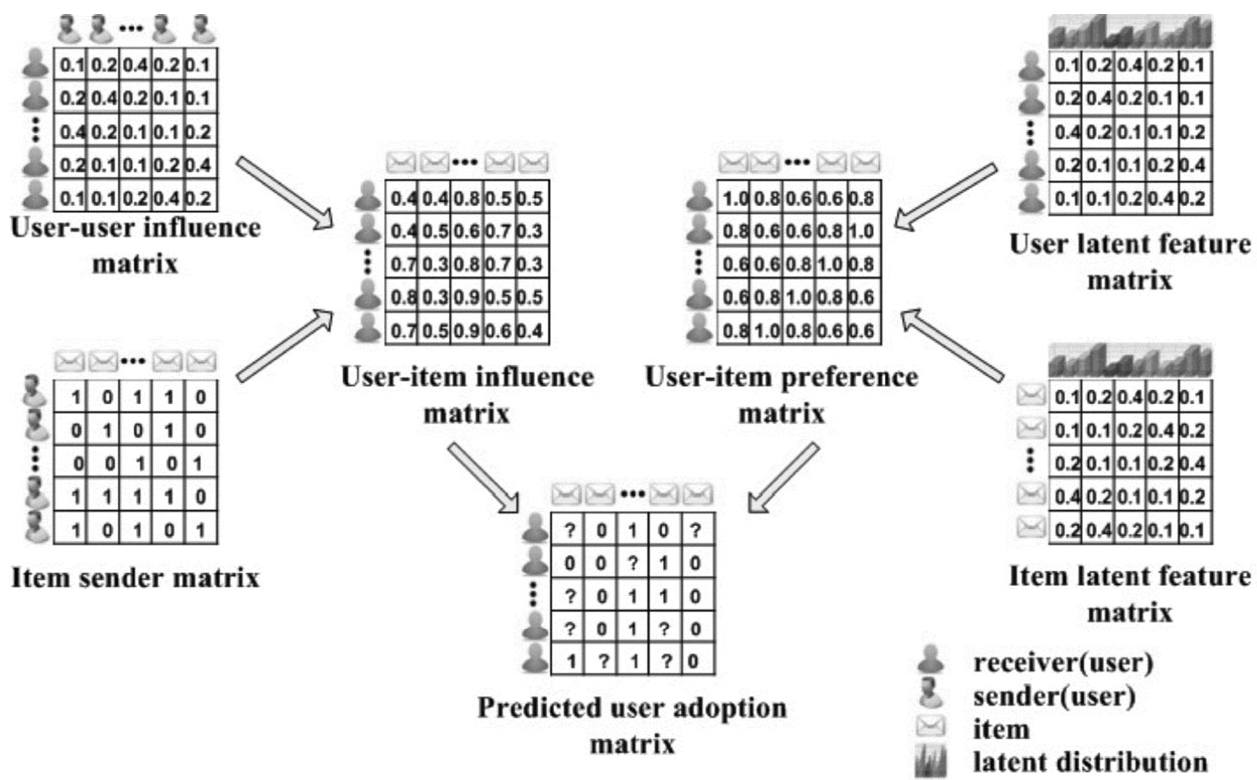 Fig 2: The ContextMF framework showing how Sender and Receiver interactions are fused with content preference.
2. Scalability through Incremental Updates (ΔContextMF)
Social networks are dynamic. Re-training a global matrix factorization model every time a new tweet is posted is computationally impossible. The authors propose ΔContextMF, an incremental algorithm that updates latent vectors for new users or items in linear time , avoiding the quadratic costs of traditional methods.
Experiments & Key Results
The model was tested against massive real-world datasets: Renren (Facebook-style) and Tencent Weibo (Twitter-style).
Performance Gains
ContextMF outperformed all baselines, including specialized social models like SoRec and SoReg.
- Accuracy: Reduced MAE and RMSE by roughly 20-25% over the best baseline.
- Ranking: Significantly higher NDCG and Precision@K, especially when is small (Top-5 recommendation).
 Table 4: ContextMF significantly dominates on all metrics, including the T-test for distinguish-ability between adopted and refused items.
The "Delta" Efficiency
In the incremental data experiments, ΔContextMF reduced processing time from 41.7 hours (for batch re-training) to just 1610 seconds for 10,000 new users, with only a negligible loss in accuracy (approx 2%). This makes it a viable solution for production-grade systems.
Critical Insight: The Complementary Effect
The most striking finding is the Pearson correlation analysis between Preference and Influence. The authors found that for 70% of users, the correlation was below 0.4. This proves that these two factors are complementary, not redundant. If you only model one, you miss more than half the social story.
Conclusion & Future Outlook
ContextMF demonstrates that "social" is not just a graph—it's a context of who is talking to whom about what. By bridging the gap between psychology (motivation) and engineering (matrix factorization), this work provides a blueprint for the next generation of social feeds.
Limitations: While powerful, the model relies on LDA for content distribution, which may be less effective than current Transformer-based embeddings (like BERT/RoBERTa). Future work could likely see ContextMF's dual-factor logic applied to deep neural architectures to capture even more nuanced social contexts.