
HoloMambaRec: Efficient Sequential Recommendation via Holographic Binding and Selective State Spaces
Scalable Sequential Recommendation under Latency and Memory Constraints
HoloMambaRec is a lightweight sequential recommendation architecture that integrates Holographic Reduced Representations (HRR) with Selective State Space Models (Mamba). It achieves state-of-the-art ranking performance on MovieLens-1M while maintaining linear time and memory complexity.
TL;DR
Traditional sequential recommenders face a "memory wall" where modeling long-term user history becomes computationally prohibitive. HoloMambaRec breaks this bottleneck by combining Holographic Reduced Representations (HRR) for compact metadata encoding and Selective State Space Models (Mamba) for linear-time sequence modeling. It delivers SOTA results on MovieLens-1M while maintaining a tiny memory footprint compared to Transformers.
The Scalability Bottleneck in Modern RecSys
In production environments, users interact with thousands of items over years. However, most models (like SASRec or BERT4Rec) truncate these histories to the last 50-100 events. Why? Because the Self-Attention mechanism has a quadratic complexity . Doubling the history length quadruples the compute cost.
While RNNs like GRU4Rec scale linearly, they suffer from "forgetting" over long sequences and are notoriously hard to parallelize during training. To solve this, the authors look toward a new frontier: State Space Models (SSMs).
Methodology: The Best of Both Worlds
HoloMambaRec introduces two major innovations to the recommendation pipeline:
1. Holographic Item-Attribute Binding
Instead of concatenating item embeddings with category/brand embeddings (which inflates the model size), HoloMambaRec uses Circular Convolution. This allows the model to "bind" metadata into the item vector without increasing its dimensionality.
The binding follows the identity:
This is implemented efficiently in the frequency domain using Fast Fourier Transforms (FFT), making the overhead nearly negligible.
2. Selective State Space Encoder
The core "brain" of the model is a Mamba-inspired Selective SSM. Unlike traditional SSMs that are time-invariant, this model uses input-dependent gates to decide what to remember and what to ignore. It provides the global receptive field of a Transformer with the efficiency of a Recurrent Neural Network.
 The SSM state update equation shows how the latent state is evolved using an adaptive step size .
Experimental Performance
The model was tested against two heavyweights: SASRec (Transformer) and GRU4Rec (RNN).
Key Results:
- MovieLens-1M: HoloMambaRec achieved a massive jump, outperforming SASRec by 27.8% in NDCG@10.
- Amazon Beauty: It remained competitive, trailing slightly behind GRU4Rec but still significantly more efficient than Transformers.
- Efficiency: The model uses a shallow 2-3 layer backbone, making it ideal for deployment on commodity GPUs (like the T4).
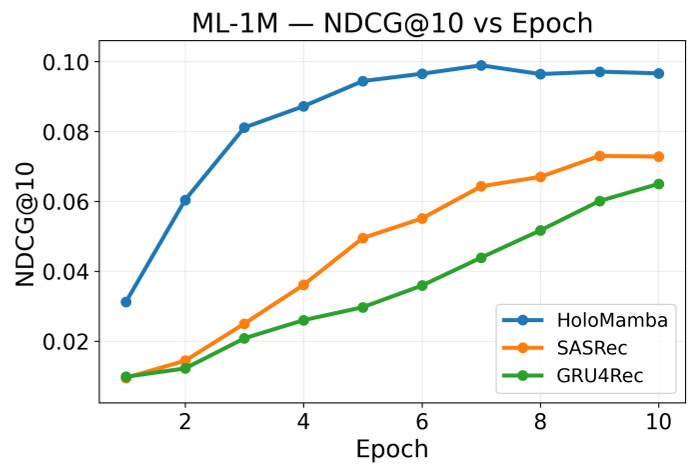 Learning curves demonstrate that HoloMambaRec converges faster and more stably than Transformer-based baselines.
The Optimization Paradox (Negative Result)
In a transparent move rare in academic publishing, the authors reported a negative result regarding "Temporal Bundling." While superimposing multiple interactions into a single vector improved latency (cutting it by ~75%), it caused a collapse in ranking accuracy. This highlights a critical challenge for the field: how to compress information without losing the fine-grained signals needed for high-precision ranking.
Critical Analysis & Conclusion
HoloMambaRec proves that we don't need massive Transformers for every recommendation task. By using Selective SSMs, we can achieve linear scaling without sacrificing the ability to model complex user dependencies.
Takeaways for Practitioners:
- Mamba is a viable SASRec replacement: If you are hitting memory limits with Transformers, Selective SSMs are the logical next step.
- Metadata Binding: Circular convolution is a clever trick to keep embedding tables small as you add more features (genre, brand, price bucket).
- Future Potential: While temporal compression didn't work out of the box, the architecture is now set up to explore "compressed-domain" recommendation.
HoloMambaRec stands as a practical, extensible framework for the next generation of scalable, metadata-aware recommendation engines.