
Graph Calculus: Navigating Billion-Node Social Graphs through the Core Net
Graph Calculus: Scalable Shortest Path Analytics for Large Social Graphs through Core Net
The paper introduces "Graph Calculus," a scalable framework for shortest-path analytics in massive social graphs using a "Core Net" architecture. By identifying Popular Nodes (high-degree) and Bridge Nodes (connectivity enhancers), the method approximates distances through triangulation while maintaining high accuracy and MapReduce scalability.
TL;DR
Calculating the shortest path in a social network with billions of edges is computationally prohibitive. This paper introduces Graph Calculus, a method that extracts a "Core Net" of popular and bridge nodes to serve as a high-speed backbone for distance estimation. It achieves orders-of-magnitude faster performance than state-of-the-art landmark methods with significantly higher accuracy.
Background: The Scalability Wall
In the era of Facebook and LinkedIn, the "Six Degrees of Separation" has actually shrunk to approximately four. However, finding these degrees for any arbitrary pair in a graph of nodes is a nightmare. Classic BFS (Breadth-First Search) is too slow for online queries, and global landmark methods suffer from massive pre-computation overhead.
The authors' intuition is simple: Social graphs are not uniform. Most paths naturally gravitate toward "popular" nodes (celebrities or hubs). By focusing computation on these hubs, we can approximate the rest of the graph effectively.
Methodology: Building the Core Net
The Core Net is constructed through a three-stage process:
- Popular Node (PN) Selection: Nodes with a degree higher than a threshold are selected.
- Bridge Node (BN) Inclusion: Since hubs aren't always directly connected, "Bridge Nodes" are added. These are non-popular nodes that act as the only link between two or more popular clusters.
- Core BFS: A full Breadth-First Search is performed only on the Core Net to create a distance matrix.
Architecture Overview
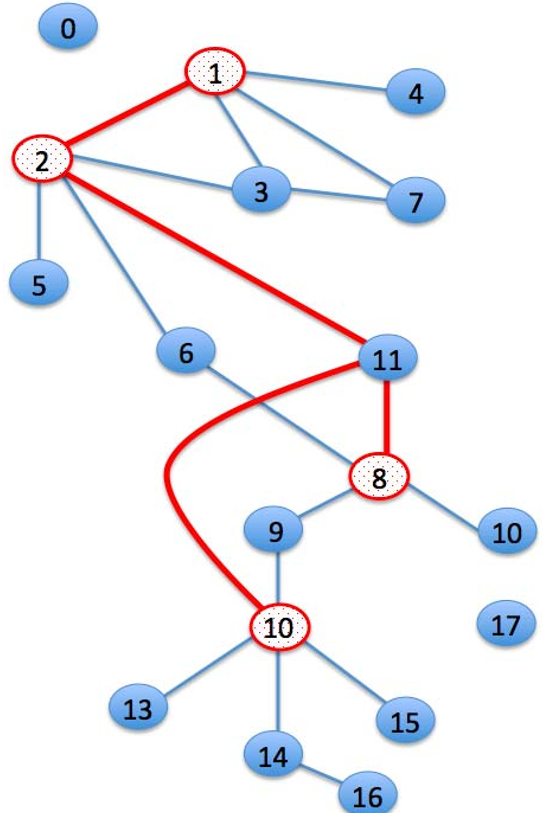 Figure 1: Illustration of a social graph highlighting popular nodes (red) and a bridge node (node 11) that maintains connectivity.
The "Calculus" Logic
The authors define Graph Calculus through a limit theory: as the degree threshold approaches zero, the Core Net converges to the original graph , and the estimated distance converges to the true shortest distance . This provides a formal framework for the trade-off between "computing cost" and "estimation precision."
Query Execution: Triangulation and Local Search
When a query arrives:
- Phase 1 (Local): The algorithm checks the 2-hop neighborhood of and . If the distance is , it returns an exact result.
- Phase 2 (Global): If no local path is found, it uses the Core Net distance matrix to find the shortest path going through hubs: where are in the Core Net.
Experimental Results
The authors tested their approach against Stanford SNAP datasets and a massive 61-million-node Facebook crawl.
- Efficiency: Core Net's offline construction time is a mere fraction of "Central" or "Constraint" landmark algorithms.
- Accuracy: In the 61M node test, Core Net's error rate was significantly lower (up to 10x better) than existing SOTA methods.
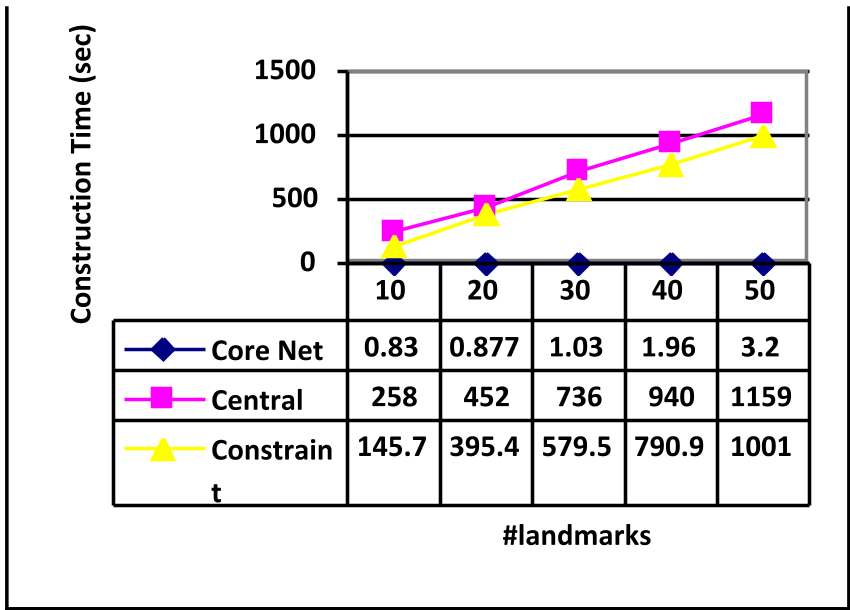 Figure 7: Offline construction time. Note how Core Net remains nearly flat compared to the exponential growth of competitors.
Critical Insight & Future Outlook
The brilliance of Graph Calculus lies in its MapReduce compatibility. Because the Core Net is exponentially smaller than the original graph, the distance matrix can fit into the memory of a single worker node, while the "local search" for neighbors can be distributed across the cluster.
Limitations: While the "miss rate" (cases where no path is found through the core) decreases as the core grows, it is not zero. Future work could involve more sophisticated bridge node selection or using machine learning to predict potential shortcuts outside the Core Net.
Conclusion: This work shifts the focus from "how to compress a graph" to "how to identify the graph's essential backbone," making billion-node analytics feasible even for organizations without supercomputing clusters.