
Scaling Social Recommendations: Why Apache Solr is More Than Just a Search Engine
Towards a scalable social recommender engine for online marketplaces: the case of apache solr
The paper presents a scalable social recommender engine for online marketplaces built on top of Apache Solr. It introduces a modular framework that integrates social interaction data (likes, comments, groups) with traditional Collaborative Filtering and Content-based algorithms, achieving SOTA real-time performance and 100% user coverage through a hybrid approach.
TL;DR
Building a recommender system that is both accurate and scalable is a notorious engineering challenge. This paper introduces a specialized social recommender engine built on Apache Solr, which doesn't just store data but actively generates recommendations. By treating "nearest neighbors" as a search query, the authors achieved 100% user coverage and sub-second response times even with massive social datasets.
The Gap Between Research and Production
Most academic papers focus on improving RMSE or Precision on static datasets. However, in the real world, developers face three major hurdles:
- Cold Start: New users or items with zero history.
- Scalability: Systems must handle thousands of queries per second.
- Real-time Updates: If a user buys an item now, their recommendations should update now, not after an overnight batch job.
Existing solutions like Hadoop are great for batch processing but fail at real-time updates. Relational databases (SQL) are excellent for transactions but terrible at the fuzzy matching required for content-based filtering.
Methodology: Recommendations as Information Retrieval
The core "Aha!" moment of this paper is the realization that Collaborative Filtering is essentially a search problem.
The Architecture
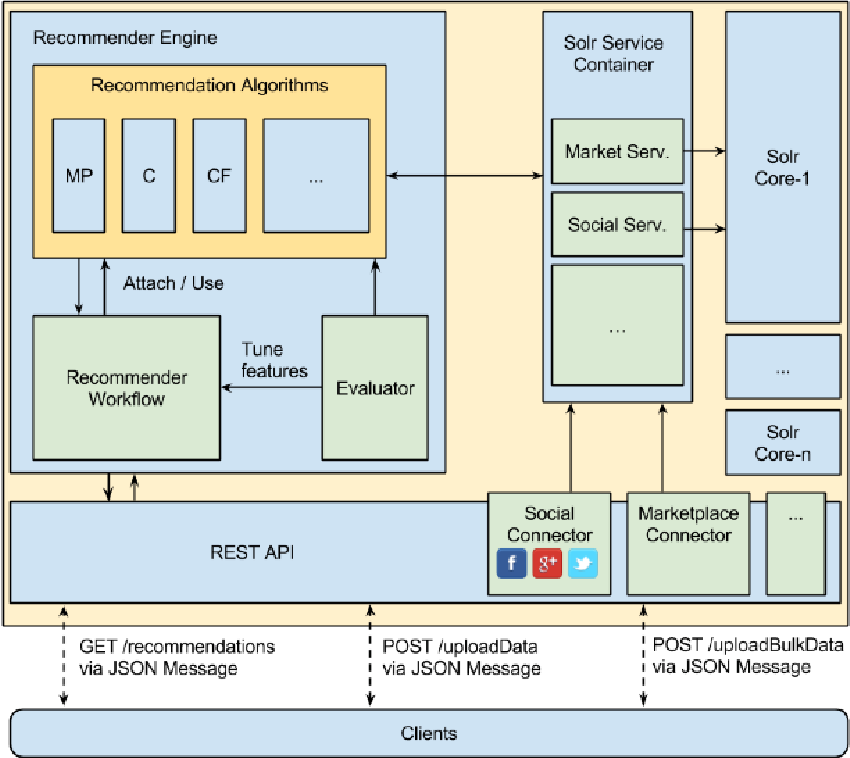
The framework (Figure 1) utilizes Solr Core as the backbone. It breaks down data into four shards: User profiles, Item profiles, User actions (purchases), and Social interactions (comments/likes).
How it Works:
- Collaborative Filtering (CF): Instead of complex matrix math, the system uses Solr's facet queries. To find items for User A, it finds "users who bought what User A bought" by querying existing purchase indices—effectively finding neighbors in the latent space through indexed lookups.
- Content-Based (CB): Using the built-in
MoreLikeThisfunction, the system matches item titles and descriptions using TF-IDF logic. - Social Integration: The authors integrated "Social Likes" and "Comments" as similarity features. If User A and User B both "loved" the same status update in a virtual world (SecondLife), they are treated as neighbors.
Performance and Results
The authors tested their system using a unique dataset from SecondLife, containing over 265,000 purchases and 1.8 million social interactions.
Accuracy vs. Coverage
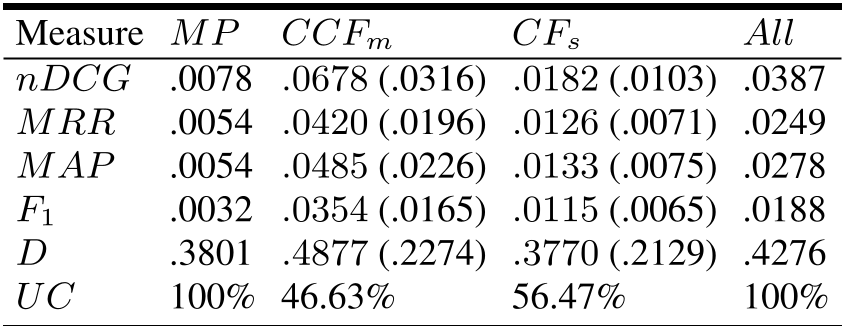
The hybrid approach (All) outperformed standalone methods. While social interactions (CFin) were highly accurate for specific users, they suffered from low coverage. By combining them into a hybrid model, the authors achieved 100% User Coverage.
Stress Testing
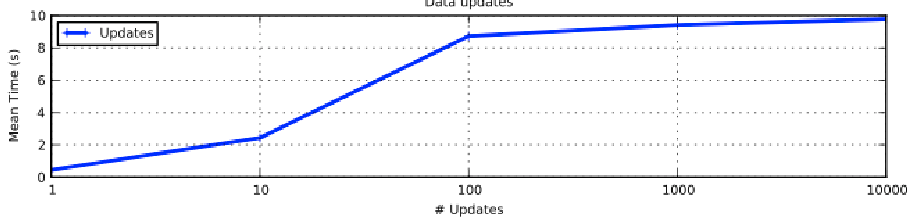
A critical part of the study was the Server Stress Test. As shown in Figure 2, the mean response time remains nearly linear even as request volume increases to 100,000. Most impressively, performing near real-time updates (adding new purchase data while recommending) caused negligible performance degradation.
Critical Insight & Conclusion
The significance of this work lies in its industrial pragmatism. By repurposing Apache Solr—a tool already found in most enterprise stacks—the authors provide a blueprint for a recommender that scales horizontally (via sharding) and vertically (via Lucene's local efficiency).
Takeaway: If you are building a marketplace recommender, don't start with a complex deep learning model that requires a GPU cluster and batch training. Start with a robust search-engine-based hybrid approach. It provides a baseline that is hard to beat in terms of latency, scalability, and the ability to combine content with social signals.
Limitations: The paper primarily uses memory-based techniques (K-NN). While Solr handles this well, more advanced Latent Factor models (like Matrix Factorization) were not natively implemented in this specific Solr version, representing a potential area for future "plugin" development.