
SUTD: Bridging the Gap Between Human Uncertainty and Big Data Scalability in Social Sensing
Scalable Uncertainty-Aware Truth Discovery in Big Data Social Sensing Applications for Cyber-Physical Systems
The paper introduces SUTD (Scalable Uncertainty-Aware Truth Discovery), a framework for Cyber-Physical Systems (CPS) that jointly estimates data correctness and source reliability in social sensing. It leverages a GPU-accelerated EM algorithm to handle big data while explicitly modeling human-reported uncertainty.
TL;DR
Social sensing turns humans into "sensors" for physical events, but humans are far noisier than hardware. This paper presents SUTD (Scalable Uncertainty-Aware Truth Discovery), a framework that accounts for the "maybe" and "unconfirmed" nature of human reports while using GPU acceleration to process millions of tweets in milliseconds—outperforming existing methods by 20% in accuracy and 1000x in speed.
Problem & Motivation: The "Human Sensor" Dilemma
In Cyber-Physical Systems (CPS), social sensing (e.g., using Twitter to map earthquake damage) is powerful but plagued by two issues:
- The Uncertainty Blind Spot: Most algorithms treat every report as a confident "fact." However, a witness shouting "There's a shooter!" has a different reliability than someone tweeting "Unconfirmed: rumors of a shooter."
- The Scalability Wall: Social media during a crisis generates data at a scale that traditional sequential algorithms cannot handle in real-time.
The authors' insight is that veracity (truth) and reliability (source quality) are deeply intertwined with the uncertainty expressed in the language itself.
Methodology: Rethinking Truth Discovery
The researchers reformulated Truth Discovery as a constraint estimation problem. Instead of a simple binary matrix, they introduced an Uncertainty Matrix ().
1. Uncertainty Quantification
They use three heuristics to label claims:
- Syntactic: Does it have a URL (low uncertainty) or is it a Retweet (high uncertainty)?
- Semantic: Does the text contain hedge words like "may," "might," or question marks?
- Combined: A hybrid of both.
2. The SUTD Framework
The core engine is an Uncertainty-Aware Expectation-Maximization (EM) algorithm.
- E-Step: Estimates the probability that a claim is true based on the current reliability of the sources who reported it.
- M-Step: Updates the reliability of sources based on how often their "uncertain" or "certain" claims match the estimated truth.
3. GPU Acceleration
To make this "Big Data" ready, the authors mapped the EM steps to CUDA kernels. By assigning each claim's hidden variable to a specific GPU thread, they transformed a bottlenecked sequential process into a massively parallel one.
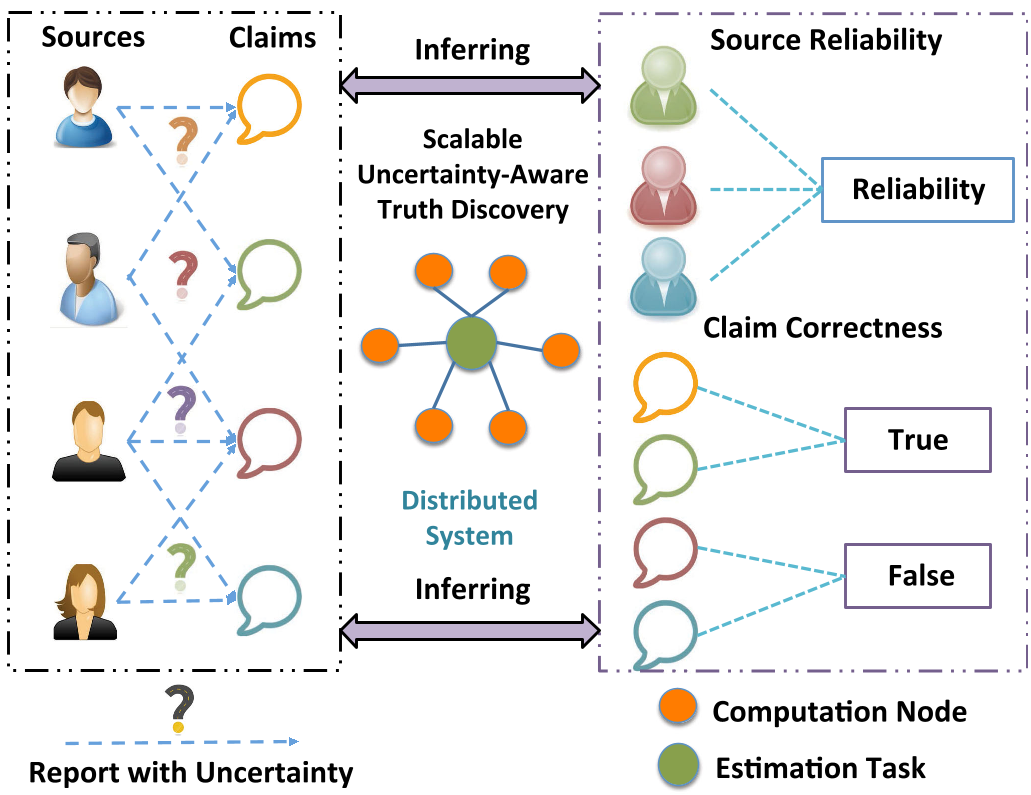 Figure 1: The SUTD scheme workflow, showing the transition from raw social data to uncertainty-aware estimation.
Experiments & Results
The model was tested against three 2015 crisis events: the Paris Attacks, the Oregon Shooting, and the Baltimore Riots.
Accuracy Gains
SUTD significantly outperformed traditional "Fact-Finders" like HITS and previous IPSN models. By explicitly modeling uncertainty, SUTD avoided being misled by "high-uncertainty" rumors that gained massive retweets (which usually tricks Majority Voting).
Performance Leap
The implementation on an NVIDIA GPU (2,496 cores) showcased the power of parallelization. While the state-of-the-art IPSN16 took nearly 10 minutes to process the Paris Attack trace, SUTD finished in 0.25 seconds.
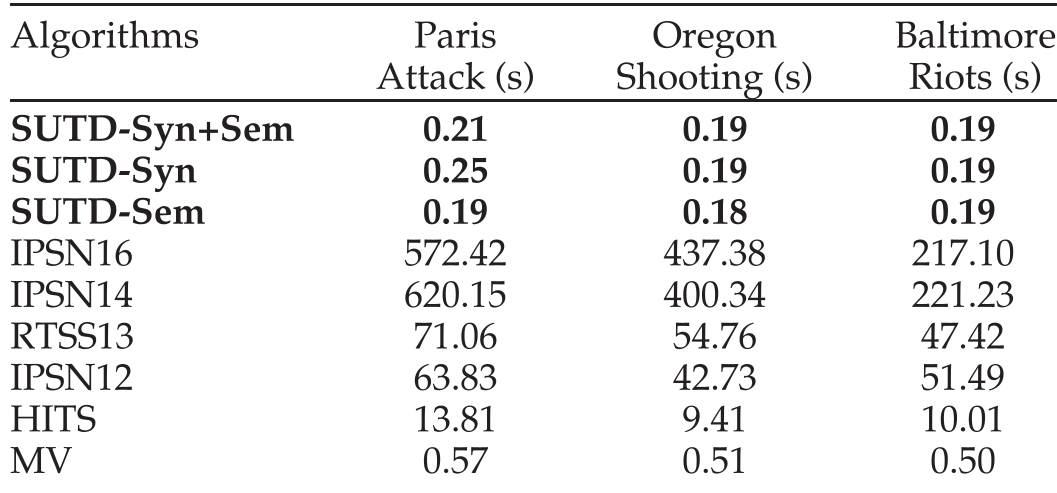 Table 1: Execution time (seconds) across different datasets. SUTD consistently operates in sub-second timeframes.
Critical Analysis & Conclusion
Takeaway: SUTD proves that for social sensing to be viable in CPS, we must treat human language as a nuanced sensor signal rather than a hard data point.
Limitations:
- Heuristic Dependency: The current uncertainty labels (URLs, keywords) are relatively simple. Modern NLP (like BERT or GPT-based embeddings) could likely refine these labels further.
- Source Independence: The model assumes sources are independent, but in reality, social media users influence each other (echo chambers), which the authors acknowledge as a future research direction.
Future Outlook: This work lays the foundation for "Real-time Truth Streaming," where a GPU-accelerated system could provide emergency responders with a live, verified "truth map" of a disaster as it unfolds.