
Scaling the World: How Geography Shapes the Internet's Social Fabric
Will Scale-Free Popularity Develop Scale-Free Geo-Social Networks?
This paper proposes a gravity-law-based geo-social network model that integrates scale-free node popularity with geographic constraints and population density. By employing a marked Poisson point process, the authors demonstrate that social networks remain scale-free unless communication ranges are strictly limited, providing a unified framework for understanding the interplay between intrinsic node fitness and spatial geometry.
TL;DR
Is the "Small World" phenomenon a result of human popularity or physical proximity? This paper introduces a Gravity-Law-based Geo-Social Model that proves scale-free properties (where a few hubs have most connections) survive spatial constraints. However, geography imposes a "speed limit": while the global network looks scale-free, the neighborhood of a "superstar" node eventually behaves like a rigid, random lattice due to physical distance limits.
Background: The Conflict of Distance and Popularity
Since Milgram's 1967 "Six Degrees of Separation" experiment, we have known social networks are efficient. Modern data from Facebook and Microsoft Messenger confirms this, attributing efficiency to Scale-Free distributions.
However, most models assume you can connect to anyone, anywhere. In reality:
- Popularity matters: We want to connect to "hubs."
- Distance hurts: We are less likely to maintain ties across continents.
- Density complicates: In a crowded city, we are pickier about distant ties.
Methodology: The Gravity of Social Ties
The authors treat individuals as points in a 2D space following a Poisson Point Process (PPP). Each node has a "mark" representing its popularity (), drawn from a power-law distribution.
1. The Gravity Criterion
They define the attraction between two nodes, and , as: Where is the rank (the population density factor). A connection forms only if .
2. The Physical Barrier
In wireless or mobile social networks, there is a hard stop: the accessibility radius (). You simply cannot connect if the distance exceeds this limit.

Key Insights: When Scale-Free Becomes Lattice
1. The Power Law survives (mostly)
The most significant finding is that the scale-free nature of the degree distribution is robust. As long as the communication range is large, the degree distribution follows . The geography doesn't destroy the hubs; it just changes the "slope" of the distribution.
2. The Poisson Transition
If the communication range is strictly limited (e.g., low-power Bluetooth in a D2D network), the hubs disappear. The network loses its "superstars" and reverts to a Poisson distribution, resembling a random lattice where everyone has roughly the same number of neighbors.
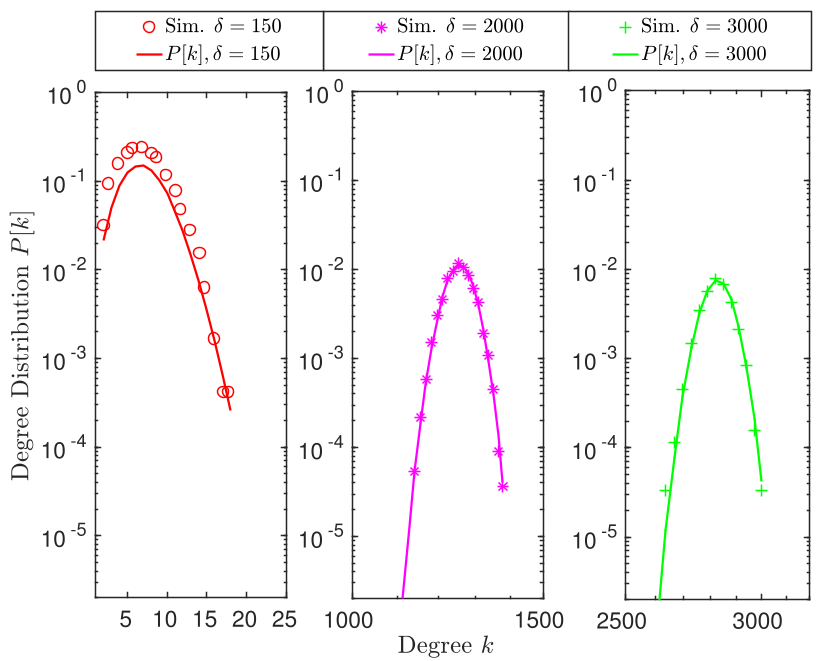 In Fig 2, increasing the threshold makes the network sparser but the power-law exponent remains stable.
3. Disassortativity and Clustering
Unlike some social models that claim "popular people hang out together" (assortativity), this geo-spatial model shows that large-scale networks are often disassortatitve. High-degree hubs are actually surrounded by low-degree followers because the spatial limitations prevent hubs from saturating the neighborhood of other hubs.
Experimental Proof
The authors validated their math via simulations (5,000 topologies per parameter).
- Rank Exponent (): Higher values (stronger distance penalty) lead to lower degrees and higher clustering.
- Accessibility Radius (): This is the "phase change" trigger. Small = Random Lattice; Large = Scale-Free Social Network.
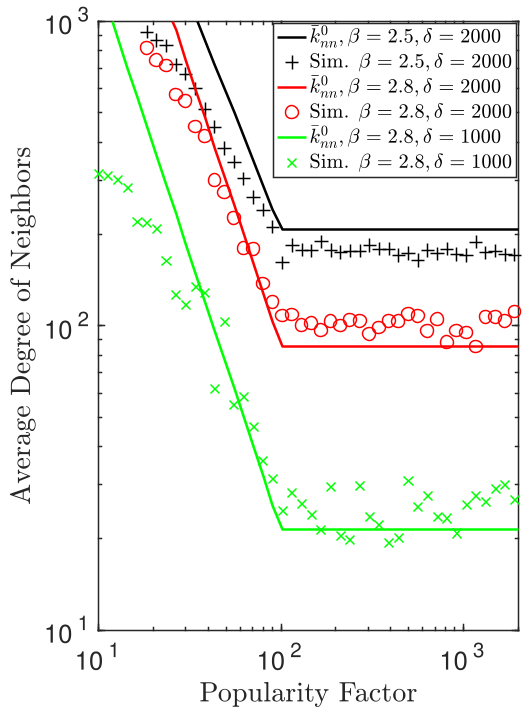 Fig 6 shows that for "superstars" (high ), the clustering coefficient flattens out, indicating that geography—not popularity—becomes the bottleneck for their social structure.
Impact: Why This Matters
This work provides a critical bridge between Graph Theory and Stochastic Geometry.
- For App Developers: It explains why Location-Based Social Networks (LBSNs) like Foursquare or Tinder feel different from global networks like Twitter.
- For Engineers: It helps in dimensioning 5G/6G D2D networks, predicting how "social hubs" can act as data relays without being overwhelmed by their physical surroundings.
Conclusion
Geography is a fundamental "regulator" of social networks. While human popularity creates the scale-free "hubs" we see globally, the physical world enforces a localized order, ensuring that even the most popular individuals are constrained by the space they inhabit.