
OWLv2: Scaling Open-Vocabulary Detection to Billions of Images
Scaling Open-Vocabulary Object Detection
OWLv2 is an advanced open-vocabulary object detection model that leverages the OWL-ST self-training recipe to scale training data to over 1 billion image-text pairs. By using an existing detector to generate pseudo-annotations from web data, it achieves state-of-the-art performance, notably improving LVIS rare class AP from 31.2% to 44.6%.
TL;DR
Google DeepMind introduces OWLv2 and the OWL-ST (Self-Training) recipe, showing that object detection can finally benefit from the same "Web-scale" data explosion as LLMs and CLIP. By using an existing detector to label 1 billion+ images with pseudo-boxes and training on these "noisy" labels, OWLv2 achieves a massive 43% relative improvement on rare object categories without ever seeing a human-annotated leaf, lark, or lute.
Problem & Motivation: The "Data Hunger" of Detectors
The success of modern AI (like GPT-4 or CLIP) is built on the backs of billions of internet-scraped image-text pairs. However, Object Detection has remained "starved" in comparison. Why? Because while a photo of a dog usually comes with the word "dog" nearby, it almost never comes with a perfect bounding box coordinate [x, y, w, h].
Previous attempts at "open-vocabulary" detection (detecting anything based on a text prompt) relied on small, human-annotated datasets like LVIS or O365. When they did try to use web data, they were often too "picky"—using strict filters that threw away 90% of the usable data. The authors' insight is simple: Don't be picky. Let the model learn from the noise.
Methodology: The OWL-ST Recipe
The core of this work isn't just a bigger model; it's a smarter way to manufacture training data.
1. The Self-Training Loop
The process follows three clear steps:
- Labeling: Take an existing OWL-ViT model and "ask" it to find objects in 1 billion web images.
- Prompting: Instead of just searching for "cat" or "dog," the authors extract every possible N-gram (phrase) from the image's alt-text. If the text says "a cute puppy playing in the grass," the model tries to find "cute puppy," "puppy," "grass," etc.
- Training: Train a new model (OWLv2) on these generated "pseudo-labels."
2. Architecture: Speeding Up the OWL
Training on billions of images is computationally expensive. OWLv2 introduces two critical efficiency boosts:
- Token Dropping: High-resolution images are mostly "empty" space (sky, backgrounds). OWLv2 drops 50% of image patches (tokens) that have low pixel variance, doubling the training speed with almost no loss in accuracy.
- Objectness Head: Instead of calculating a full classification for every single "pixel-tile" (of which there are thousands), a small "objectness" head identifies the top (e.g., 10%) most likely candidates first.
Note: The architecture utilizes a Vision Transformer (ViT) backbone with a lightweight detection head.
Experiments & Results
The results prove that scale wins.
- LVIS Rare Classes: These are the "long-tail" objects that rarely appear in human-annotated data. OWLv2 (L/14) improved the score from 31.2% to 44.6%.
- Scaling Laws: The authors demonstrate that detection follows "scaling laws" similar to LLMs—more data and more compute predictably lead to better performance.
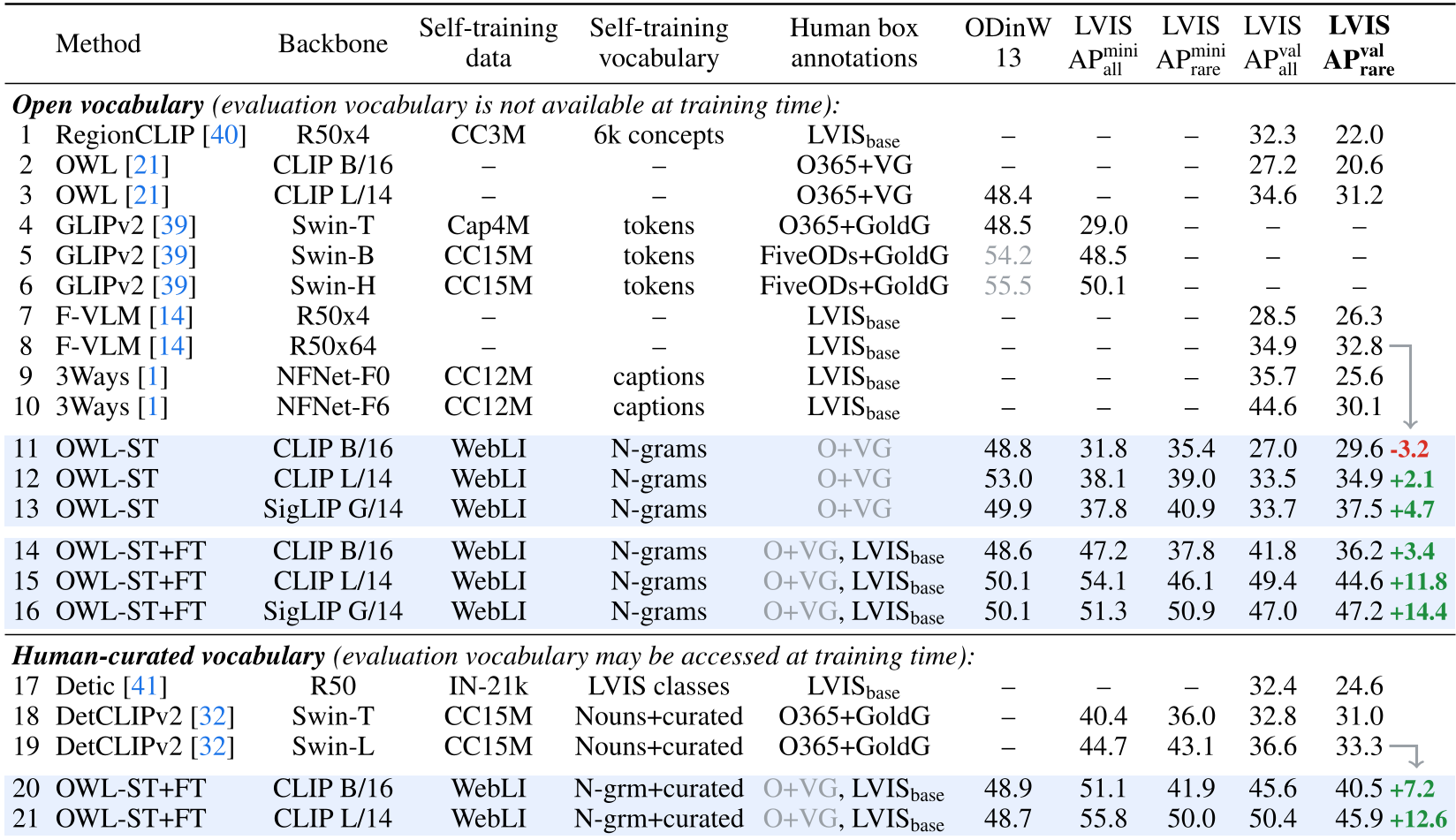 Table 1: OWLv2 (OWL-ST) consistently outperforms previous SOTA methods like GLIPv2 and F-VLM, particularly on rare classes.
The Fine-Tuning Paradox
Interestingly, the authors found a trade-off. Fine-tuning on a specific dataset (like LVIS) makes the model better at that dataset but worse at "in-the-wild" general detection. To solve this, they used Weight Ensembling: averaging the weights of the "generalist" self-trained model and the "specialist" fine-tuned model.
Critical Analysis & Conclusion
Takeaway: OWLv2 proves that the "self-training" paradigm is the key to scaling localization. By moving away from human-dependent labeling and embracing the messy, vast world of web data, we can create detectors that truly understand the "open world."
Limitations:
- Compute Cost: While the method is scalable, training on billions of images requires massive GPU/TPU resources.
- Pseudo-label Bias: The model is limited by the "intelligence" of the teacher model used to create the initial pseudo-labels.
OWLv2 represents a significant step toward "universal" computer vision, where a single model can identify anything described in natural language with high precision.