
Proactive Scaling: Bridging the Gap Between Social Influence and Cloud Economics
10332_Scaling Social Media Applications Into Geo-Distributed Clouds.
The paper proposes a proactive online algorithm for scaling social media applications in geo-distributed clouds. It integrates an epidemic-based social demand prediction model with a -step look-ahead optimization mechanism to manage content migration and request distribution, achieving near-offline optimal operational costs.
Executive Summary
In the era of viral short-form videos and global social networks, the infrastructure supporting these platforms must be as dynamic as the content itself. This paper addresses the challenge of scaling social media applications across geo-distributed cloud sites. By leveraging the Social Influence of users as a predictive signal, the authors propose an online algorithm that manages content migration and request distribution with a level of efficiency that rivals offline optimal solutions.
The Problem: The High Cost of Shortsightedness
Most content distribution strategies are reactive—they move data only after a spike in demand is detected. In a geo-distributed cloud (e.g., AWS regions across the globe), this leads to two major issues:
- Latency Traps: Serving a user in Tokyo from a server in Virginia because the content wasn't moved in time.
- Cost Inefficiency: Frequent, unnecessary data migrations (churn) caused by "thrashing" between one-shot optimal states. Historically, CDNs managed static content well, but they lack the social context required to anticipate why a video might go viral in a specific geographic cluster.
Methodology: The "Epidemic" of Content
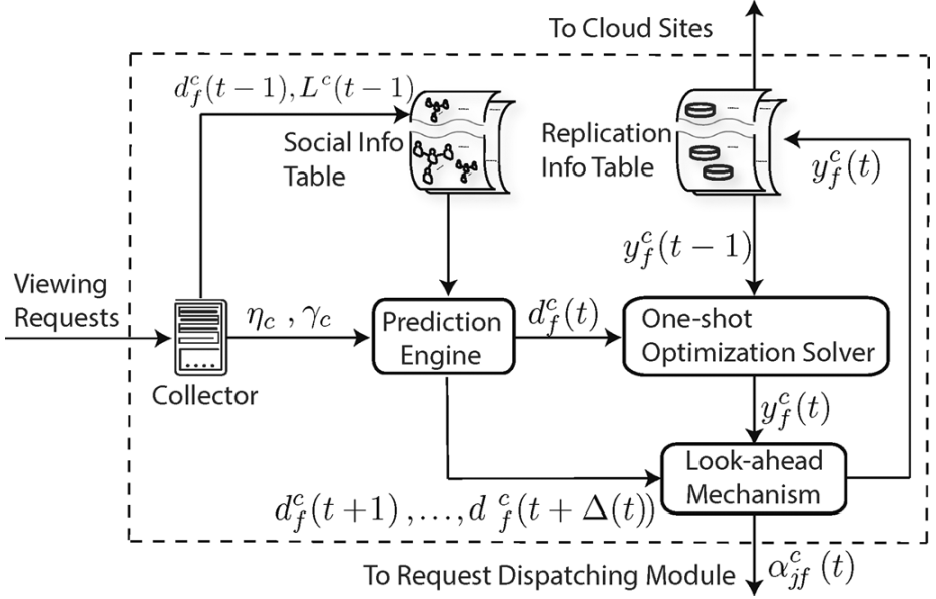
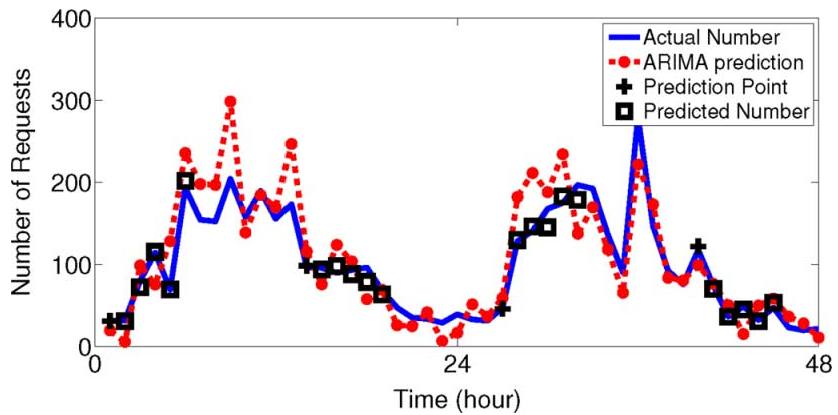
The core innovation lies in treating video views like a virus. The authors utilize an SIR-like Epidemic Model to predict future requests.
1. Social Demand Prediction
Instead of just looking at historical playback counts, the model considers:
- Social Connections: If your friend comments on a video, you are a "potential infected" viewer.
- Interest Correlation: System recommendations (e.g., "watched X, try Y") expand the potential viewer pool. This allows the system to calculate —the predicted demand for video in region —well before the requests actually hit the servers.
2. Dual Decomposition for One-Shot Optimization
To solve the complex Mixed Integer Program (MIP) of where to store what, the authors use Dual Decomposition. This breaks the massive problem into two parallel subproblems:
- Content Replication: Deciding which cloud site gets a copy of the file.
- Request Distribution: Deciding which site serves which user to minimize costs while staying under a 150ms latency cap.
3. The -Step Look-Ahead
The most "academic" yet practical contribution is the look-ahead mechanism. If a one-shot optimizer says "delete this video now to save storage cost," the look-ahead logic checks if that same video will be needed again in 2 or 3 hours. If the future migration cost to bring it back outweighs the current storage savings, the system keeps the video cached.
Experiments and Results
The researchers didn't just stay in simulation; they deployed a prototype across eight Amazon EC2 regions (including Virginia, Tokyo, and Ireland).
- Cost Savings: Their algorithm significantly undercut "Smart CDNs" (which only focus on locality) and "Simple CDNs" (which replicate everything).
- Proximity to Optimum: The online algorithm reached an impressive 8% within the offline optimum (the theoretical best possible result if you knew the entire future).
- Latency: While meeting the 150ms QoS target, it proved that you don't always need to serve from the closest site—sometimes serving from a slightly further but much cheaper site is the global optimum.
Critical Insight: Why This Matters
The breakthrough here is the proof that social meta-data is an infrastructure asset. By understanding the "social cascade," we can transform "reactive" infrastructure into "proactive" infrastructure.
However, there are limitations: the model assumes a somewhat world-consistent "initial popularity" factor () and a "decay rate" (). In reality, social media trends are often chaotic. Future work could benefit from integrating real-time sentiment analysis or multi-modal cues to refine these epidemic parameters.
Conclusion
This work provides a rigorous bridge between social science (epidemic modeling) and cloud engineering (stochastic optimization). For practitioners building the next generation of global streaming platforms, the message is clear: Look at who follows whom, and you'll know where to put your data.