
Scalpel-CD: Surgical Precision in Debugging Noisy Training Data
Scalpel-CD: Leveraging Crowdsourcing and Deep Probabilistic Modeling for Debugging Noisy Training Data
Scalpel-CD is a human-in-the-loop system designed to debug noisy labels in machine learning training sets. It combines a Deep Probabilistic Model (DPM) for automated error detection with strategic crowdsourcing and label propagation to refine data quality. The system achieves state-of-the-art results, improving label accuracy by an average of 12.9% across diverse datasets.
TL;DR
Scalpel-CD is a hybrid intelligence system that rescues machine learning models from "garbage-in, garbage-out" scenarios. By using a Deep Probabilistic Model (DPM) to map data into a latent feature space, the system identifies likely mislabeled instances. It then selectively asks humans to verify the "messiest" data points and automatically propagates these manual fixes to similar items, boosting label accuracy by nearly 13% with minimal human overhead.
The Hidden Tax of Noisy Labels
Modern AI is data-hungry, but sourcing high-quality labels is expensive. Consequently, researchers often resort to Distant Supervision (matching text with external databases) or Crowdsourcing, both of which introduce noise.
Existing automated debuggers have a major flaw: they look at low-level features (like individual words) rather than the underlying semantic structure. This makes them blind to Structural Noise—where a model might be consistently wrong but highly confident because the data distribution itself is skewed.
Methodology: The Scalpel-CD Workflow
The system operates as an end-to-end pipeline designed to maximize the "ROI" of every human click:
- Deep Probabilistic Modeling: The heart of the system is a generative model that learns two latent variables: (latent features) and (the true class). It uses deep neural networks to approximate the complex relationships between the data and its noisy label .
- Adaptive Loss Balancing: The model introduces a parameter to control how much it trusts the existing noisy label versus the learned data distribution.
- Smart Sampling: Instead of random selection, the Data Sampler uses the learned latent space to cluster data. It selects points that are either highly uncertain (near the decision boundary) or representative of large data "neighborhoods."
- Label Propagation: Once a human fixes a label, that "knowledge" is pushed to neighbors in the latent space.
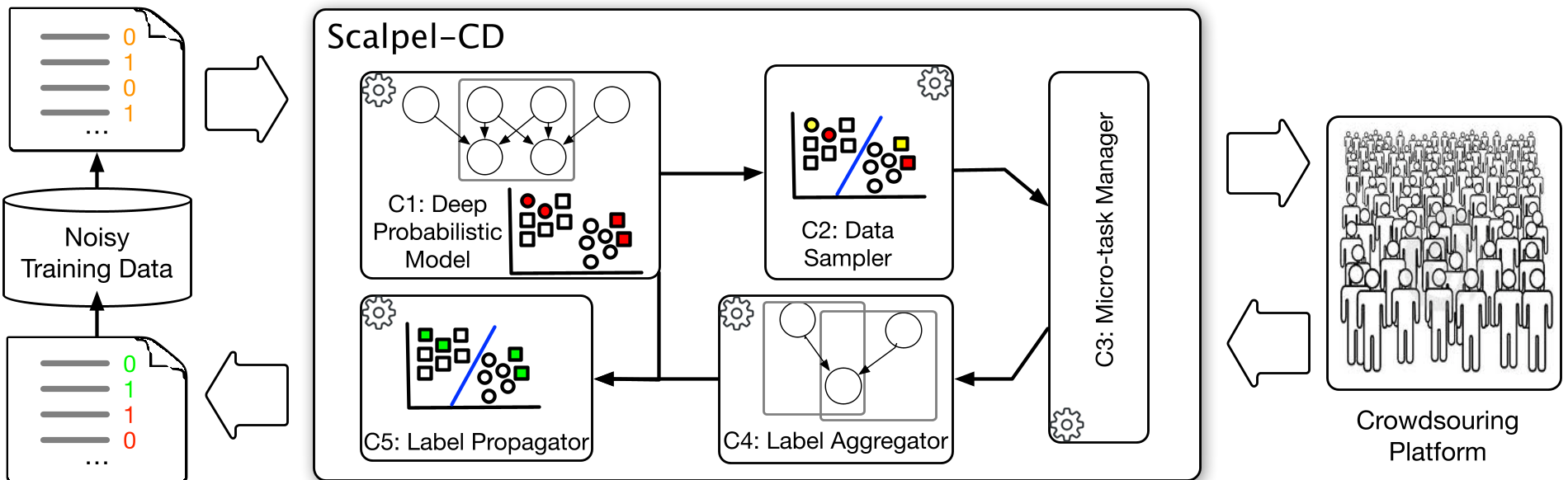 The Scalpel-CD Pipeline: From noisy input to human verification and latent propagation.
Why it Works: The Latent Space Advantage
The authors demonstrated that their model creates a semantic map where classes are naturally separated. In the figure below, we see how the DPM identifies the "Decision Boundary." While structural noise (non-random errors) can fool standard models, Scalpel-CD uses random sampling and latent clustering to find these clusters of misinformation.
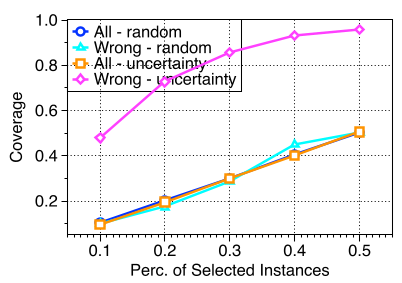 Visualization of Correct vs. Wrong Inference: The system targets points where the model's structure contradicts the noisy label.
Experimental Battleground
Scalpel-CD was tested against three different challenges:
- MovieReview: Simple random noise.
- PoliDying: Complex structural noise in Twitter data.
- NYT: Rich relational noise from distant supervision.
The results were conclusive. On the NYT dataset, while traditional methods like Ratio or Pattern actually decreased performance, Scalpel-CD consistently improved both the label quality and the performance of downstream models (like CNNs).
| Method | MovieReview (Acc) | PoliDying (Acc) | NYT (Acc) |
|---|---|---|---|
| Original Noise | 0.800 | 0.625 | 0.701 |
| Scalpel-CD (Full) | 0.956 | 0.812 | 0.745 |
| Label quality improvement after cleaning. |
Conclusion: Human-in-the-Loop is the Future
The real takeaway from Scalpel-CD is that automation alone isn't enough. Even a tiny amount of human intelligence (2.8%), when applied to the right latent "knots" in a dataset, can untangle noise that would otherwise baffle a pure neural network.
Future Outlook: As we move toward larger foundation models, systems like Scalpel-CD will be vital for "data-centric AI," ensuring that the billions of tokens we feed into models are as clean as possible without requiring a literal army of human annotators.