
Beyond the Grid: Reimagining Schelling Models with Social Networks
Schelling Models with Localized Social Influence: A Game-Theoretic Framework
This paper introduces the Schelling Model with Localized Social Influence (SG-LSI), a game-theoretic framework that generalizes the classic Thomas Schelling segregation model. It integrates two novel features: allowing multiple individuals to occupy the same location and incorporating a weighted, directed social network to model influence among agents within and across locations.
TL;DR
Researchers have evolved the classic Schelling segregation model by introducing Localized Social Influence (LSI). Unlike the 1970s version where agents live solo on a grid, this new game-theoretic framework allows agents to share locations and be influenced by a complex web of social ties. The result? A model that isn't just more realistic, but mathematically "sharper"—drastically reducing the number of predicted outcomes to find the most likely social configurations.
Background: Why the Classic Model is Falling Short
For decades, Thomas Schelling’s model explained how slight individual preferences (e.g., "I don't want to be the only person of my type in the neighborhood") lead to massive collective segregation. However, modern urban living is more complex:
- Shared Spaces: We share buildings, parks, and schools (multiple occupants per location).
- Social Circles: We aren't just influenced by "types"; we are influenced by specific people—friends, colleagues, and influencers.
- Predictive Noise: Previous computational models often produced too many stable states (PSNE), making it impossible to predict which one would actually occur.
The Core Insight: Localized Social Influence (LSI)
The paper introduces the SG-LSI (Schelling Games with Localized Social Influence). The physical world is represented by a Location Graph, while the human world is a Social Network.
The Utility Function
An agent 's happiness depends on two factors:
- Localized Influence: The sum of weights from friends (positive) and "enemies" (negative) who choose the same spot.
- Location Effect: The traditional influence from neighboring areas.
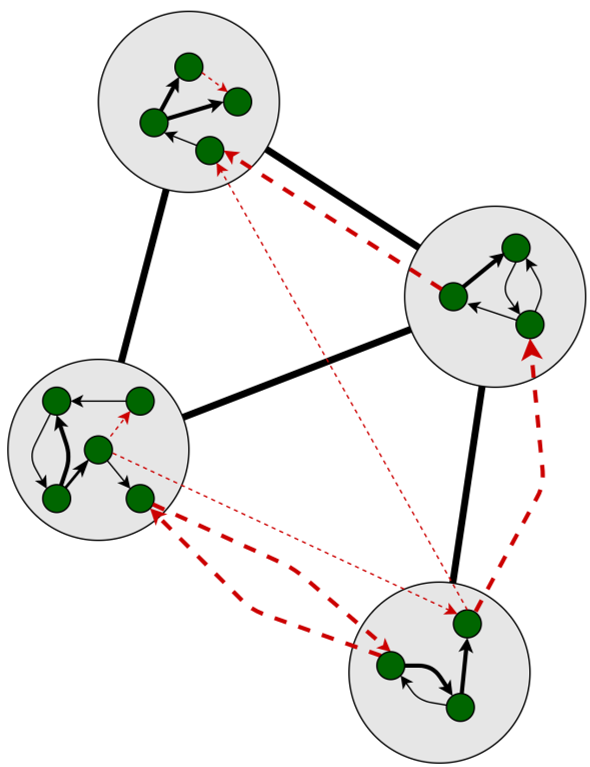 Figure 1: The dual-graph approach. Large gray nodes represent physical locations; small green dots represent agents connected by a directed, weighted social network.
The Complexity Challenge
The shift to realistic social networks comes with a computational cost. The authors proved:
- General Hardness: Finding any stable configuration (PSNE) is NP-complete.
- Counting Hardness: Determining the total number of possible stable outcomes is #P-complete.
- Optimality: Finding the "best" social outcome for everyone is NP-hard, even in simple scenarios.
Despite this, the authors identified "islands of tractability." For tree-structured social networks (hierarchical influences), they adapted the Tree-Nash algorithm to find stable states in polynomial time—specifically .
Experimental Proof: Sharper Predictions
The most striking finding comes from the experiments. In traditional Schelling games (), the number of PSNE is massive. As the weight of Localized Social Influence () increases, the number of potential stable outcomes collapses.
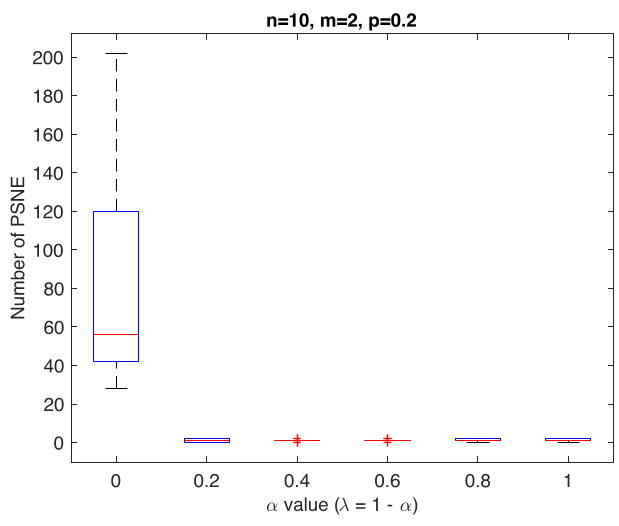 Figure 2: Sensitivity analysis showing that as social influence () becomes the dominant factor, the number of stable equilibria drops significantly across different network sizes (n=10 vs n=20).
This "collapse" is actually a good thing for social scientists. It suggests that our social networks act as a constraint that steers society toward a few specific stable configurations, rather than a chaotic range of possibilities.
Takeaways & Future Work
The SG-LSI framework bridges the gap between abstract economic models and the data-driven reality of social networks.
- Refined Granularity: We can now model negative influence (avoidance) and positive influence (homophily) with specific weights.
- Capacity Realism: By allowing multiple agents per location, we can model everything from urban housing to the "clumping" of people in social media Echo Chambers.
Limitations: The model is currently focused on static stability (PSNE). The next frontier is dynamics—how do these segregated states form over time when people move in and out of neighborhoods?
Referenced Paper: Schelling Models with Localized Social Influence: A Game-Theoretic Framework (AAMAS 2020).