
CDBG: Accelerating Scholar Recommendations through Parallel Graph Computing
Scholar Recommendation Model in Large Scale Academic Social Networking Platform
This paper introduces the CDBG (Community Detection Based on GraphChi) model, a parallelized scholar recommendation framework for large-scale academic social networks. By integrating the GraphChi system with an Adaptive Label Propagation Algorithm (ALPA), the model achieves high-speed community discovery and offers three personalized recommendation strategies: CWR, CRR, and ACR.
TL;DR
The proliferation of academic social networks has made it harder for researchers to find relevant collaborators amidst a sea of data. This paper presents CDBG (Community Detection Based on GraphChi), a system that utilizes a parallel processing framework to partition large-scale social graphs into communities within seconds. By combining these communities with tailored strategies like Acquaintance Community Recommendation (ACR), the system achieves a Precision of nearly 85% in suggesting potential academic connections.
The Bottleneck: Massivity vs. Responsiveness
In academic platforms like SCHOLAT, the topology of user relationships is dense and complex. Current recommendation systems face a dilemma:
- Information Overload: Users cannot manually filter potential collaborators.
- Computational Latency: Standard topology-based algorithms, such as basic Label Propagation (LPA), become prohibitively slow as the node count grows, failing to provide real-time responses.
- Contextual Relevance: General social recommendations don't account for the unique "circle-based" nature of academia, where your mentor's colleagues or your department's peers are more relevant than high-profile strangers.
Methodology: The Fusion of GraphChi and ALPA
The authors propose the Community Detection Based on GraphChi (CDBG) algorithm to solve the scale problem.
1. Parallel Sliding Windows (PSW)
Instead of loading the entire global graph into memory—which is impossible for large-scale platforms on a single machine—the system uses GraphChi. It slices the graph into intervals and uses the PSW mechanism to update vertices in parallel. This allows for massive graph processing on a stand-alone machine without sacrificing the performance found in distributed systems.
2. Core Network Identification
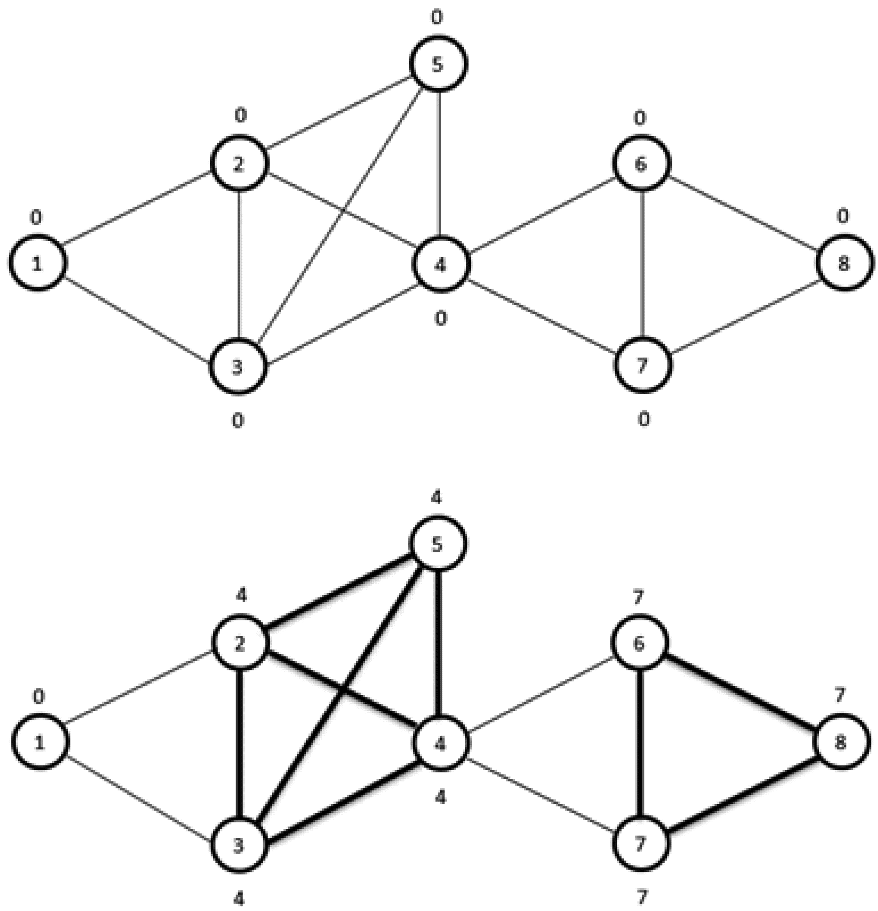
The algorithm starts by identifying the "Core Network." According to the paper's definition, if two nodes and are each other's maximum degree neighbors among unmarked nodes, they form the nucleus of a community.
3. Adaptive Weight-Based Label Propagation
Once the core is set, labels propagate outward. To prevent "label explosion" (too many redundant tags), the researchers implemented an adaptive threshold. Labels with weights less than (where is the number of labels) are pruned. This ensures that the resulting communities are stable and representative of the underlying academic structure.
Personalized Strategies: CWR, CRR, and ACR
The paper doesn't just cluster users; it explores how to recommend within these clusters:
- Community Weight Recommended (CWR): Targets high-influence scholars. Best for senior professors.
- Community Random Recommended (CRR): A baseline for "cold starts" where little information is known.
- Acquaintance Community Recommended (ACR): Prioritizes connections within a user's local "acquaintance" circle (e.g., colleagues and peers).
Experimental Insights & SOTA Results
The researchers tested the model on the SCHOLAT dataset. The system processed the graph and generated 442 communities in a remarkable 1.508 seconds.
Performance Metrics
The results indicate that the ACR (Acquaintance) method significantly outperforms influence-based models for the general user base.
| Method | Precision (L=5) | MAP (L=5) |
|---|---|---|
| ACR | 84.67% | 85.84% |
| CRR | 60.21% | 63.59% |
| CWR | 52.34% | 57.09% |
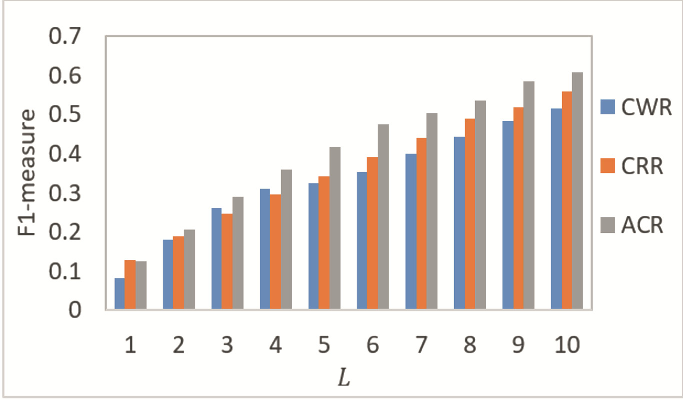
Key Finding: The poor performance of CWR (Weight-based) suggests that in academic networks, a "high weight" or "large influence" doesn't necessarily translate to a recommendation that a specific user wants to accept. Users are much more likely to connect with those in their "acquaintance" social circle.
Critical Analysis & Conclusion
The CDBG model successfully bridges the gap between high-performance graph computing and social-aware recommendations. By utilizing the GraphChi architecture, it democratizes large-scale research, allowing powerful community detection on single-machine setups.
Limitations: While the speed is impressive, the paper primarily relies on topological data. Future work could incorporate Content-based Filtering (analyzing paper abstracts and topics) alongside the topology to further refine the quality of communities in highly interdisciplinary fields.
Takeaway: In the world of academic social networks, "Who you know" (Local Topology) remains a stronger predictor of future collaboration than "Who is famous" (Global Influence).