
Beyond the Screen: Decoding the Reciprocal Link Between Social Media and Academic Success
School performance, social networking effects, and learning of school children: Evidence of reciprocal relationships in Abu Dhabi
This study utilizes Structural Equation Modeling (SEM) to investigate the reciprocal relationships between social networking usage and school performance among 34,896 children in Abu Dhabi. It validates a complex social network model categorized into attitudes, usage reasons, and activities, achieving a comprehensive map of how digital behavior influences—and is influenced by—academic outcomes.
TL;DR
Is social media destroying student performance, or is it the new frontier of collaborative learning? A massive study of nearly 35,000 students in Abu Dhabi suggests the answer isn't a simple "yes" or "no." Using Structural Equation Modeling (SEM), researchers found that while negative content hurts grades, the relationship is reciprocal: a student’s academic standing actually shapes how they choose to use social networks.
The "Distraction" Myth vs. Reality
For years, the narrative surrounding children and social media has been one of alarm. Parents and educators often view platforms like Snapchat, Instagram, and Facebook solely as "time thieves" that divert attention from homework. However, the academic community has struggled with inconsistent data—some studies show a massive drop in GPA, while others find no correlation or even slight improvements in language skills.
The researchers in this study identified a critical flaw in previous logic: they treated the student as a passive recipient of social media's effects. In reality, students are active agents. The study's core insight is that we must examine the "why" and "how" of usage, rather than just the "how much."
Methodology: The Power of Latent Constructs
To map this complex ecosystem, the authors moved away from simple surveys and toward Structural Equation Modeling (SEM). They defined several "Latent Constructs"—unobservable variables like "Attitude toward Learning" and "Social Absorption"—measured through specific indicators like time spent on homework and types of topics discussed online.
The Model Architecture
The researchers tested three iterations of their model. The most sophisticated version, the Reciprocal Model, suggests that performance isn't just an endpoint; it's a feedback loop.
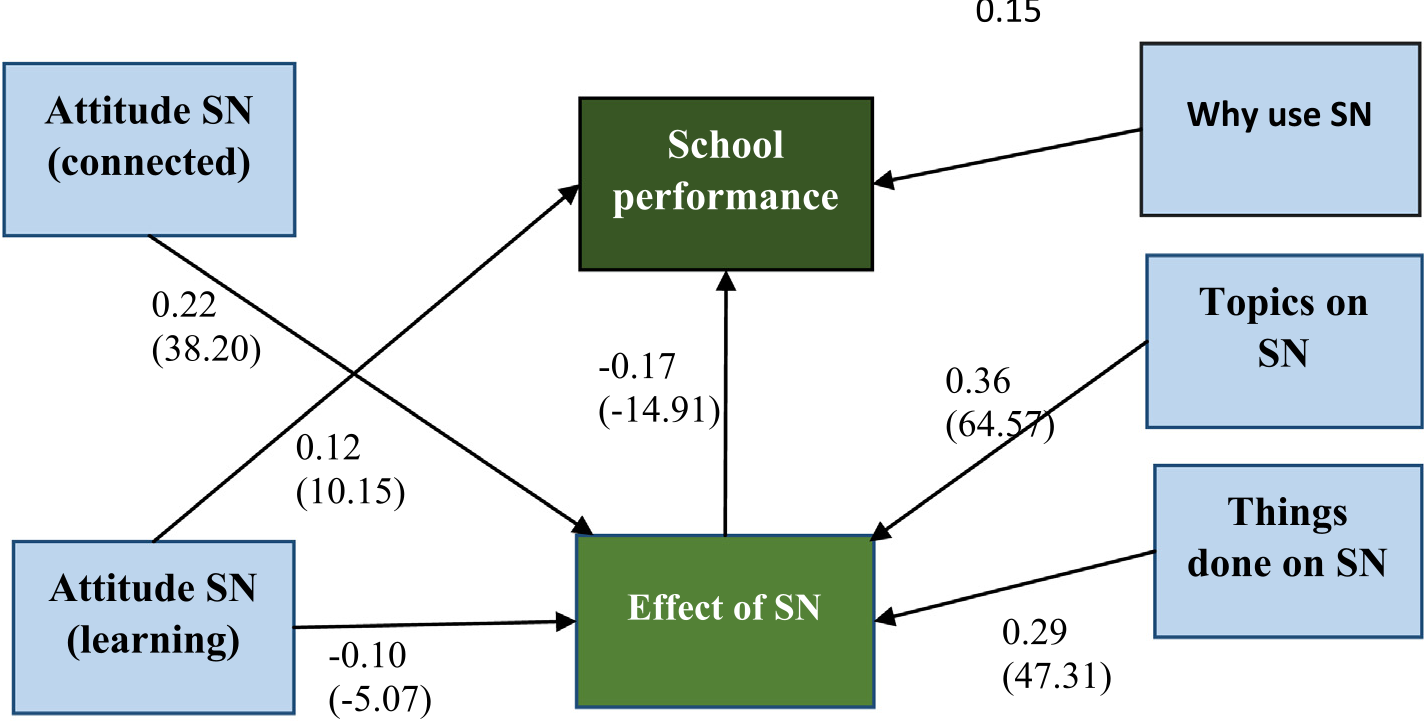 Figure 1: The expanded SEM model shows the complex web of interactions between social networking attitudes and academic outcomes.
Key Findings: The Great Filter
The study’s results provide a nuanced "heat map" of digital influence:
- The Learning Catalyst: Students who approach social media with an "attitude toward learning" saw a positive path coefficient (+0.11) toward school performance.
- The Negative Impact: Exposure to "Negative Topics" (e.g., self-harm, drugs) had a direct negative estimate (-0.16) on perceived performance.
- The Reciprocity Revelation: This is the study's "smoking gun." The model shown in Figure 3 confirms that school performance affects how students perceive the reasons for using social media. "Excellence" in school acts as a protective filter, leading students toward more productive digital behaviors.
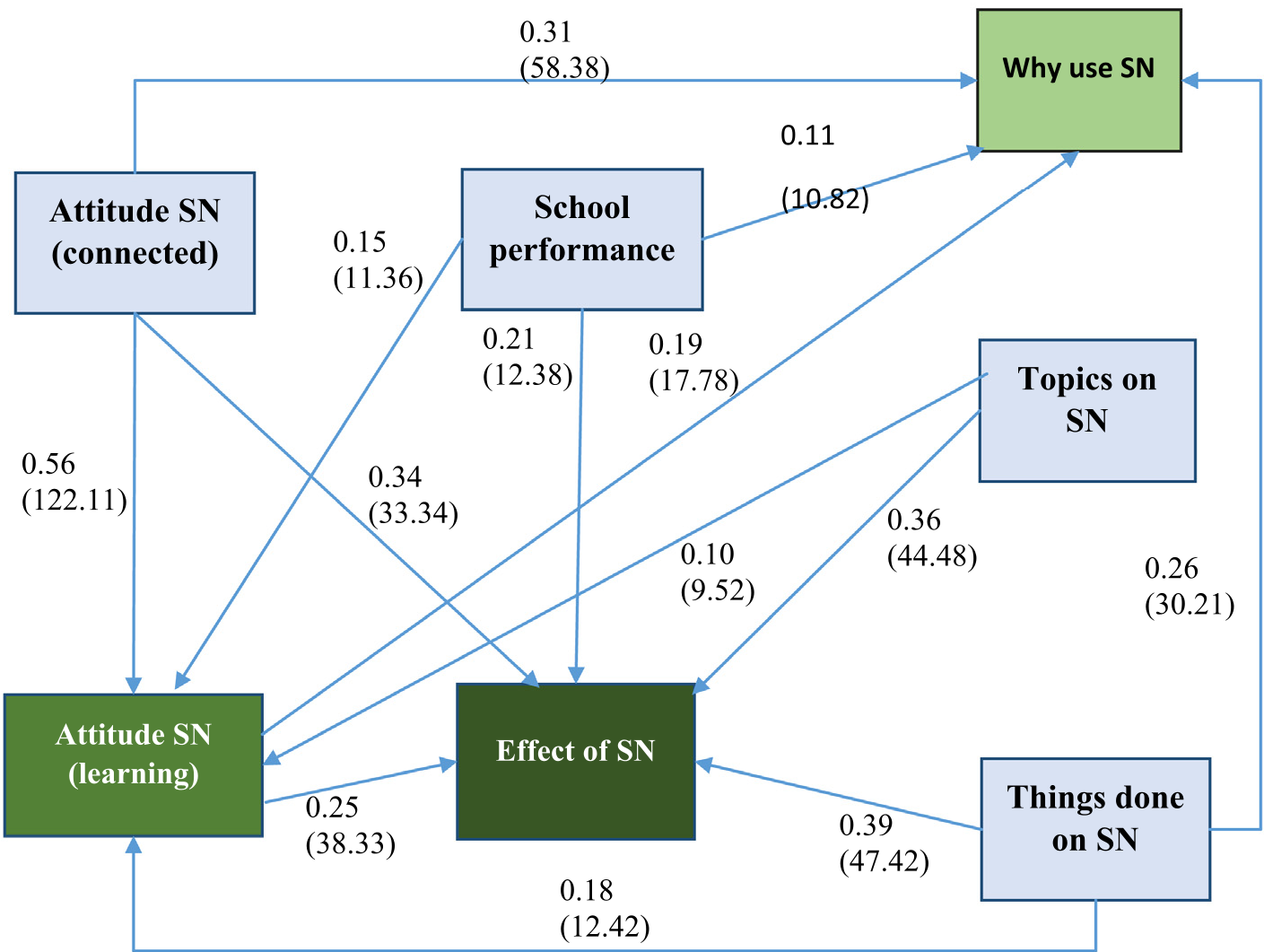 Figure 2: The reciprocal-effect SEM parameters, highlighting how performance levels influence social media intentions.
Critical Insight: Education as Cyber-Defense
The data suggests that the best way to protect a child from the "dark side" of social media isn't necessarily to take their phone away—it’s to improve their academic engagement and sense of school performance.
High-performing students naturally gravitate toward the "connected" and "learning" aspects of social networks, using them to exchange ideas and research. Conversely, students struggling academically are more susceptible to "social absorption," where social media becomes a replacement for—not a supplement to—their studies.
Conclusion & Future Outlook
This Abu Dhabi study marks a shift from "Media Effects" to "Media Ecology." It tells us that:
- Moderation is key, but Intention is more important.
- Reciprocity matters: We cannot solve "social media addiction" without looking at the underlying school engagement of the student.
- Policy shift: Policymakers should stop trying to curtail usage and start encouraging "student-directed" learning styles that leverage social media for curriculum delivery.
The future of education in a technology-driven world won't be found in banning apps, but in transforming them into digital classrooms where the loop between performance and participation is virtuous, not vicious.