
Haeff’s Memory Tube: The Forgotten Bridge from Early RAM to Modern Computer Graphics
Screen History: The Haeff Memory and Graphics Tube
This paper explores the history of the Haeff Memory Tube, a cathode ray tube (CRT) developed in 1947 by Andrew Haeff. It analyzes its technical principles of "holding beam" storage and its evolution from an early competitor of Williams-tube computer memory to a dominant technology in computer graphics and displays until the 1980s.
TL;DR
Long before modern SSDs or even magnetic core memory, the battle for the "soul" of computer storage was fought with vacuum tubes. While the Williams tube is often celebrated as the first RAM, Andrew Haeff’s Memory Tube (1947) introduced a radically different "holding beam" principle. Though it lost the race to be the primary memory for the first digital computers, it became the cornerstone of the computer graphics revolution, powering the iconic Tektronix terminals that defined engineering workstations for decades.
Contextualizing the 1940s Memory Crisis
In the mid-1940s, computers like ENIAC were "bottlenecked" by their memory. Acoustic delay lines (using mercury) were slow and serial—if you needed a bit of data, you had to wait for it to physically travel through a tube of liquid. The industry was desperate for Random Access Memory (RAM).
The primary technical challenge was "leakage." You could "paint" a charge onto a CRT screen, but it would vanish in milliseconds. Researchers took two paths:
- The Williams Path: Constantly read and rewrite the data (Regeneration).
- The Haeff Path: Use a secondary electron gun to "hold" the charge in place (Fixture).
Methodology: The Magic of the Holding Beam
Haeff’s 1947 patent described a design that felt like science fiction at the time. Instead of just one electron gun, his tube used up to three:
- Writing Gun: Painted the data or image.
- Reading Gun: Scanned the screen to output the signal.
- Holding Gun: Flooded the entire screen with a diffuse beam of low-energy electrons.
Physics Intuition
The "Holding Beam" relied on Secondary Electron Emission. If an area was positively charged, the holding beam would knock off even more electrons, keeping it positive. If it was negative, the beam would be repelled, keeping it negative. This created a bistable state—the image stayed on the screen "for hours without noticeable deterioration," a feat the Williams tube could only achieve through constant, power-hungry refreshing.
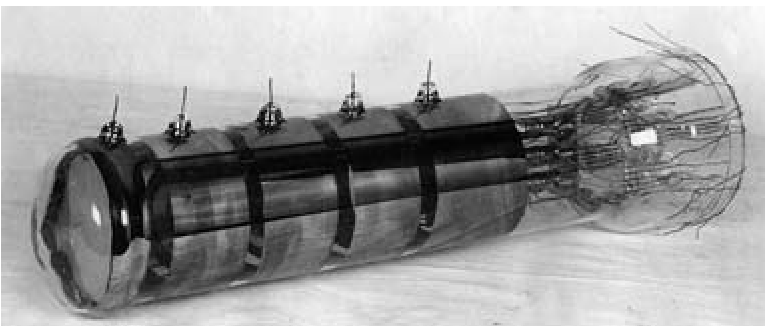 Figure: The 1947 experimental Memory Tube showing the guns for writing, holding, and reading.
Why It Lost the RAM War (But Won the Graphics War)
Haeff’s tube was technically superior in persistence but harder to manufacture. It required custom internal wire meshes and precise alignment.
- The RAM Defeat: The Williams tube used off-the-shelf oscilloscope parts, making it the "lean startup" choice for early computer labs. Even the Naval Research Lab eventually chose Williams memory over Haeff’s local invention for their NAREC computer.
- The Graphics Victory: Because Haeff’s tube was "direct-view" (you could see the glow of the stored charge), it was perfect for displays. In 1947, Haeff showcased what is arguably the first representational digital image stored on a screen.
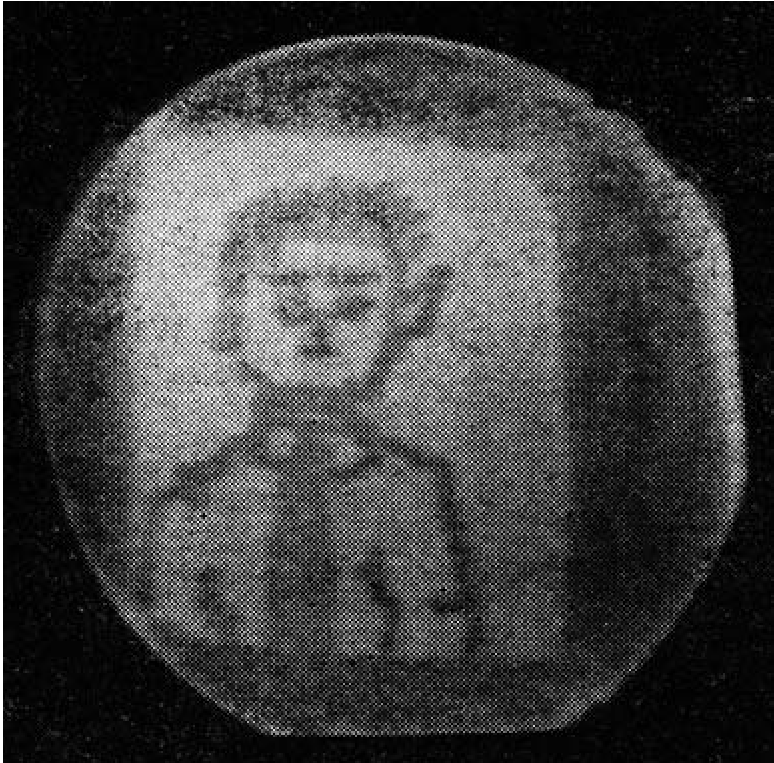 Figure: A momentous relic—likely the first representational picture displayed continuously on an electronic screen via Haeff's tube.
The Tektronix Era: From Theory to $1B Industry
The final evolution of Haeff’s insight came via Robert Anderson at Tektronix in the 1960s. By replacing Haeff’s complex metal meshes with a "porous phosphor" layer, Anderson solved the "granularity" problem Turing had warned about in 1947.
This led to the Direct-View Storage Tube (DVST). These monitors (like the Tektronix 4014) were revolutionary because they didn't need a "frame buffer"—memory was so expensive then that storing a high-resolution image in silicon was impossible. The Haeff-style screen was the memory. This allowed for incredibly sharp vector graphics that paved the way for modern CAD/CAM software.
Critical Analysis & Conclusion
Haeff’s work reminds us that technical "failure" is often contextual. As a computer RAM, the Memory Tube was an exotic, expensive "side-branch" of evolution. However, its core mechanism—using physics to maintain state without active CPU intervention—was perfectly suited for the birth of human-computer interaction.
Key Takeaways:
- Persistence is Key: Haeff solved the "refresh" problem 40 years before modern "Always-On" displays.
- Infrastructure Matters: The Williams tube won the memory race not because it was better, but because it was compatible with the existing supply chain of standard CRTs.
- Legacy: Every time we look at high-resolution vector art, we see the descendant of Haeff's 1947 "Electrograph."
The Haeff tube finally disappeared in the late 1980s as cheap RAM made raster-scan color monitors (like we use today) more viable, but for two decades, it was "the graphics company" technology that digitized the world of engineering.