
Searching for Personality: How Machines Decode the Human Psyche
17289_Searching for Personality [Social Sciences].
This paper explores the automatic prediction of Big Five personality traits using two distinct computational paradigms: "thin-slice" behavioral analysis and social network structural analysis. It presents a comparative study of how machines can emulate human-like personality attribution (layperson task) versus theory-driven "psychologist" tasks using digital traces.
TL;DR
Can a machine know you better than a stranger, or even yourself, just by looking at your call logs or listening to a few seconds of your voice? This paper investigates the transition from "naive psychology" to automated personality prediction. By leveraging the Big Five model and Brunswick’s Lens Model, the authors demonstrate that digital traces—like Bluetooth proximity and vocal pitch—can predict personality traits with surprising accuracy, often exceeding 80%.
The Core Challenge: The Consistency Paradox
In our daily lives, we use descriptors like "bold" or "sociable" to predict behavior. However, for AI, this is a nightmare. Personality traits are stable, yet human behavior is volatile. An extravert isn't talkative 100% of the time.
The paper identifies a critical gap:
- Physical Cues vs. Inner Traits: Machines must bridge "distal cues" (measurable behaviors) with high-level abstractions (traits).
- Perception Gap: There is often a low correlation () between how we see ourselves (self-assessment) and how others see us (stranger-assessment).
Methodology: Two Paths to the Soul
1. The "Thin-Slice" Attribution (The Layperson Task)
This approach emulates the human ability to judge someone after meeting them for just a few seconds. Using a modified Brunswick Lens Model, researchers extract audio/visual features—vocal pitch, formants, energy, and gaze patterns—and feed them directly into machine learning classifiers.
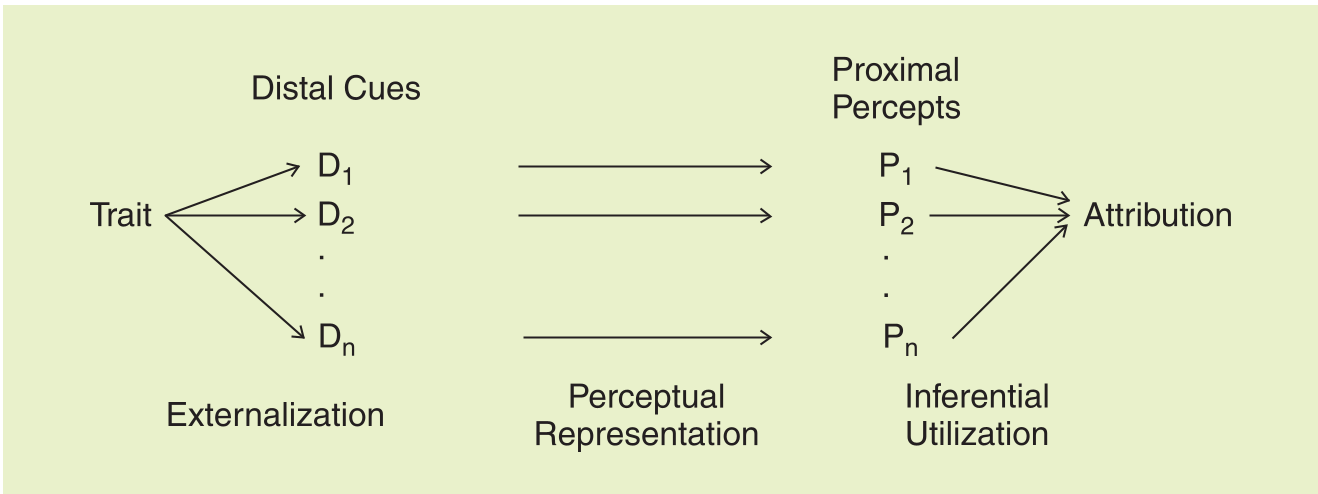 Fig 1: The Brunswick Lens Model illustrates how internal traits are externalized through distal cues and then reconstructed by an observer.
2. Social Network Structure (The Ego-Net Task)
Instead of looking at what you say, this method looks at who you are with. By analyzing "Ego-nets" (your direct social circle), researchers found that:
- Extraverts follow the "friends of my friends are my friends" principle (High Transitivity).
- Neurotic individuals tend to avoid tightly clustered social groups, possibly to minimize anxiogenic social situations.
Key Results: Bluetooth vs. Calls
The study by Staiano et al. showed that Bluetooth (BT) data—representing physical co-location—is generally a better predictor of personality than phone call metadata.
 Table 1: Statistical significance of network types across different traits.
Performance Highlights:
- Extraversion: Achieved 80% accuracy using transitivity measures on Bluetooth networks.
- Neuroticism: Uniquely better predicted by Call logs rather than Bluetooth, suggesting that neurotic traits manifest more clearly in point-to-point communication than in physical gatherings.
- Context Matters: Adding features of "other people in the room" boosted accuracy significantly (up to 92% in some cases), proving that personality is a social performance.
 Table 2: Best accuracy results achieved per trait and network index.
Critical Insight: From "Traits" to "States"
The paper concludes with a profound shift in perspective. Instead of seeing personality as a fixed point, we should view it as a distribution of states.
An introvert doesn't never act extraverted; they just do so less frequently or in specific situations. The future of the field lies in:
- Personality States: Characterizing concrete behavioral episodes.
- Situational Efficacy: Defining the context not just by GPS coordinates, but by "psychological efficacy"—how a situation triggers a specific trait.
Conclusion
This work highlights that while "thin slices" of behavior offer a window into how others perceive us, the "digital breadcrumbs" of our social networks provide a more objective map of our stable traits. For developers of social robots or conversational agents, the message is clear: to understand a user's personality, you must look at the interplay between the person and their social situation.