
Seasons: Revitalizing Intangible Cultural Heritage through Dynamic Thermochromic Smart Textiles
Seasons: Exploring the Dynamic Thermochromic Smart Textile Applications for Intangible Cultural Heritage Revitalization
This paper introduces "Seasons," an interactive Shanghai-style Cheongsam that utilizes dynamic thermochromic smart textiles to revitalize Intangible Cultural Heritage (ICH). By integrating programmable heating layers with temperature-sensitive pigments, the garment displays animated floral patterns representing the four seasons, achieving a harmonious blend of traditional craftsmanship and HCI technology.
TL;DR
"Seasons" is an interactive Shanghai-style Cheongsam that bridges the gap between centuries-old Chinese craftsmanship and modern Human-Computer Interaction (HCI). By employing programmable thermochromic pigments and conductive fabrics, the garment "breathes" with life, displaying animated floral transitions that mirror the four seasons. This research highlights how smart materials can serve as a "living" medium for cultural inheritance.
Problem & Motivation: The Static Nature of Heritage
Intangible Cultural Heritage (ICH), specifically the artistry of the Shanghai-style Cheongsam, risk becoming obsolete in a fast-paced, high-tech world. Traditional methods of "preservation" often involve placing items in glass cases or creating 3D digital replicas. While useful, these methods strip the clothing of its functional and fashion-forward purpose.
The authors identified a crucial gap: How can we make traditional garments interactive without losing their soul? The challenge lies in introducing technology that respects the delicate texture of silk and the hand-painted aesthetics of the original craft, while providing the "smart" functionality that resonates with the younger generation.
Methodology: The Anatomy of a Living Textile
To achieve a subtle, non-emissive animation (unlike harsh LED screens), the team adopted a multi-layer smart structure.
1. The Multi-Layer Mechanism
The design is divided into three functional layers that work in tandem:
- The Display Layer: Silk fabric featuring hand-drawn Magnolia patterns. The secret lies in mixing thermochromic pigments (activated at 31°C) with traditional paints to maintain the "brushstroke" feel.
- The Thermal Layer: Utilizes EeonTex High-Conductivity Heater Fabric. This layer is laser-cut to match the floral patterns exactly, ensuring only the target area changes color.
- The Control Layer: A customized sewable microcontroller manages the timing and voltage, connected via parallel circuits.
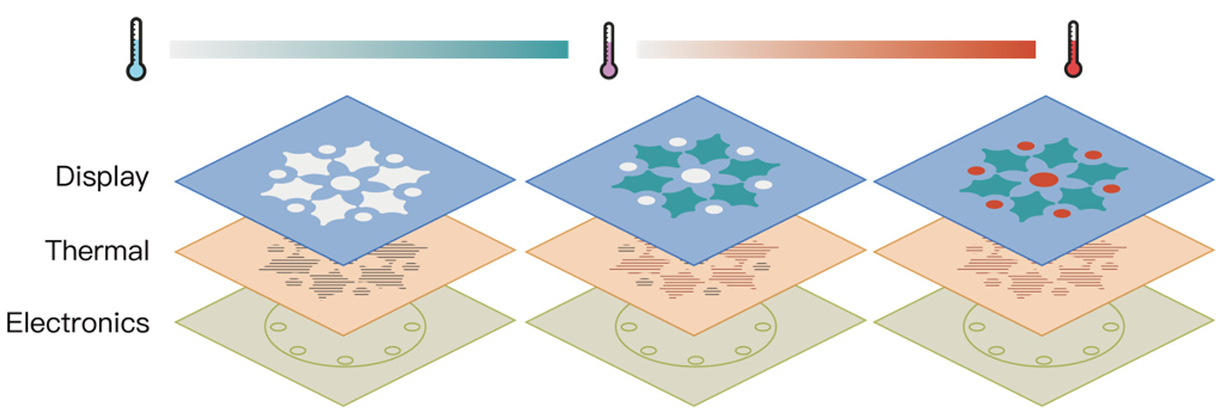 Figure: The multi-layer structure of the Seasons interactive cheongsam.
2. Narrative Design: The Four Seasons
The Magnolia pattern is split into four controllable groups. Each group represents a stage of the year:
- Spring/Summer: Buds transition into full bloom.
- Autumn: Leaves turn a warm yellow.
- Winter: The arrival of "snow" visual effects.
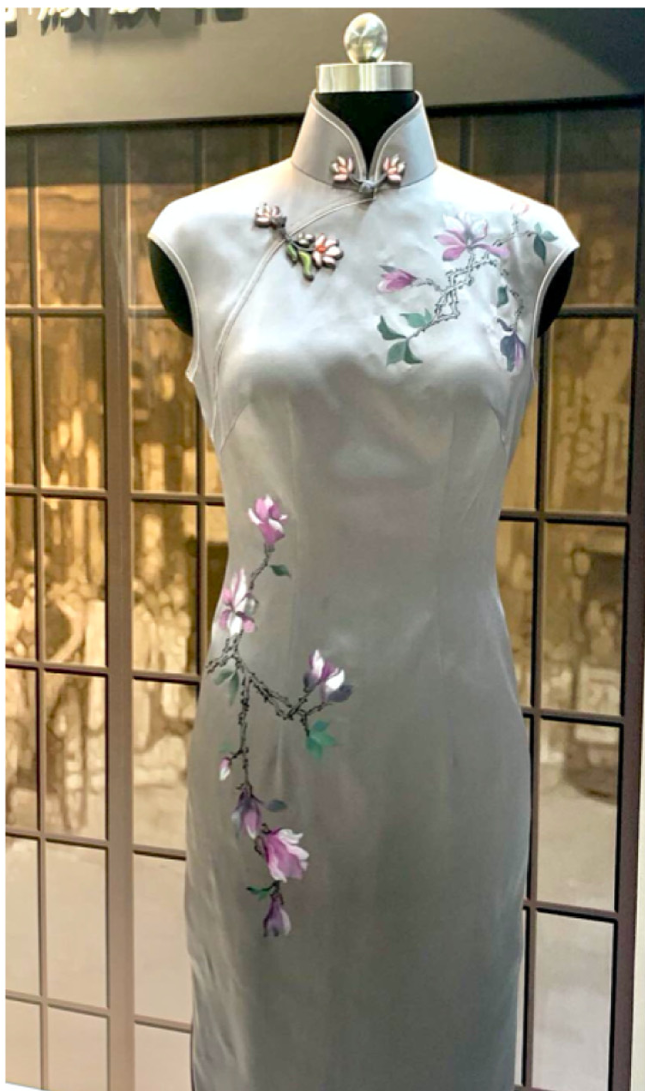 Figure: Sequential activation creating the animation of seasonal changes.
Implementation & Expert Co-Creation
A standout aspect of this work is the co-design process. The authors didn't just buy a dress and add wires; they worked with master craftspeople to integrate the heating layers and microcontrollers into the traditional production workflow—after the silk was cut but before the final sewing. This ensures that the electronic "lining" acts as both a heat insulator for the wearer and a structural support for the circuits.
 Figure: The collaborative process between designers and ICH masters.
Results: Aesthetic Acceptance vs. Practicality
During the Second China International Import Expo, the prototype received high praise:
- Expert Feedback: Experts PE1 and PE2 highlighted that the "living" nature of the color change attracts youth while preserving the "historical" feel.
- User Preference: Visitors found the non-emissive transitions more elegant and "fashionable" than digital screens.
- Technical Performance: The team successfully managed a 5-second fade-in and clear color shifts within safe temperature ranges.
However, the authors noted limitations: the power consumption for large-scale heating is significant, currently requiring batteries that may be too bulky for high-fashion daily wear.
Critical Analysis & Conclusion
"Seasons" represents a shift from "Smart Textiles as Sensors" to "Smart Textiles as Aesthetic Output." By focusing on the physio-chemical properties of materials rather than just adding hardware, the researchers have created a blueprint for future ICH revitalization.
Key Takeaways:
- Material Integrity: The use of pigments rather than LEDs preserves the tactile quality of silk.
- Programmable Aesthetics: The ability to control time and space on a fabric opens new doors for "Fashion 2.0."
- Sustainability Challenge: Future work must address the energy-intensive nature of thermal activation, perhaps through more efficient conductive yarns or harvested energy.
In conclusion, "Seasons" proves that technology doesn't have to "replace" tradition; it can be the very fire that keeps the tradition warm and visible in the modern world.