
The Global Social Soundtrack: How Culture Shapes Our Second-Screen Conversations
Analyzing Second Screen Based Social Soundtrack of TV Viewers from Diverse Cultural Settings
This study investigates the "Social Soundtrack"—the real-time social media commentary—generated by TV viewers using second screens across diverse cultural settings. By analyzing over 469,000 tweets from four countries (US, Spain, India, Brazil), the authors identify distinct cultural biases in communication patterns, achieving statistical significance via ANOVA and Games-Howell tests.
TL;DR
Is the way we talk about TV on Twitter universal? Not even close. This research analyzes nearly half a million tweets to prove that our cultural background dictates whether we share links, reply to others, or simply broadcast our thoughts into the void while watching our favorite shows.
Background Positioning
In the landscape of Social TV (sTV) research, this paper moves beyond the "what" (people use second screens) to the "how" (cultural nuance in interaction). It positions itself as a critical bridge between social computing and cross-cultural psychology, providing a framework to categorize the "Social Soundtrack"—the digital chatter that accompanies modern broadcasts.
Problem & Motivation: The Myth of the Universal Viewer
Existing literature has long established that second screens (phones, tablets) enrich the TV experience. However, most studies treated "the viewer" as a monolithic entity. The authors argue that this overlooks cultural bias. Why does a viewer in Madrid retweet more than a viewer in Mumbai? If broadcasters ignore these behavioral signatures, their engagement strategies and ad placements will inevitably fail in the global market.
Methodology: Decoding the Interaction DNA
The researchers tracked four popular shows across four different nations:
- True Blood (USA)
- Bienvenidos al Lolita (Spain)
- Mahabharat (India)
- Doce de Mãe (Brazil)
To quantify behavior, they established a hierarchy of four communication patterns:
- Retweet (RT): Passing along information.
- Referral (RF): Sharing URLs and external content.
- Response (RS): Direct "@" engagement with other users.
- Broadcast (BC): General statements or opinions sent to followers.
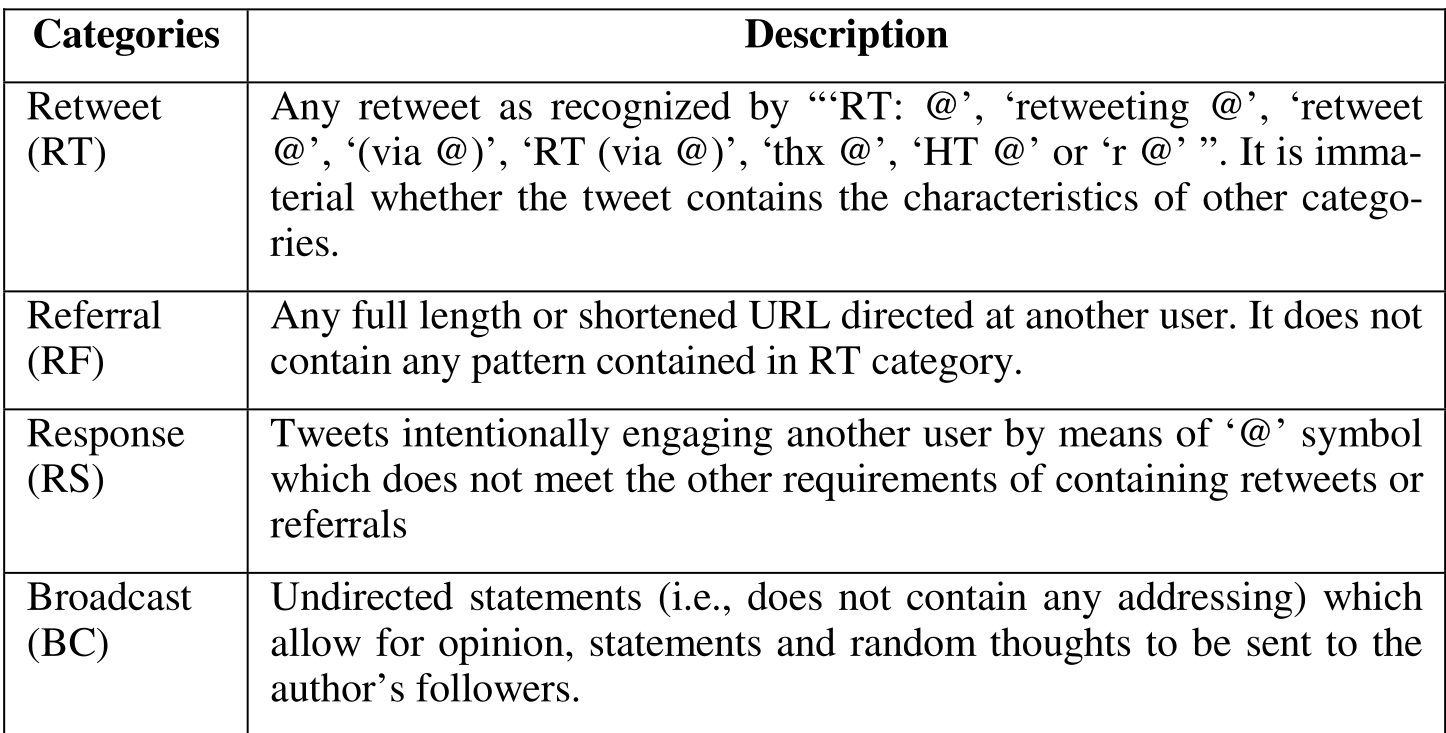
The authors implemented a priority-based classification (RT > RF > RS > BC) to ensure data exclusivity, followed by a log-transformation and ANOVA testing to handle the non-normal distribution of social media data.
Experiments & Results: A Map of Cultural Signatures
The results were striking. The ANOVA tests produced significant F-statistics across all categories, confirming that culture is a dominant factor in how we use the second screen.
Key Findings by Country:
- Spain (RT Dominance): Spanish viewers focus on "passing along" content, acting as amplifiers for the show.
- USA (RF Dominance): US viewers are highly information-driven, sharing links and referring to external sources more than any other group.
- India (RS Dominance): Indian viewers are the most social, prioritizing direct mentions and conversational "replies."
- Brazil (BC Dominance): Brazilian viewers use Twitter as a digital megaphone for undirected personal opinions.

Critical Analysis & Conclusion
Takeaway
The study proves that the "Social Soundtrack" is not a uniform noise; it is a culturally tuned melody. For global media companies, this means a "one-size-fits-all" social media campaign is ineffective.
Limitations & Future Work
The research acknowledges that the data spans only a few weeks per show. Furthermore, while it identifies what people do, it doesn't yet dive into the sentiment (the "why" behind the emotion). The authors suggest that future work should involve sentiment analysis and content-heavy data collection over longer periods to see if these patterns hold across different genres (e.g., news vs. sports).
Final Thought
As we move further into the era of hyper-personalized content, understanding these cultural "interaction fingerprints" will be the difference between a show that trends globally and one that falls silent.