
Secrecy Capacity in Socially-Aware Networks: Why Friendship Enhances Security
Secrecy Capacity Scaling of Large-Scale Networks With Social Relationships
This paper investigates the secrecy capacity scaling laws of large-scale wireless networks by integrating social relationship models and inhomogeneous node distributions. Using a rank-based social model and self-interference cancellation (SIC), the authors derive asymptotic secrecy throughput bounds for both noncolluding and colluding eavesdropper scenarios across homogeneous and multiclustered network topologies.
In the world of wireless communication, the "broadcast nature" of the medium is a double-edged sword. While it allows for easy connectivity, it exposes every bit of data to potential eavesdroppers. Traditional scaling laws, dating back to Gupta and Kumar, told us that as a network grows, each node's share of the bandwidth shrinks at a rate of . But what happens when we add secrecy constraints and social behavior into the mix?
This paper provides a rigorous asymptotic analysis of how social relationships and non-uniform node distributions affect the "Secrecy Capacity" of large-scale networks.
TL;DR
The research demonstrates that when nodes prefer to talk to "friends" (nearby neighbors), the network's secrecy capacity actually improves. By using a 3-antenna jamming technique, the authors show that we can achieve optimal secrecy throughput even when eavesdroppers cooperate (collude), provided we account for the bottleneck created by inhomogeneous node clustering.
The "Social" Insight: Distance Matters
Most theoretical models assume any two nodes are equally likely to communicate. In reality, you are more likely to message a neighbor or a colleague than someone on the other side of the city. The authors use a Rank-Based Model to quantify this: As the social factor increases, the average Source-Destination (S-D) distance decreases. Because the signal doesn't have to travel as far, the "spatial footprint" of a transmission is smaller, allowing more concurrent secure transmissions across the network.
Methodology: Active Defense via SIC
The core technical enabler here is Self-Interference Cancellation (SIC). Instead of relying on encryption, which can be broken by high-resource eavesdroppers, the authors propose a physical-layer defense:
- 3-Antenna Receivers: One antenna listens to the message.
- Proactive Jamming: The other two antennas transmit "artificial noise" (jamming signals).
- The Result: Because the receiver knows its own jamming signal, it cancels it out. Eavesdroppers, however, are drowned in noise.
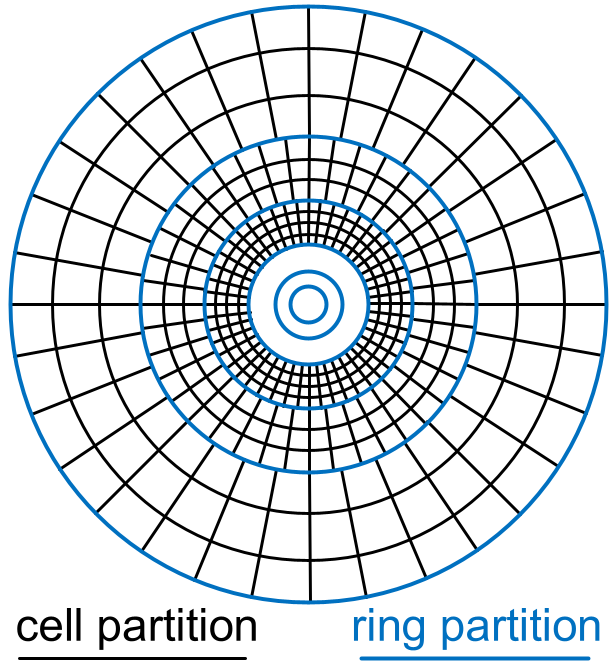 Figure 1: The cell-partition and TDMA scheme used to manage inter-cell interference while maintaining secure hops.
The Challenge of Inhomogeneity
Physical networks aren't uniform grids; they are "clumpy." The paper uses a shot-noise Cox process to model this inhomogeneity ().
- The Bottleneck: In clumpy networks, the low-density regions between clusters become traffic bottlenecks.
- The Findings: If the inhomogeneity is severe (), the network connectivity suffers so much that the secrecy capacity collapses. However, for moderate clumpiness, the authors' proposed multihop relaying scheme maintains optimal scaling.
Colluding vs. Non-Colluding Eavesdroppers
The study considers two types of threats:
- Non-colluding: Each eavesdropper tries to decode the message alone.
- Colluding: Eavesdroppers pool their received signals to cancel noise and amplify the target signal.
Surprisingly, in the non-colluding case, secrecy capacity is almost independent of eavesdropper density in an "order sense." In the more dangerous colluding case, the capacity does decrease as the density of eavesdroppers () increases, but the degradation follows a predictable scaling law that can be compensated for by increasing jamming power ().
 Figure 2: The impact of eavesdropper density on the secure rate. Note the polylogarithmic gap between the lower bound and optimal capacity.
Critical Insight: The Value of Location Awareness
The paper objectively admits a "polylogarithmic gap" in its results. This gap exists because the legitimate nodes are assumed to be unaware of eavesdropper locations. If legitimate nodes could "see" the eavesdroppers, they could fine-tune their jamming steerable beams, potentially closing this efficiency gap further.
Conclusion
This work confirms that social structure is a benefit, not a burden, for network security. By focusing communication locally, social networks naturally reduce the "exposure surface" for eavesdropping. For future 6G or satellite networks, this suggests that security protocols should be deeply "context-aware"—leveraging the social and geographic proximity of users to optimize physical-layer defenses.