
Scaling the Shadows: How Social Ties and Clustering Dictate Network Secrecy
Secrecy Capacity Scaling of Large-Scale Networks With Social Relationships
This paper investigates the secrecy capacity scaling laws of large-scale wireless networks by incorporating social relationships via a rank-based model. It provides an asymptotic analysis for both homogeneous (PPP) and inhomogeneous (multiclustering) node distributions across noncolluding and colluding eavesdropper scenarios using self-interference cancelation.
Executive Summary
In the world of wireless communications, the broadcast nature of the medium makes eavesdropping an inherent threat. While traditional cryptography provides one layer of defense, Physical Layer Security (PLS) offers a fundamental information-theoretic alternative. This paper, authored by Kechen Zheng and colleagues, provides a rigorous asymptotic analysis of Secrecy Capacity in large-scale networks.
The breakthrough here is the integration of two real-world phenomena: Social Relationships (modeled via a rank-based approach) and Node Inhomogeneity (clustered distributions). By utilizing three-antenna self-interference cancelation at receivers, the authors prove that social-aware communication patterns can actually optimize throughput, even under the threat of colluding eavesdroppers.
Problem & Motivation: The Gap in the Scaling Laws
Since the seminal work of Gupta and Kumar, we have known that per-node throughput in random wireless networks scales as . However, most theoretical models assume nodes are "antisocial"—choosing destinations at random. In reality, we communicate more with neighbors. Furthermore, standard models assume a uniform (homogeneous) distribution of nodes, which fails to capture the "clustering" seen in real-world deployments (e.g., urban centers).
The research challenge addressed here is: How do these clustering effects and social preferences impact the secrecy of a network when eavesdroppers are silent, passive, and potentially collaborative?
Methodology: Rank-Based Models and SIC
The authors employ two primary technical levers to solve the secrecy-capacity puzzle:
-
Rank-Based Social Model: The probability of node communicating with node is proportional to .
- If is high, the network is highly local.
- If is low, it mimics a traditional random network.
-
Self-Interference Cancelation (SIC): Legitimate receivers use two antennas to transmit a "jamming" signal while the third receives the data. Because the receiver knows its own jamming signal, it can cancel the interference, but the passive eavesdropper—ignorant of the jamming code—sees its SINR decimated.
Architecture for Inhomogeneous Networks
To handle clustered (inhomogeneous) distributions, the authors propose a Cell Partition Multihop Relay Scheme. They divide the space based on cluster heads and use a TDMA frame to allow nodes to forward data across rings of varying densities.
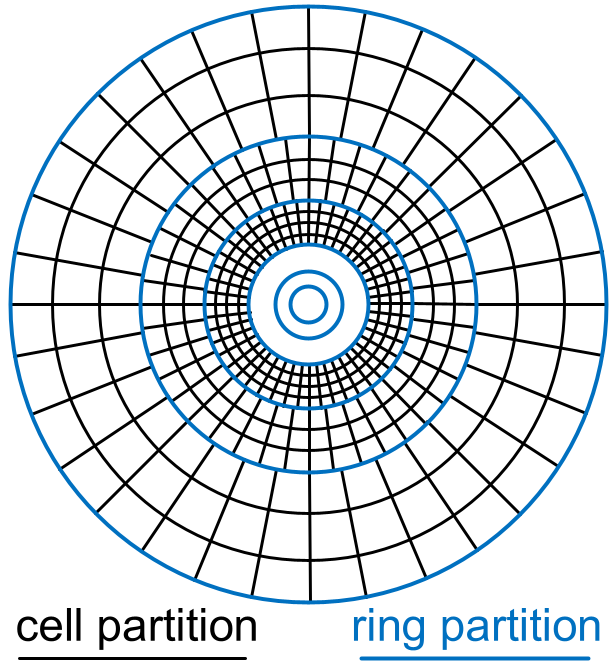 Fig 2. The -TDMA scheme used for interference analysis in clustered environments.
Experimental Analysis & Key Results
The paper derives bounds for two scenarios: Noncolluding (eavesdroppers work alone) and Colluding (eavesdroppers combine signals).
- Homogeneous Networks: The secrecy throughput is primarily limited by the average Source-Destination (S-D) distance. As shown in the study, higher social clustering (larger ) reduces the average hop count, significantly boosting the per-node throughput.
- Inhomogeneous Networks: Clustering creates low-density "voids" that lack enough nodes to sustain high-traffic multihop relaying. Consequently, the secrecy capacity is lower than in the homogeneous case.
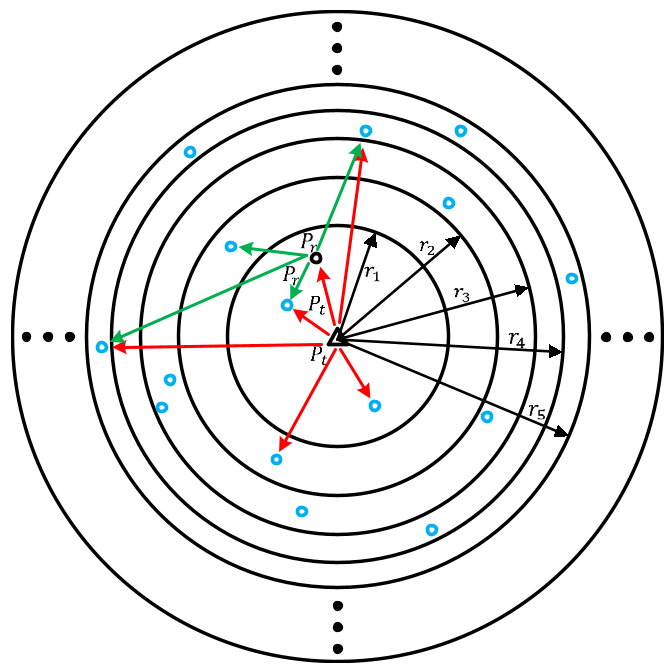 Fig 3. Analytical geometry for evaluating the sum-SINR at colluding eavesdroppers.
The Impact of Eavesdropper Density
A critical finding is that in the noncolluding case, the secrecy capacity is surprisingly resilient to eavesdropper density in an "order" sense. However, when eavesdroppers collude, the density becomes a major factor, leading to a scaling rate that varies with the eavesdroppers' collaborative power.
Critical Insight & Conclusion
This work highlights a fascinating trade-off: Sociality is a security asset. By localizing traffic, social relationships reduce the "exposure surface" of any given transmission, making it harder for a random eavesdropper to intercept the message while maintaining high network efficiency.
Limitations: The model assumes static nodes and does not account for modern "active" attacks where eavesdroppers might also act as jammers.
Future Outlook: These findings offer a blueprint for designing secure 5G/6G "Social-IoT" networks where geographic clustering is a feature, not a bug.